
Mapa mental
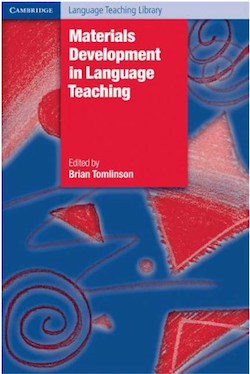
Materials Development for Language and Teaching
Conteúdo do mapa
Materials Development for Language and Teaching
LITERATURE
- Universal an local Criteria by Tomlinson
- that evaluators need to develop their own principled criteria which take into consideration the context of the evaluation and their own beliefs. -Evaluation is inevitably subjective - Analysis of materials
- principles and procedures of conducting evaluations
- ELT Journal, Practical English Teaching, Modern English Teacher, English Teaching Professional, Folio, The Language Teacher, TESOL Journal and RELC Journal.
- Materials adaption
- Madsen & Bowen (1978), good teachers are always adapting the materials they are using to the context in which they are using them in order to achieve the optimal congruence between materials, methodology, learners, objectives.
- Writing materials
- Johnson (2003) says he searched the literature in vain for reports of the actual procedures involved in writing materials. -He studied the literature on task-based teaching but found nothing on the procedures involved in actually writing a task -the experts wrote their materials in very different ways from the novices.
- language acquisition to materials development
- -the language experience needs to be contextualised and comprehensible • the learner needs to be motivated, relaxed, positive and engaged • the language and discourse features available for potential acquisition need to be salient, meaningful and frequently encountered • the learner needs to achieve deep and multi-dimensional processing of the language
- Research
- Richards (2005) stressed that all materials reflect the writers’ theories of language, language use and language acquisition. - Extensive Research sometimes affects usefulness - Research, approach, Authentic materials
- Universal an local Criteria by Tomlinson
LEARNING A LANGUAGE
- cours ebooks, videos, graded readers, flash cards, games, websites and mobile phone interactions, though, inevitably, much of the literature focuses on printed materials.
- History of materials
- 1980- Appeared some Articles about materials Development to learn a lanuage 1980-1990 Methods and approaches quoting extracts from course books, 1990-2000 Conferences and events (Bird,1995) - Field of academic study Practical guidance, Curricula
- Globalisation
- -socio-cultural theorists - English Culture - ADVERTISEMENT - New tech in designing -organizational advantages - Facilitating reading - Collaborative solving problems - Designing projects
- Language learning Materials
- -Efectiness -Aplication theory to practice - to asure larning evaluation based on criteria is necessary
- Gaps in literature
- Basically, Literature tells us much about the actual effect of different types of materials on language acquisition and development, nor about how to encourage teachers and learners to try new types of materials - Nevertheless commercial publishers are the key for teachers and students continue learning in modern living
- The value of Books
- For years there has been debate about whether or not the textbook is the best medium for delivering language-learning materials - Coast, efectiness, credibility and time are the corcern of academic and Institutions. Nevertheless, the author agreed with the idea of texbooks based on contextualization
- The current situation
- In the last forty years Materials development has progressed dramatically, both as an academic field and as a practical undertaking. - Institutional projects - Regions - Language acquisition and learning
- Enter text here
- A humanistic coursebook can help to engages affect through personalised activities and which provides imaging, inner voice, kinaesthetic and process activities. all related to Educational Field in where customize is the key to asure usefulness -Affective and cognitive engagement
MATERIALS
- Materials development’ refers to all the processes made use of by practitionerswho produce and/or use materials for language learning, including materials evaluation, their adaptation, design, production, exploitation and research.
- Informative
- informing the learner about the target language
- Experiential
- providing the learner with experience of the language in use
- Eliciting
- encouraging the learner to use the language
- Exploratory
- helping the learner to make discoveries about the language
- Materials in the classroom
- Most teachers and students welcome published materials and can gain from them. It could help to provide a help to encourage the class members
- Methodology
- -natural approaches based on topics - PPP -Syllabus is based on the ‘can do’ statements of the Common European Framework -Multi-dimensional approaches -MATSDA Conference on Innovation in Materials Development at Queens University, Belfast in January 2011.
- Authenticy of text
- An authentic text is one which is produced in order to communicate rather than to teach, and an authentic task is one which involves the learners in communication in order to achieve an outcome, rather than practice the language.
- Acceptability
- - the agreements of the syllabus based on the needs of students - At the moment of publishing documents, authors have to be careful in topics such as politics, alcohol, religion and sex
THE FUTURE
- -Materials will increasingly be delivered electronically through computers and smart phones - The role of commercial publishers in creating - The involvement in materials development is necessary in teachers and participants to learn distinct topics
- REFERENCES
- Adaskou, K. D., D. Britten & B. Fahsi (1990). Design decisions on the cultural content of a secondary English course for Morocco. ---ELT Journal 44.1, 3–10. Al-Busaidi, S. & K. Tindle (2010). Evaluating the impact of in-house materials on language learning. In B. Tomlinson & H. Masuhara (eds.), 137–149. - Johnson, K. (2003). Designing language teaching tasks. Basingstoke: Palgrave Macmillan. -Jolly, D. & R. Bolitho (2011). A framework for materials writing. In B. Tomlinson (ed.), 107–134.
Imagens e arquivos do mapa


Informações
- Descrição
- Mapa Mental sobre Materials Development for Language and Teaching, criado por eduardos_2810 em 14-09-2014.
- Criado por
- eduardos_2810
- Visualizações
- 20
- Avaliação