
Mapa mental
Week 6/7
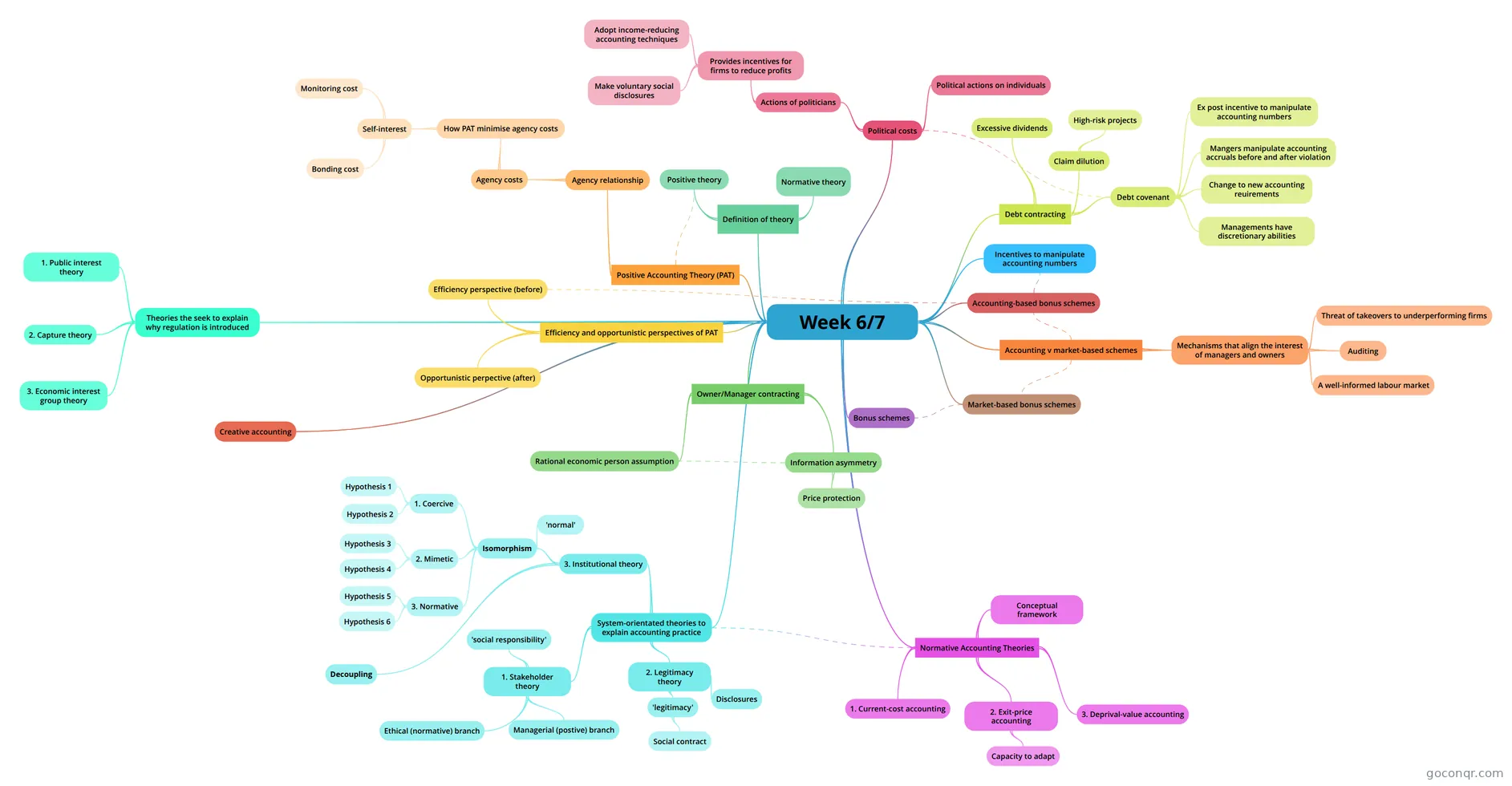
Mind map: Positive Accounting Theory
Conteúdo do mapa
Week 6/7
Definition of theory
- Definition of theory: A coherent set of hypothetical, conceptual and pragmatic principles forming the general framework or reference for a field of inquiry.
- Accounting theories typically either explain and/ or predict accounting practice, or they prescribe specific accounting practice. Such theories are referred to as positive of normative theories.
- Positive theory
- Positive theories explain and predict particular phenomena. They are developed and supported on the basis of observation (empirically based). Making more observations will be better placed to predict what will happen in the future.
- Normative theory
- Normative theories are referred to as prescriptive theories, because they seek to inform others about particular practices that should be followed to achieve particular outcomes.
Positive Accounting Theory (PAT)
- Positive accounting theory: 'is concerned with explaining accounting practice. It is designed to explain and predict which firms will and which firms will not use a particular accounting method... but is says nothing as to which method a firm should use.' (Watts and Zimmerman 1986, p. 7) PAT focuses on the relationships between the various individuals involved in providing resources to an organization. This could be the relationship between: - Owners (as supplier of equity); - Managers (as suppliers of managerial labor); or - Between managers and the firm's debt providers.
- Agency relationship
- Agency relationship: involves the delegation of decision making from the principle (owner) to the agent (manager).
- Agency costs
- Agency costs: The delegation of decision-making authority can lead to a loss of efficiency and increased costs (refer to agency costs of equity). Example: the owner delegates decision-making authority to the manager, it is possible that the manager will not work as hard as the owner would, given the manager does not share directly in the results of the organization. Any profit or loss brought about because the manager under-performs is considered to be a cost of decision-making delegation within the agency relationship - an agency cost.
- How PAT minimise agency costs
- PAT investigates how a particular contractual arrangement can be put in place to minimise costs.
- Self-interest
- The central assumption is that all individual action is driven by self-interest and that individuals will act in an opportunistic manner to increase their wealth (no notion of loyalty and morality). Organizations are considered collections of self-interested individuals who have agreed to cooperate to the extent that it is in their manner to do so. Various bonding and monitoring costs might be incurred to address the agency problems that arise within the organization.
- Bonding cost
- Costs involved in agents bonding their behaviour to expectations of principals. –e.g. preparing financial statements
- Monitoring cost
- Costs of monitoring agents’ behaviour –e.g. auditing financial statements
Efficiency and opportunistic perspectives of PAT
- Efficiency perspective (before)
- Mechanisms are put in place ‘up front’ with the objective of minimizing future agency costs: - For example, reward structures might be implemented to motivate and retain managers, perhaps by providing them with bonuses tied to accounting profits, or providing them with shares or options. Ex ante (before the fact) perspective: - Voluntary audits might be undertaken to reduce the perceived risks of investors (referred to as ex ante perspective). Results to decrease in risks, and a consequent decrease in the costs of attracting capital to the entity.
- –Accounting methods adopted by firms best reflect the underlying financial performance of the entity—might select the most efficient way to portray the performance of the entity. –Regulation is therefore argued by PAT advocates to impose unwarranted costs on reporting entities—it causes the firm to provide an inefficient perspective of the performance and position of the organisation as it requires movement to a one-size-fits-all approach to reporting.
- Opportunistic perpective (after)
- Considers opportunistic actions that could be taken after various contractual arrangements have been put in place. this perspective is referred to as ex post (after the fact) perspective. For example: once a profit sharing scheme has been put in place to motivate managers to increase the value of the organization (i.e. put in place for efficiency reasons), managers will—to the extent they can get away with it—be predicted to try to manipulate reported profits so as to generate the greatest wealth transfer to themselves. Assumes managers will opportunistically select accounting methods to increase their own personal wealth.
- Efficiency perspective (before)
Owner/Manager contracting
- A manager who also owns a firm (an owner-manager) bears the costs associated with their own perquisite consumption, which could include consumption of the firm's resources for private purposes. For example: acquiring and overly expensive company car or luxurious offices, expensive hotel accommodation etc. As percentage of ownership decreases, managers begin to bear less of the costs of their own perquisite consumption - costs begin to be absorbed by the other owners of the firm.
- Perquisite consumption: Consumption by employees of non-salary benefits.
- Rational economic person assumption
- PAT adopts as a central assumption that all actions taken by an individual is driven by self-interest, and that the major interest of all individuals is to maximize their own wealth.
- Information asymmetry
- Managers have access to information not available to principals, thus increasing the potential for managers to take actions that are beneficial to themselves at the expense of the owners (agency costs). PAT assumes that the principle (owner) expect their agents to undertake activities that might be advantageous to the agents but disadvantageous to the value of the firm.
- Price protection
- In the absence of contractual mechanisms to restrict agents’ potentially opportunistic behavior the principal will pay the agent a lower salary (compensates principals for the expected opportunistic behavior of agents (managers)). Agents will therefore have incentives to enter contracts which appear to limit actions detrimental to agents. –Monitoring by owners –Bonding by managers –Managers may be rewarded: on a fixed basis on the basis of the results achieved on a basis that combines the two
Bonus schemes
- PAT argues that it can be necessary to put in place remuneration schemes that reward managers in a way that is tied to the performance of the firm. If the performance of the firm improves, the rewards paid to managers increase correspondingly. •Bonuses might be based on: –profits of the firm –sales of the firm –return on assets •May also be rewarded based on market price of shares [refer to 'market-based schemes'].
Accounting-based bonus schemes
- Rewarding managers in terms of accounting numbers (profit) - a strategy aimed at aligning the interest of owners and managers. •Given that the amounts paid to managers might be tied directly to accounting numbers (profits/sales/assets) -any changes in the accounting methods used by an organisation will affect the bonuses paid (e.g. as a result of a new accounting standard). •Changing the bonuses paid impacts on cash flows, and this in turn is predicted to impact on the value of the organisation. •Contracts may rely on ‘floating’, generally accepted accounting principles. - This means that changing an accounting rule that affects an item used within a contract made by the firm might consequently change the value of the firm.
Incentives to manipulate accounting numbers
- - Rewarding managers on the basis of accounting profits can induce them subsequently to manipulate the related accounting numbers to improve their apparent performance and thus the related rewards. - Accounting profits might not always provide an unbiased measure of a firm’s performance [related to 'accounting-based schemes']. For example: managers receive rewards after a pre-specified level of earnings had been reached, managers would adopt accounting methods consistent with maximizing that bonus. 'Taking a bath': If profits do not reach a maximum level, managers adopts strategies that further reduce income in that period. This leads to higher income in the next period - shift earnings to future periods (therefore, increasing the chance to reach the required income).
- Rewarding managers on the basis of accounting profits might discourage them from adopting such stratagies and might encourage them instead to adopt a short-term, as opposed to long-term, focus.
Market-based bonus schemes
- PAT argues that is it more appropriate to rewards managers in terms of market value of the firm's securities, which are influenced by expectations about the net present value (NPV) of expected future cash flows. This can be done by: - cash bonus for increase in share price; or - providing managers with shares or options to shares. If firm's shares increases, both managers and owners will benefit therefore, managers will be given an incentive to increase the value of the firm.
- There are problems associated with rewarding managers in terms of share price movement: 1) Share price is controlled by both managers and market-wide factors. The actions of the manager cannot control/influence the general market's movements. 2) senior managers have more effect on the cash flow hence, the value of the firm's securities (shares) as oppose to lower-level management. Therefore, market-related incentives might be appropriate for senior management ONLY.
Accounting v market-based schemes
- Both "accounting-based" and "market-based" performance measures and rewards are driven half by 'noise'. Noise: noisy in the sense that they are affected not only by the actions of management but also largely by general movements over which the manager has no control. •More likely to be based on accounting earnings where – share returns relatively more sensitive to general market movements. – earnings have a high association with firm-specific movement in the firm’s share values. – earnings have a less positive association with market-wide movements in equity values.
- Mechanisms that align the interest of managers and owners
- Threat of takeovers to underperforming firms
- /under-performing a company might be subject to takeover attempts, which can motivate managers to better align their interest to the business's to avoid the risk of losing their job. The consequence of under-performing managers/agents might lose their jobs when alternative teams of managers target firms with resources that are currently being used inefficiently by the current management team. This will motivate managers to use their resources efficiently both for the benefit of the owners and because inefficient utilization might result in the firm being taken over and subsequently in loss of employment for managers.
- A well-informed labour market
- A well-informed labour market will motivate management to work to maximize the value of its firm. Under-performance might lead to the manager losing his/her job, and if the labour market is efficient in disseminating data, a 'failed' manager might have difficulty attracting a position with comparable pay elsewhere.
- Auditing
- In managers are rewarded on the basis of accounting numbers (accounting-based scheme), they will be more motivated to manipulate accounting numbers to increase personal wealth. Therefore, auditing financial statements will act to arbitrate (judge) reasonableness of the accounting methods. However, there will always be a scope of opportunism.
- Threat of takeovers to underperforming firms
Debt contracting
- When a debt holder lends funds to another organization (debtor), the debtor might undertake activities that reduce or even eliminate the probability of the funds being repaid.
- Excessive dividends
- A debtor might pay excessive dividends, leaving few assets in the organization to repay the debt.
- Claim dilution
- The debtor might take on additional debt. Therefore, the original and new debt holders would then compete to see who gets repaid first.
- High-risk projects
- Debtor might invest in high-risk projects which will not be beneficial to the debt holders. Debt holders have a FIXED claim therefore: - If the project generates high returns, debt holders will receive no greater return, as oppose to the owners who will share the increased value. - If the project fails, the debt holder will receive nothing however, the firm will suffer the consequences of any significant losses.
- Debt holders will assume that management will take actions that might not always be in the interest of debt holders' interest. As a result, tin the absence of contractual safeguards, it is assumed that they will require the firm to pay higher costs of interest to compensate for the high-risk exposure.
- Debt covenant
- A loan covenant is a condition in a commercial loan or bond issue that requires the borrower to fulfill certain conditions or which forbids the borrower from undertaking certain actions, or which possibly restricts certain activities to circumstances when other conditions are met. The covenants provide a mechanism to limit managers' ability to expropriate (take ownership to benefit) the wealth of the creditors/debt holders. This provides an incentive to managers to adopt income/asset increasing accounting methods, when they are close to breaching debt covenants.
- Ex post incentive to manipulate accounting numbers
- The existence of a debt contract provides management with an (ex post) incentive to manipulate accounting numbers - an incentive that increases as the accounting-based constraint approaches violation. For example: if the firm agreed not to exceed a certain debt ratio (to reduce the risk of debt holders being paid) however, it nearly approaches violation, management might have an incentive to either inflate assets of deflate liabilities. Management would be acting opportunistically and not to benefit individuals holding the debt.
- Change to new accounting reuirements
- Managers will determine when to adopt a new accounting requirement (usually in transitional period) which will then become mandatory. This is to reduce the risk of covenant violation.
- Managements have discretionary abilities
- Management will always have some discretionary ability to enable it to loosen the effects of accounting-based restrictions negotiated by debt holders.
- Mangers manipulate accounting accruals before and after violation
- Managers manipulate accounting accruals in the years before and after violation agreement. If the firm approaches violation of the debt agreement, managers have a greater tendency to adopt income-increasing strategies (include calculating pension liabilities, and adopting LIFO cost-flow assumptions). Compared with managers in firms that are not approaching technical default of accounting-based covenants.
Political costs
- Costs that groups external to the firm might be able to impose on the firm: –increased taxes –increased wage claims –product boycotts –decreased subsidies Organizations are affected by governments, trade unions, environmental lobby groups or particular consumer groups.
- Demands placed on the firm might be affected by accounting results: –Higher reported profits –How accounting numbers are generated is not important Accounting numbers might be used as a means of providing ‘excuses’ for effecting wealth transfers in the political process. There will be a perception that highly profitable organizations can ‘afford’ to pay higher salaries, higher taxes, reduce prices—so if firms reduce ‘profits’ such expectations might decrease.
- Political actions on individuals
- - Limited expected ‘pay-off’ from the actions of individuals results in the formation of interest groups. - Information costs shared, ability to investigate government and business action increases. - Given self-interest, representatives of interest groups predicted to maximise own welfare as constituents have limited motivation or means to be fully informed.
- Actions of politicians
- Governments seeking re-election could be motivated to take actions against unpopular firms or industries if it can bolster their chances of re-election. - They argue that it is for the public interest even though it's their own interest. - This is consistent with the PAT assumption that all individuals only have self-interest. For example: Governments might decide to reduce the tariff protection of a particular industry and, in doing so, it could highlight the profits that have been reported by the firms within that industry; could use the profits as an excuse for their actions.
- Politicians can use accounting numbers (e.g. profits) to justify their own particular actions or provide 'excuses', given that they expect it will be too costly for the constituents (firms or industries) to determine the politicians 'real' motivations for their actions. - The cost of being fully informed about the government's actions could be greater than the benefits firms or industries could generate from that knowledge.
- Provides incentives for firms to reduce profits
- The reported accounting numbers (e.g. profits) might result in the imposition of costs on the firm from government officials. This might include: - Increases taxes - calls for reduced prices - calls for wage increase for workers etc... As a result, large firms are subject to political scrutiny, rather than small firms. Therefore, it provides incentives for firms to reduce reported profits.
- Adopt income-reducing accounting techniques
- Make voluntary social disclosures
Normative Accounting Theories
- Seeks to provide guidance to individuals to enable them to select the most appropriate accounting policies for given circumstances. There are 3 main classifications: 1. Current-cost accounting 2. Exit-price accounting 3. Deprival-value accounting
- Normative theories were developed in 1950s and 1960s. This was during high rates of inflations which generated a pressing need for guidance on how to account for changing prices. This was needed because inflation overstated accounting profits therefore, could lead to excessive payments of dividends, eroding the future ability of an organisation.
- Conceptual framework
- Conceptual framework is considered normative theory because: - seeks to identify the objective of general purpose financial reporting - seeks to provide accounting guidance within a ‘coherent’ and ‘consistent’ framework - identifies the qualitative characteristics financial information should possess - makes recommendations that sometimes depart from current practice
- 1. Current-cost accounting
- Aim is to provide a calculation of income that, after adjusting for changing prices, can be withdrawn from the entity and still leave the physical capital (operating capacity) of the entity intact –Referred to as true measure of income
- 2. Exit-price accounting
- Theory which prescribes that assets should be valued on the basis of exit prices or selling prices of an entity's assets and liabilities - hence it is called exit-price theory - and that financial statements should function to inform users about the organisation's capacity to adapt. Key assumptions: – Firms exist to increase the wealth of their owners – The ability to adapt to changing circumstances – Capacity to adapt best reflected by current selling prices
- Capacity to adapt
- A measure, promoted by Chambers, ties to the cash that could be obtained if an entity sold its assets.
- 3. Deprival-value accounting
- Deprival value represents the amount of loss that might be incurred by an entity if it were deprived of the use of an asset and the associated economic benefits. This method considers: - Net selling price - Present value (future cash flows that the asset will produce) - Current replacement cost
- The deprival value is the lower of current replacement costs and the greater of the net selling price and present value (value in use).
System-orientated theories to explain accounting practice
- These theories focus on the role of information and disclosure in the relationships between organisations, the State, individuals and groups. An entity is assumed to be influence by the society in which it operates and in turn to have an influence on society. System-based theories include: 1. Stakeholder theory 2. Legitimacy theory 3. Institutional theory
- 1. Stakeholder theory
- Stakeholder theory is broken into 2 branches: 1. Ethical (normative) branch 2. Managerial (positive) branch
- Managers should manage the business for the benefit of all stakeholders. Management must must give equal consideration to the interest of all stakeholders and, when the interest conflict, manage the business so as to attain optimal balance between them.Stakeholder theory does imply that business has true 'social responsibilities'.
- – Stakeholders are any group or individual who can affect or are affected by the achievement of the firm’s objectives –Includes shareholders, employees, customers, lenders, suppliers, local charities, interest groups, government
- Ethical (normative) branch
- All stakeholders have the right to be provided with information about how the organisation is affecting them, even if they choose no to use that information, and even if they cannot directly affect the survival of the organisation.
- It is the stakeholder's control over limited resources that are required by an organisation that influences whether specific information is provided to that stakeholder - not issues associated with the rights to information.
- Managerial (postive) branch
- – Seeks to explain and predict how an organisation will react to demands of various stakeholders. - The organisation identifies its group of shareholders, particularly those that are considered to be important to the ongoing operations and survival of the business. - The greater the importance of stakeholders, the greater the expectation that management of the firm will take actions to 'manage' the relationships with those stakeholders. - As the expectations and power relativities of the various stakeholder groups can change, organisations must continually adapt their operating and disclosure strategies.
- A major role of corporate management is to assess the importance of meeting stakeholder demands in order to achieve the strategic objectives of the firm. As the level of stakeholder power increases, the importance of meeting stakeholder demands increases also. Our position is that organisations survive to the extent that they are effective. Their effectiveness derives from the management of demands, particularly the demands of interest groups upon which the organisation depends.
- 'social responsibility'
- Social responsibility activities are useful in developing and maintaining satisfactory relationships with stakeholder, creditors, and political bodies. Developing a corporate reputation as being socially responsible through performing and disclosing social responsibility activities is part of a strategy for managing stakeholder relationships.
- 2. Legitimacy theory
- Organisations continually seek to ensure that they operate within the bounds and norms of society; they attempt to ensure that their activities are perceived by outside parties to be 'legitimate'. These bounds and norms are subject to change, requiring the organisation to be responsive to the environment in which they operate. Legitimacy theory emphasises that the organisations must appear to consider the rights of the public at large, not just investors.
- 'legitimacy'
- Legitimacy is a generalised perception or assumption that the actions of an entity are desirable, proper, or appropriate within some socially constructed system of norms, values, beliefs, and definitions. 'Legitimacy' is considered to be a resource upon which an organisation depends for its survival. This is based on a 'social contract' between society and the organisation.
- Social contract
- Social contract: Considered to be an implied contract constituted by the expectations that society holds about the conduct of an organisation. An organisation is deemed to be operating with 'legitimacy' when its operations are perceived by society o be complying with the terms or requirements of the 'social contract'.
- Disclosures
- Where this social contract is perceived as being breached then the organisation will take corrective action, and this action might include disclosure. Organisations must appear to consider the rights of the public at large, not just investors. To gain or maintain legitimacy, organisations might rely on disclosure within their annual report. Research using this theory (and a number of studies are referred to in the textbook) shows that when the legitimacy of an organisation is threatened (perhaps as a result of a particular incident or event) managers will use information disclosure to try to maintain or regain legitimacy. Disclosures are linked to corporate survival rather than to ‘accountability’.
- 3. Institutional theory
- Considers the forms organisation's take and provide explanations for why organisations within particular 'organisations fields' tend to take on similar characteristics and forms. Institutional theory provides a complementary perspective, to both 'Stakeholder theory' and 'Legitimacy theory', for understanding how organisations interpret and respond to changing social and institutional pressures and expectations. Two main dimensions to the theory—isomorphism and decoupling.
- Isomorphism
- Isomorphism is ' a constraining process that forces one organisation in a population to resemble other organisations that face the same set of environmental conditions; organisations that adopt structures of processes at variance with other organisations because differences will attract criticism. There are three isomorphic processes: 1. Coercive 2. Mimetic 3. Normative.
- The institutional isomorphism processes can be expected to proceed in the absence of evidence that they increase internal organisational efficiency as organisations are rewarded for being similar to other organisations in their fields. This similarity makes it easier for organisations to transact with other organisations, to attract career-minded staff, to be acknowledge as legitimate and reputable, and to fit into administrative categories that define eligibility for public and private grants and contracts.
- 'normal'
- Organisations need to maintain legitimacy therefore, adopt the same (homogeneity) structure and practices in order to be considered 'normal'. Organisations that deviate from the form that has become 'normal' could potentially have problems gaining or retaining legitimacy.
- 1. Coercive
- Arises when organisations change their institutional practices in response ti pressure form stakeholders upon which the organisation is dependent. The more powerful the stakeholder, the more the organisation will follow their demands and expectations (ignoring the less powerful stakeholders) because powerful stakeholders might have similar expectations to those of the organisation. - pressures from other organisations in which they are dependent upon and by cultural expectations from society. Some are governmental mandates, some are derived from contract law, financial reporting requirements.
- Hypothesis 1
- The greater the dependence of an organisation on another organisation, the more similar it will become to that organisation in structure, climate, and behavioural focus.
- Hypothesis 2
- The greater the centralisation of organisations A's resources supply, the greater the extent to which organisation A will change isomorphically to resemble the organisations on which it depends for resources.
- 2. Mimetic
- Organisations seek to imitate or improve upon the institutional practices of other organisations: - often for reasons of competitive advantage (in terms of legitimacy); or - the organisation encounters uncertainty therefore, elect to model itself on other organisations.
- Hypothesis 3
- The more uncertain the relationship between means and ends the greater the extent to which an organisation will model itself after organisations it perceives to be successful.
- Hypothesis 4
- The more ambiguous the goals of an organisation, the greater the extent to which organisation will model itself after organisations that it perceives to be successful.
- 3. Normative
- Normative isomorphism relates to the pressures arising from group norms to adopt particular institutional practices (change internally). Pressures could arise through less formal group influences from a range of both formal or informal groups to which managers belong.
- Driven by pressures brought about by professions. One mode is the legitimisation inherent in the licensing and crediting of educational achievement. The other is the inter-organisational networks that span organisations. Norms developed during education are entered into organisations. Inter-hiring between existing firms also encourages isomorphism.
- Hypothesis 5
- The greater the reliance on academic credentials in choosing managerial and staff personnel, the greater the extent to which an organisation will become like other organisations in its field.
- Hypothesis 6
- The greater the participation of organisational managers in trade and professional associations, the more likely the organisation will be, or will become, like other organisations in its field.
- Decoupling
- Decoupling is when an organisations structure or practice is seperate and distinct from actual organisational practice; the practice is not integrated into the organisation's managerial and operational processes. Formal structure has much more to do with the presentation of an organisational-self than with the actual operations with the actual operations of the organisations. Ideally, organisations pursue economic efficiency by attempting to develop an alignment between organisational hierarchies and activities. However, they may face conflicts of inconsistencies between the demand for efficiency and the need to comply to similar institutional context. Therefore, organisations try to maintain appearances to grant legitimacy whether or not they directly facilitate economic efficiency.
- – Actual practices can be very different from formally sanctioned and publicly pronounced processes and practices. – Disclosures might not actually represent real corporate conduct. – Such theories caution us against ‘believing’ everything we are told (including within financial reports). ‘Creative Accounting’
Creative accounting
- – a term used by the media to describe the process of selecting accounting methods when creating reports that provide results desired by preparers and occurs, according to PAT, because managers will work for their own interests. – may follow the letter of the rules of standard accounting practices, but deviate from the ‘spirit’ of those rules. – characterised by excessive complication and the use of novel ways of defining income, assets, or liabilities and the intent to influence readers towards the interpretations desired by the authors. – occurs when managers use judgment in financial reporting and in structuring transactions to alter financial reports to either mislead some stakeholders about the underlying economic performance of a company or influence contractual outcomes that depend on reported accounting numbers.
Theories the seek to explain why regulation is introduced
- •Just as there are theories to explain why particular accounting disclosures are made (e.g. PAT, Legitimacy Theory, Stakeholder Theory), or why particular organisational forms exist (Institutional Theory), there are also theories to explain why particular regulations (e.g. accounting regulations) are developed. Such theories include: –Public interest theory –Capture theory –Economic interest group theory.
- 1. Public interest theory
- This puts in place to benefit society as a whole, rather than benefit particular vested interests, and the regulator body is considered to represent the interests of the society in which it operates, rather than the private interest of the regulators. The application of this argument to financial accounting implies that society needs confidence in the capital markets to help ensure that resources are directed towards productive assets. However, it is arguable that legislators will enact legislations only because it might increase their own wealth and not for public interest. Because of the PAT assumption that everything is for the self-interest.
- 2. Capture theory
- • While regulations might initially be introduced in the ‘public interest’, the regulated parties will seek ultimately to take charge of (or capture) the regulator. • They will seek to ensure that rules subsequently released are advantageous to themselves (the parties subject to the regulation). This is because they will know that the decisions made by the regulator will potentially have significant impacts on their industry.
- 3. Economic interest group theory
- • Assumes groups will form to protect particular economic interests. • Groups are often in conflict with each other and will lobby government to put in place legislation that will benefit them at the expense of others. • No notion of public interest inherent in the theory. • Regulators (and all other individuals) deemed to be motivated by self-interest. • If regulators believe that particular regulation will provide economic benefits to themselves (the regulators) then they will support that regulation.
- • The regulator is not a neutral arbiter but is seen as an interest group •The regulator is motivated to ensure re-election or maintenance of its position of power •Regulation serves the private interests of politically effective groups •Those groups with insufficient power will not be able to lobby effectively for regulation to protect their own interests
Informações
- Descrição
- Contemporary issues in accounting (Week 6/7) Mapa Mental sobre Week 6/7, criado por Micky Marshall em 22-03-2018.
- Criado por
- Micky Marshall
- Visualizações
- 1
- Avaliação