
Mapa mental
Economic Development
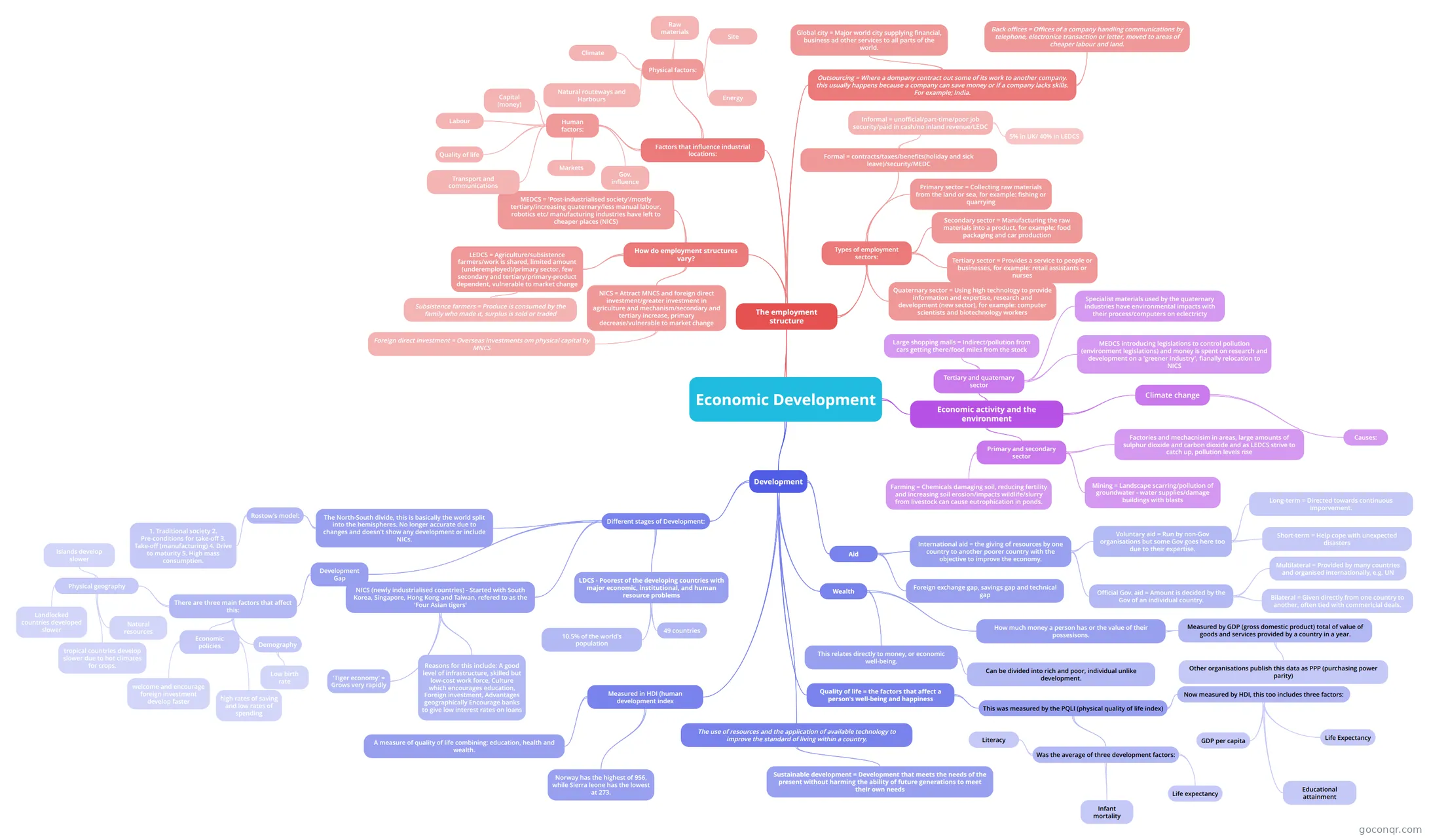
Mind map: Economic development
Conteúdo do mapa
Economic Development
Development
- The use of resources and the application of available technology to improve the standard of living within a country.
- Sustainable development = Development that meets the needs of the present without harming the ability of future generations to meet their own needs
- Wealth
- This relates directly to money, or economic well-being.
- Can be divided into rich and poor, individual unlike development.
- How much money a person has or the value of their possesisons.
- Measured by GDP (gross domestic product) total of value of goods and services provided by a country in a year.
- Other organisations publish this data as PPP (purchasing power parity)
- Measured by GDP (gross domestic product) total of value of goods and services provided by a country in a year.
- This relates directly to money, or economic well-being.
- Measured in HDI (human development index
- A measure of quality of life combining: education, health and wealth.
- Norway has the highest of 956, while Sierra leone has the lowest at 273.
- Quality of life = the factors that affect a person's well-being and happiness
- This was measured by the PQLI (physical quality of life index)
- Was the average of three development factors:
- Literacy
- Life expectancy
- Infant mortality
- Now measured by HDI, this too includes three factors:
- Life Expectancy
- GDP per capita
- Educational attainment
- Was the average of three development factors:
- This was measured by the PQLI (physical quality of life index)
- Different stages of Development:
- The North-South divide, this is basically the world split into the hemispheres. No longer accurate due to changes and doesn't show any development or include NICs.
- Rostow's model:
- 1. Traditional society 2. Pre-conditions for take-off 3. Take-off (manufacturing) 4. Drive to maturity 5. High mass consumption.
- Rostow's model:
- LDCS - Poorest of the developing countries with major economic, institutional, and human resource problems
- 49 countries
- 10.5% of the world's population
- NICS (newly industrialised countries) - Started with South Korea, Singapore, Hong Kong and Taiwan, refered to as the 'Four Asian tigers'
- 'Tiger economy' = Grows very rapidly
- Reasons for this include: A good level of infrastructure, skilled but low-cost work force, Culture which encourages education, Foreign investment, Advantages geographically Encourage banks to give low interest rates on loans
- Development Gap
- There are three main factors that affect this:
- Physical geography
- Landlocked countries developed slower
- Islands develop slower
- tropical countries develop slower due to hot climates for crops.
- Natural resources
- Economic policies
- welcome and encourage foreign investment develop faster
- high rates of saving and low rates of spending
- Demography
- Low birth rate
- Physical geography
- There are three main factors that affect this:
- The North-South divide, this is basically the world split into the hemispheres. No longer accurate due to changes and doesn't show any development or include NICs.
- Aid
- Foreign exchange gap, savings gap and technical gap
- International aid = the giving of resources by one country to another poorer country with the objective to improve the economy.
- Official Gov. aid = Amount is decided by the Gov of an individual country.
- Bilateral = Given directly from one country to another, often tied with commericial deals.
- Multilateral = Provided by many countries and organised internationally, e.g. UN
- Voluntary aid = Run by non-Gov organisations but some Gov goes here too due to their expertise.
- Long-term = Directed towards continuous imporvement.
- Short-term = Help cope with unexpected disasters
- Official Gov. aid = Amount is decided by the Gov of an individual country.
- The use of resources and the application of available technology to improve the standard of living within a country.
The employment structure
- Types of employment sectors:
- Primary sector = Collecting raw materials from the land or sea, for example: fishing or quarrying
- Secondary sector = Manufacturing the raw materials into a product, for example: food packaging and car production
- Tertiary sector = Provides a service to people or businesses, for example: retail assistants or nurses
- Quaternary sector = Using high technology to provide information and expertise, research and development (new sector), for example: computer scientists and biotechnology workers
- Formal = contracts/taxes/benefits(holiday and sick leave)/security/MEDC
- Informal = unofficial/part-time/poor job security/paid in cash/no inland revenue/LEDC
- 5% in UK/ 40% in LEDCS
- Informal = unofficial/part-time/poor job security/paid in cash/no inland revenue/LEDC
- How do employment structures vary?
- MEDCS = 'Post-industrialised society'/mostly tertiary/increasing quaternary/less manual labour, robotics etc/ manufacturing industries have left to cheaper places (NICS)
- NICS = Attract MNCS and foreign direct investment/greater investment in agriculture and mechanism/secondary and tertiary increase, primary decrease/vulnerable to market change
- Foreign direct investment = Overseas investments om physical capital by MNCS
- LEDCS = Agriculture/subsistence farmers/work is shared, limited amount (underemployed)/primary sector, few secondary and tertiary/primary-product dependent, vulnerable to market change
- Subsistence farmers = Produce is consumed by the family who made it, surplus is sold or traded
- Outsourcing = Where a dompany contract out some of its work to another company. this usually happens because a company can save money or if a company lacks skills. For example; India.
- Back offices = Offices of a company handling communications by telephone, electronice transaction or letter, moved to areas of cheaper labour and land.
- Global city = Major world city supplying financial, business ad other services to all parts of the world.
- Factors that influence industrial locations:
- Physical factors:
- Site
- Raw materials
- Energy
- Natural routeways and Harbours
- Climate
- Human factors:
- Capital (money)
- Labour
- Transport and communications
- Markets
- Gov. influence
- Quality of life
- Physical factors:
- Types of employment sectors:
Economic activity and the environment
- Primary and secondary sector
- Farming = Chemicals damaging soil, reducing fertility and increasing soil erosion/impacts wildlife/slurry from livestock can cause eutrophication in ponds.
- Mining = Landscape scarring/pollution of groundwater - water supplies/damage buildings with blasts
- Factories and mechacnisim in areas, large amounts of sulphur dioxide and carbon dioxide and as LEDCS strive to catch up, pollution levels rise
- Tertiary and quaternary sector
- Large shopping malls = Indirect/pollution from cars getting there/food miles from the stock
- Specialist materials used by the quaternary industries have environmental impacts with their process/computers on eclectricty
- MEDCS introducing legislations to control pollution (environment legislations) and money is spent on research and development on a 'greener industry', fianally relocation to NICS
- Climate change
- Causes:
- Primary and secondary sector
Informações
- Descrição
- A-level Geography Mapa Mental sobre Economic Development, criado por sunflower24 em 11-06-2013.
- Criado por
- sunflower24
- Visualizações
- 559
- Tags
- Avaliação