
Mapa mental
Practice Standard for Work Breakdown Structures
Conteúdo do mapa
Practice Standard for Work Breakdown Structures
Are a guide for defining work as it relates to a specific project’s objectives.
- Project professionals use a WBS to define project deliverables and establish the structure to manage work to completion.
Provides direction for the preliminary development and implementation of the WBS.
Chapter 1 Introduction to the Practice Standard for Work Breakdown Structures—Second Edition
- Overview
- Successful project management relies on thorough planning.
- First define the objectives of the project with sufficiently detailed information.
- The (WBS) provides the foundation for defining work as it relates to project
- The WBS also establishes the framework for managing the work to its completion.
- Successful project management relies on thorough planning.
- Concept
- The WBS is used in projects as follows:
- To define the project’s scope of work in terms of deliverables and to further decompose these deliverables into components.
- The WBS can also define the project’s lifecycle
- as well as
- Deliverables appropriate to the project
- Program
- Portfolio
- as well as
- To provide the project management team with a framework on which to base project status and progress reports.
- To facilitate communication between the project manager and stakeholders throughout the life of the project.
- As a key input to other project management processes and deliverables.
- The WBS is used in projects as follows:
- Objectives
- Provide a common ground for understanding the concepts and benefits of the WBS
- Present a standard application of the WBS as a project management tool.
- Overview
Chapter 2 Defining the WBS
- Overview
- defines unique work elements that can be arranged and completed in the order defined by the network diagram
- sequentially
- parallel
- in the specific order necessary to accomplish project outcomes
- The WBS represents a clear description of the project’s deliverables and scope—the ‘‘what’’ of the project.
- defines unique work elements that can be arranged and completed in the order defined by the network diagram
- Common Usage of Terms
- according to the PMBOK
- A WBS is A deliverable-oriented hierarchical decomposition of the work to be executed by the project team to accomplish the project objectives and create the required deliverables.
- Work.
- Sustained physical or mental effort, exertion, or exercise of skill to overcome obstacles and achieve an objective.
- Breakdown.
- Division into parts or categories; separation into simpler substances; decomposition.
- Structure.
- Something arranged in a definite pattern of organization.
- Deliverable.
- Any unique and verifiable product, result, or capability to perform a service that must be produced to complete a process, phase, or project.
- Oriented.
- Aligned or positioned with respect to a point or frame of reference; focused toward the concerns and interests of a specific group.
- Hierarchical.
- Classified according to various criteria into successive levels or layers.
- Decomposition.
- A planning technique that subdivides the project scope and project deliverables into smaller, more manageable components, until the project work associated with accomplishing the project scope and providing the deliverables
- Work.
- A WBS is A deliverable-oriented hierarchical decomposition of the work to be executed by the project team to accomplish the project objectives and create the required deliverables.
- according to the PMBOK
- Definition of Terms
- Activity.
- A component of work performed during the course of a project.
- Apportioned Effort.
- Effort applied to project work that is not readily divisible into discrete efforts for that work
- Control Account.
- A management control point where scope, budget (resource plans), actual cost, and schedule are integrated and compared to earned value for performance measurement.
- Discrete Effort.
- Work effort that is separate, distinct, and related to the completion of specific work breakdown structure components and deliverables
- Level of Effort (LOE).
- Support-type activity (e.g., seller or customer liaison, project cost accounting, project management, etc.), which does not produce definitive end products.
- Task.
- For project work varies by the application area, industry, and brand of project management software.
- Work Breakdown Structure Component.
- An entry in the work breakdown structure that can be at any level.
- Work Package.
- A deliverable or project work component at the lowest level of each branch of the work breakdown structure.
- WBS Element.
- Any single work breakdown structure (WBS) component and its associated WBS attributes contained within an individual work breakdown structure.
- Activity.
- Concept
- Overview
- The WBS assists project leaders, participants, and stakeholders in the development of a clear vision of the end products or outcomes produced by the project.
- Deliverables
- Any unique and verifiable product, result, or capability to perform a service that must be produced to complete a process, phase, or project.
- benefits
- Better communication to project sponsors, stakeholders, and team members
- More accurate estimation of tasks, risks, timelines, and costs
- Increased confidence that 100% of the work is identified and included
- A foundation for the control processes within the project.
- benefits
- Any unique and verifiable product, result, or capability to perform a service that must be produced to complete a process, phase, or project.
- Design
- A well-designed WBS that presents information at the appropriate level of detail and in formats and structures meaningful to those performing the work is an invaluable tool in project management.
- roles
- Decomposes (or disassembles) the overall project scope
- Clearly and comprehensively defines the scope of the project
- Supports documentation of the accountability and responsibility for the various deliverables
- Provides a structure for organizing information regarding the project’s progress
- Supports tracking of risks to assist the project manager
- roles
- A well-designed WBS that presents information at the appropriate level of detail and in formats and structures meaningful to those performing the work is an invaluable tool in project management.
- Management
- The WBS supports effective project management
- Separating project deliverables into component parts
- Supporting the decomposition of project scope into simpler components
- Providing a framework for specifying performance objectives
- Providing the basis for integrating and assessing schedule and cost performance
- Supporting the planning and assignment of responsibilities
- Assisting in determining resource requirements such as technical skills, experience and knowledge
- Facilitating the reporting and analysis of project progress and status data
- The WBS supports effective project management
- Organizational Perspective
- The WBS provides the foundation for assigning work to the appropriate organizational units, subcontractors, or individuals
- WBS Levels
- The WBS includes all work to be done by the project leaders, stakeholders, and both internal and external participants, such as team members and subcontractors.
- The 100% Rule
- This rule states that the WBS includes 100% of the work defined by the project scope and captures
- ALL deliverables—internal, external, and interim—in terms of work to be completed, including project management.
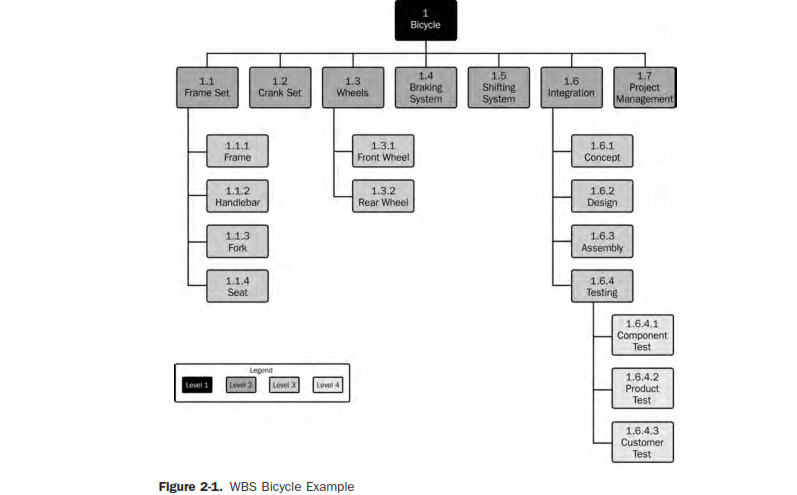
- WBS for Construction of a Bicycle
- The scope of a project can be decomposed in multiple ways.
- Regardless of the manner of decomposition, the sum of the work packages for each different decomposition should add up to the same scope of work.
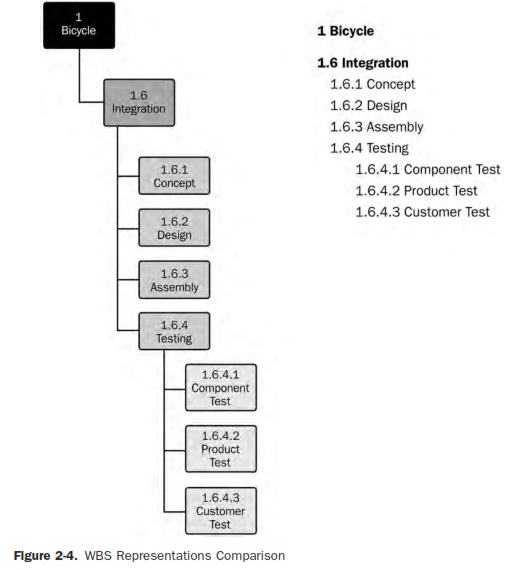
- Representations of the WBS
- the WBS enables the project team to predict and forecast costs, schedules, resource requirements, and allocations more accurately.
- Overview
- Overview
Chapter 3 Importance of the WBS
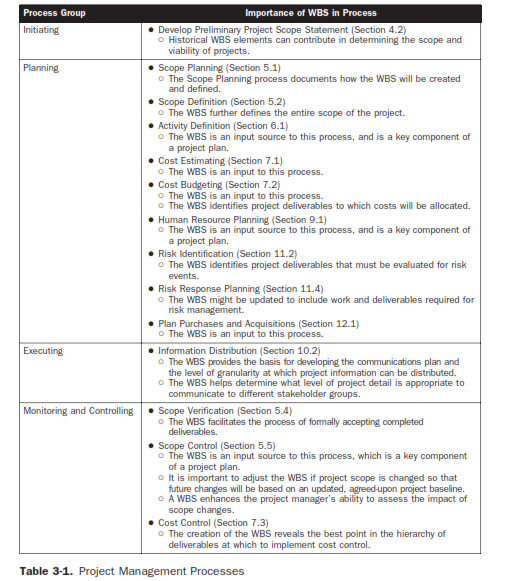
- Integration with Project Management Processes
- The WBS also plays an integral role in other project management processes.
- Overview
- the WBS does the following:
- Defines all the work of the project, and only the work of the project, thereby clarifying the project scope
- Reflects the input from all team members to ensure buy-in
- Provides the baseline for subsequent change control
- Is a primary input to other project management processes
- Provides the framework for project control, performance monitoring, and the foun- dation for communication with all stakeholders
- Ensures the work of the project correlates appropriately with the Responsibility Assignment Matrix (RAM) and the Organizational Breakdown Structure (OBS)
- Is referenced in other PMI standards, for example, the PMBOK Guide—Third Edition and Practice Standard for Earned Value Management (EVM), as an essential planning deliverable supporting key project management functions.
- A poorly constructed WBS can result
- Incomplete project definition leading to ongoing project extensions
- Unclear work assignments, goals, objectives, or deliverables
- Scope creep or unmanageable, frequently changing scope
- Budget overrun
- Missed deadlines on scheduled deliverables, or timeline slippage
- Unusable new product or feature
- Failure to deliver on some elements of project scope.
- the WBS does the following:
- Relationship to Other Tools
- Interrelationships Among Project Management Tools
- Any change in the WBS requires an associated change in the related tools.
- WBS Development Tools
- There are many benefits to using tools to develop a WBS. For example, tools often promote consistency and repeatability in the development of a WBS, especially enterprise productivity tools.
- Project Management Tools
- organize the scope of a project
- Project Charter.
- Project Scope Statement.
- Program and Portfolio WBS
- RBS. The Resource Breakdown Structure
- OBS. The Organizational Breakdown Structure
- WBS Dictionary:
- Project Schedule Network Diagram:
- Project Schedule:
- organize the scope of a project
- Interrelationships Among Project Management Tools
- WBS Integration and Use by Other Standards
- Standards that take advantage of the WBS typically fall into one of two categories.
- The first category focuses on using the content output of the WBS as an input. PMI’s Practice Standard for Earned Value Management (EVM) and upcoming Practice Standard for Scheduling fall into this category.
- Standards that take advantage of the WBS typically fall into one of two categories.
- Integration with Project Management Processes
Chapter 4 Defining WBS Quality
- Overview
- There are two basic principles that govern the quality of a WBS. This chapter will describe these principles and identify the characteristics of a high-quality WBS that flows from each principle
- WBS Quality Principle 1
- A quality WBS is a WBS constructed in such a way that it satisfies all of the requirements for its use in a project.
- WBS Quality Sub-Principle 1—Core Characteristics
- Is a deliverable-oriented grouping of project elements
- Defines the scope of the project
- Clarifies the work and communicates project scope to all stakeholders
- Contains 100% of the work defined by the scope
- Captures internal, external, and interim deliverables in terms of work to be com- pleted, including project management
- WBS Quality Sub-Principle 2—Use-Related Characteristics
- Achieves a sufficient level of decomposition.
- Provides sufficient detail for communicating all work.
- Is appropriate for tracking, as required by the specific project or organization.
- Is appropriate for control activities.
- Can contain specific kinds of WBS elements, as needed for each project
- Enables assignment of accountability at the appropriate level.
- Has a succinct, clear, and logically organized structure to meet project management and oversight requirements.
- WBS Quality Sub-Principle 1—Core Characteristics
- A quality WBS is a WBS constructed in such a way that it satisfies all of the requirements for its use in a project.
- WBS Quality Principle 2
- WBS quality characteristics apply at all levels of scope definition.
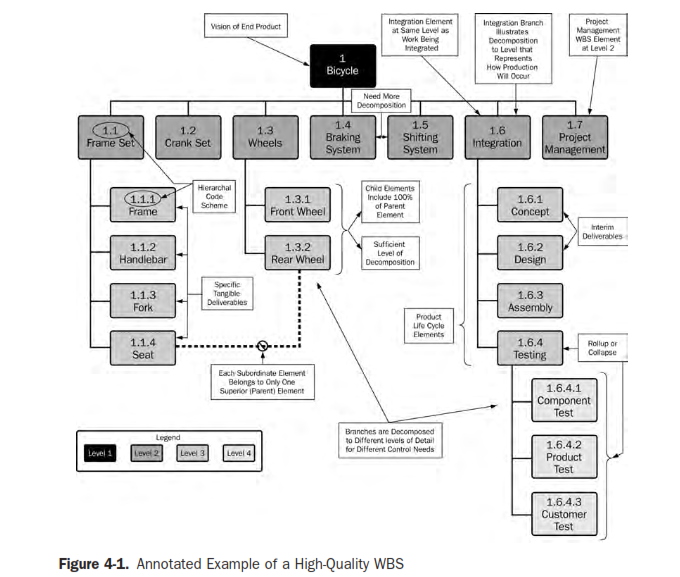
- Annotated Example of a High-Quality WBS
- Level 1
- is the overall product, always a single WBS element.
- Level 2
- is the high-level breakdown of the major areas in the scope of work.
- Level 3
- This level would tend to start targeting specific, tangible deliverables of the project effort. Here, integration is decomposed into interim deliverables based on the project life cycle chosen for this project.
- Level 4
- In the same manner, each exclusive area in Level 3 would be decomposed further, if applicable.
- Level 1
- Problem Diagnostic Checklist
- key WBS defects
- There are frequently missed deadlines and an extended schedule
- Project is over budget
- Individuals are unable to use the new product or feature
- The project scope has changed and is unmanageable
- The project has become an ongoing project with no end in sight
- Project team members are confused about their individual responsibilities
- Some planned work does not get done
- key WBS defects
- Overview
Imagens e arquivos do mapa
Informações
- Descrição
- G Ingeniería Mapa Mental sobre Practice Standard for Work Breakdown Structures, criado por ida muñoz rojas em 15-04-2018.
- Criado por
- ida muñoz rojas
- Visualizações
- 3
- Avaliação