
Mapa mental
MM - Evolutionary Explanations for Attraction
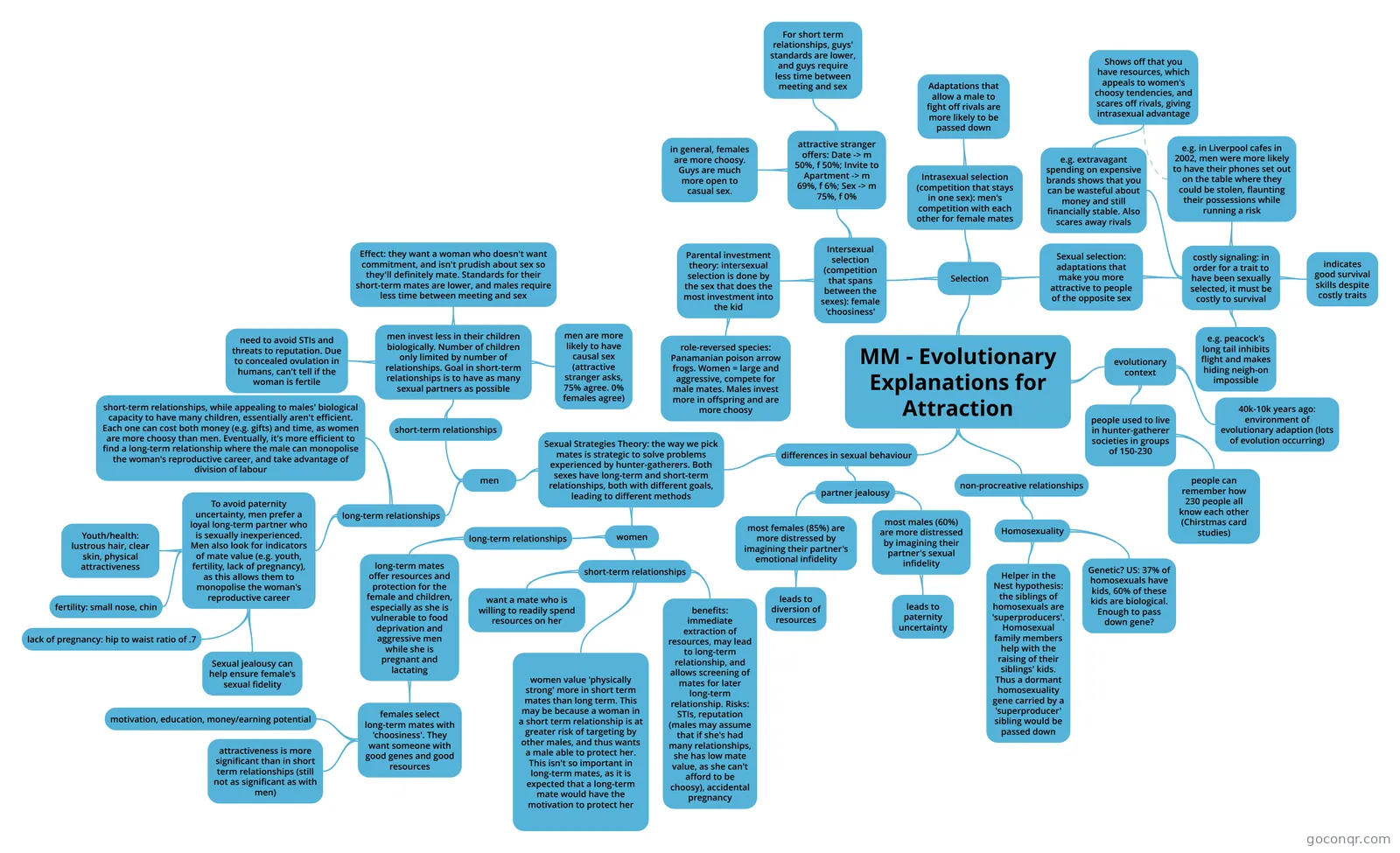
Mind map: Evolutionary Explanations for Attraction
Conteúdo do mapa
MM - Evolutionary Explanations for Attraction
Selection
- Intersexual selection (competition that spans between the sexes): female 'choosiness'
- Parental investment theory: intersexual selection is done by the sex that does the most investment into the kid
- role-reversed species: Panamanian poison arrow frogs. Women = large and aggressive, compete for male mates. Males invest more in offspring and are more choosy
- attractive stranger offers: Date -> m 50%, f 50%; Invite to Apartment -> m 69%, f 6%; Sex -> m 75%, f 0%
- in general, females are more choosy. Guys are much more open to casual sex.
- For short term relationships, guys' standards are lower, and guys require less time between meeting and sex
- Parental investment theory: intersexual selection is done by the sex that does the most investment into the kid
- Intrasexual selection (competition that stays in one sex): men's competition with each other for female mates
- Adaptations that allow a male to fight off rivals are more likely to be passed down
- Sexual selection: adaptations that make you more attractive to people of the opposite sex
- costly signaling: in order for a trait to have been sexually selected, it must be costly to survival
- e.g. peacock's long tail inhibits flight and makes hiding neigh-on impossible
- indicates good survival skills despite costly traits
- e.g. in Liverpool cafes in 2002, men were more likely to have their phones set out on the table where they could be stolen, flaunting their possessions while running a risk
- e.g. extravagant spending on expensive brands shows that you can be wasteful about money and still financially stable. Also scares away rivals
- Shows off that you have resources, which appeals to women's choosy tendencies, and scares off rivals, giving intrasexual advantage
- costly signaling: in order for a trait to have been sexually selected, it must be costly to survival
- Intersexual selection (competition that spans between the sexes): female 'choosiness'
differences in sexual behaviour
- partner jealousy
- most males (60%) are more distressed by imagining their partner's sexual infidelity
- leads to paternity uncertainty
- most females (85%) are more distressed by imagining their partner's emotional infidelity
- leads to diversion of resources
- most males (60%) are more distressed by imagining their partner's sexual infidelity
- Sexual Strategies Theory: the way we pick mates is strategic to solve problems experienced by hunter-gatherers. Both sexes have long-term and short-term relationships, both with different goals, leading to different methods
- women
- long-term relationships
- long-term mates offer resources and protection for the female and children, especially as she is vulnerable to food deprivation and aggressive men while she is pregnant and lactating
- females select long-term mates with 'choosiness'. They want someone with good genes and good resources
- motivation, education, money/earning potential
- attractiveness is more significant than in short term relationships (still not as significant as with men)
- females select long-term mates with 'choosiness'. They want someone with good genes and good resources
- long-term mates offer resources and protection for the female and children, especially as she is vulnerable to food deprivation and aggressive men while she is pregnant and lactating
- short-term relationships
- benefits: immediate extraction of resources, may lead to long-term relationship, and allows screening of mates for later long-term relationship. Risks: STIs, reputation (males may assume that if she's had many relationships, she has low mate value, as she can't afford to be choosy), accidental pregnancy
- want a mate who is willing to readily spend resources on her
- women value 'physically strong' more in short term mates than long term. This may be because a woman in a short term relationship is at greater risk of targeting by other males, and thus wants a male able to protect her. This isn't so important in long-term mates, as it is expected that a long-term mate would have the motivation to protect her
- long-term relationships
- men
- long-term relationships
- short-term relationships, while appealing to males' biological capacity to have many children, essentially aren't efficient. Each one can cost both money (e.g. gifts) and time, as women are more choosy than men. Eventually, it's more efficient to find a long-term relationship where the male can monopolise the woman's reproductive career, and take advantage of division of labour
- To avoid paternity uncertainty, men prefer a loyal long-term partner who is sexually inexperienced. Men also look for indicators of mate value (e.g. youth, fertility, lack of pregnancy), as this allows them to monopolise the woman's reproductive career
- Youth/health: lustrous hair, clear skin, physical attractiveness
- Sexual jealousy can help ensure female's sexual fidelity
- lack of pregnancy: hip to waist ratio of .7
- fertility: small nose, chin
- short-term relationships
- men invest less in their children biologically. Number of children only limited by number of relationships. Goal in short-term relationships is to have as many sexual partners as possible
- men are more likely to have causal sex (attractive stranger asks, 75% agree. 0% females agree)
- need to avoid STIs and threats to reputation. Due to concealed ovulation in humans, can't tell if the woman is fertile
- Effect: they want a woman who doesn't want commitment, and isn't prudish about sex so they'll definitely mate. Standards for their short-term mates are lower, and males require less time between meeting and sex
- men invest less in their children biologically. Number of children only limited by number of relationships. Goal in short-term relationships is to have as many sexual partners as possible
- long-term relationships
- women
- partner jealousy
evolutionary context
- people used to live in hunter-gatherer societies in groups of 150-230
- people can remember how 230 people all know each other (Chirstmas card studies)
- 40k-10k years ago: environment of evolutionary adaption (lots of evolution occurring)
- people used to live in hunter-gatherer societies in groups of 150-230
non-procreative relationships
- Homosexuality
- Genetic? US: 37% of homosexuals have kids, 60% of these kids are biological. Enough to pass down gene?
- Helper in the Nest hypothesis: the siblings of homosexuals are 'superproducers'. Homosexual family members help with the raising of their siblings' kids. Thus a dormant homosexuality gene carried by a 'superproducer' sibling would be passed down
- Homosexuality
Informações
- Descrição
- Psychology of Attractiveness Mapa Mental sobre MM - Evolutionary Explanations for Attraction, criado por Jamie Otten em 29-05-2018.
- Criado por
- Jamie Otten
- Visualizações
- 0
- Avaliação