
Mapa mental
Relationship Development & Maintenance
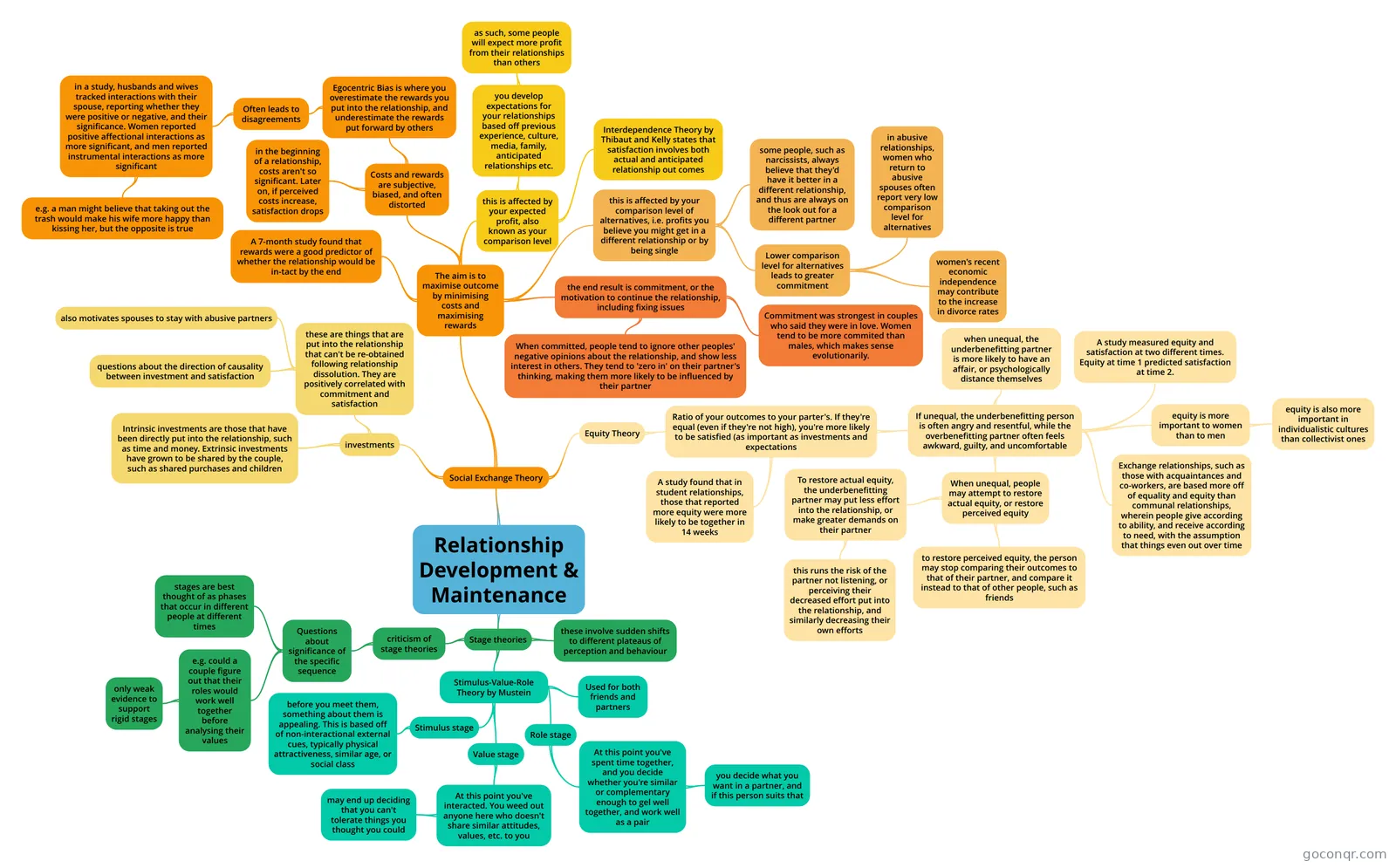
Mind map: Relationship development and maintenance
Conteúdo do mapa
Relationship Development & Maintenance
Stage theories
- these involve sudden shifts to different plateaus of perception and behaviour
- Stimulus-Value-Role Theory by Mustein
- Stimulus stage
- before you meet them, something about them is appealing. This is based off of non-interactional external cues, typically physical attractiveness, similar age, or social class
- Used for both friends and partners
- Value stage
- At this point you've interacted. You weed out anyone here who doesn't share similar attitudes, values, etc. to you
- may end up deciding that you can't tolerate things you thought you could
- At this point you've interacted. You weed out anyone here who doesn't share similar attitudes, values, etc. to you
- Role stage
- At this point you've spent time together, and you decide whether you're similar or complementary enough to gel well together, and work well as a pair
- you decide what you want in a partner, and if this person suits that
- At this point you've spent time together, and you decide whether you're similar or complementary enough to gel well together, and work well as a pair
- Stimulus stage
- criticism of stage theories
- Questions about significance of the specific sequence
- e.g. could a couple figure out that their roles would work well together before analysing their values
- only weak evidence to support rigid stages
- stages are best thought of as phases that occur in different people at different times
- e.g. could a couple figure out that their roles would work well together before analysing their values
- Questions about significance of the specific sequence
Social Exchange Theory
- The aim is to maximise outcome by minimising costs and maximising rewards
- A social exchange map is a representation of relationship commitment using the following formula: Rewards - Costs = Outcome Outcome - Comparison Level = Satisfaction Satisfaction - Alternatives + Investments = Commitment
- A 7-month study found that rewards were a good predictor of whether the relationship would be in-tact by the end
- Costs and rewards are subjective, biased, and often distorted
- in the beginning of a relationship, costs aren't so significant. Later on, if perceived costs increase, satisfaction drops
- Egocentric Bias is where you overestimate the rewards you put into the relationship, and underestimate the rewards put forward by others
- Often leads to disagreements
- in a study, husbands and wives tracked interactions with their spouse, reporting whether they were positive or negative, and their significance. Women reported positive affectional interactions as more significant, and men reported instrumental interactions as more significant
- e.g. a man might believe that taking out the trash would make his wife more happy than kissing her, but the opposite is true
- in a study, husbands and wives tracked interactions with their spouse, reporting whether they were positive or negative, and their significance. Women reported positive affectional interactions as more significant, and men reported instrumental interactions as more significant
- Often leads to disagreements
- this is affected by your expected profit, also known as your comparison level
- you develop expectations for your relationships based off previous experience, culture, media, family, anticipated relationships etc.
- as such, some people will expect more profit from their relationships than others
- Interdependence Theory by Thibaut and Kelly states that satisfaction involves both actual and anticipated relationship out comes
- you develop expectations for your relationships based off previous experience, culture, media, family, anticipated relationships etc.
- this is affected by your comparison level of alternatives, i.e. profits you believe you might get in a different relationship or by being single
- some people, such as narcissists, always believe that they'd have it better in a different relationship, and thus are always on the look out for a different partner
- Lower comparison level for alternatives leads to greater commitment
- women's recent economic independence may contribute to the increase in divorce rates
- in abusive relationships, women who return to abusive spouses often report very low comparison level for alternatives
- the end result is commitment, or the motivation to continue the relationship, including fixing issues
- Commitment was strongest in couples who said they were in love. Women tend to be more commited than males, which makes sense evolutionarily.
- When committed, people tend to ignore other peoples' negative opinions about the relationship, and show less interest in others. They tend to 'zero in' on their partner's thinking, making them more likely to be influenced by their partner
- investments
- these are things that are put into the relationship that can't be re-obtained following relationship dissolution. They are positively correlated with commitment and satisfaction
- also motivates spouses to stay with abusive partners
- questions about the direction of causality between investment and satisfaction
- Intrinsic investments are those that have been directly put into the relationship, such as time and money. Extrinsic investments have grown to be shared by the couple, such as shared purchases and children
- these are things that are put into the relationship that can't be re-obtained following relationship dissolution. They are positively correlated with commitment and satisfaction
- Equity Theory
- Ratio of your outcomes to your parter's. If they're equal (even if they're not high), you're more likely to be satisfied (as important as investments and expectations
- If unequal, the underbenefitting person is often angry and resentful, while the overbenefitting partner often feels awkward, guilty, and uncomfortable
- When unequal, people may attempt to restore actual equity, or restore perceived equity
- To restore actual equity, the underbenefitting partner may put less effort into the relationship, or make greater demands on their partner
- this runs the risk of the partner not listening, or perceiving their decreased effort put into the relationship, and similarly decreasing their own efforts
- to restore perceived equity, the person may stop comparing their outcomes to that of their partner, and compare it instead to that of other people, such as friends
- To restore actual equity, the underbenefitting partner may put less effort into the relationship, or make greater demands on their partner
- when unequal, the underbenefitting partner is more likely to have an affair, or psychologically distance themselves
- A study measured equity and satisfaction at two different times. Equity at time 1 predicted satisfaction at time 2.
- equity is more important to women than to men
- equity is also more important in individualistic cultures than collectivist ones
- Exchange relationships, such as those with acquaintances and co-workers, are based more off of equality and equity than communal relationships, wherein people give according to ability, and receive according to need, with the assumption that things even out over time
- When unequal, people may attempt to restore actual equity, or restore perceived equity
- A study found that in student relationships, those that reported more equity were more likely to be together in 14 weeks
- If unequal, the underbenefitting person is often angry and resentful, while the overbenefitting partner often feels awkward, guilty, and uncomfortable
- Ratio of your outcomes to your parter's. If they're equal (even if they're not high), you're more likely to be satisfied (as important as investments and expectations
- The aim is to maximise outcome by minimising costs and maximising rewards
Informações
- Descrição
- Psychology of Attractiveness Mapa Mental sobre Relationship Development & Maintenance, criado por Jamie Otten em 29-05-2018.
- Criado por
- Jamie Otten
- Visualizações
- 1
- Avaliação