
Mapa mental
Investor Relations
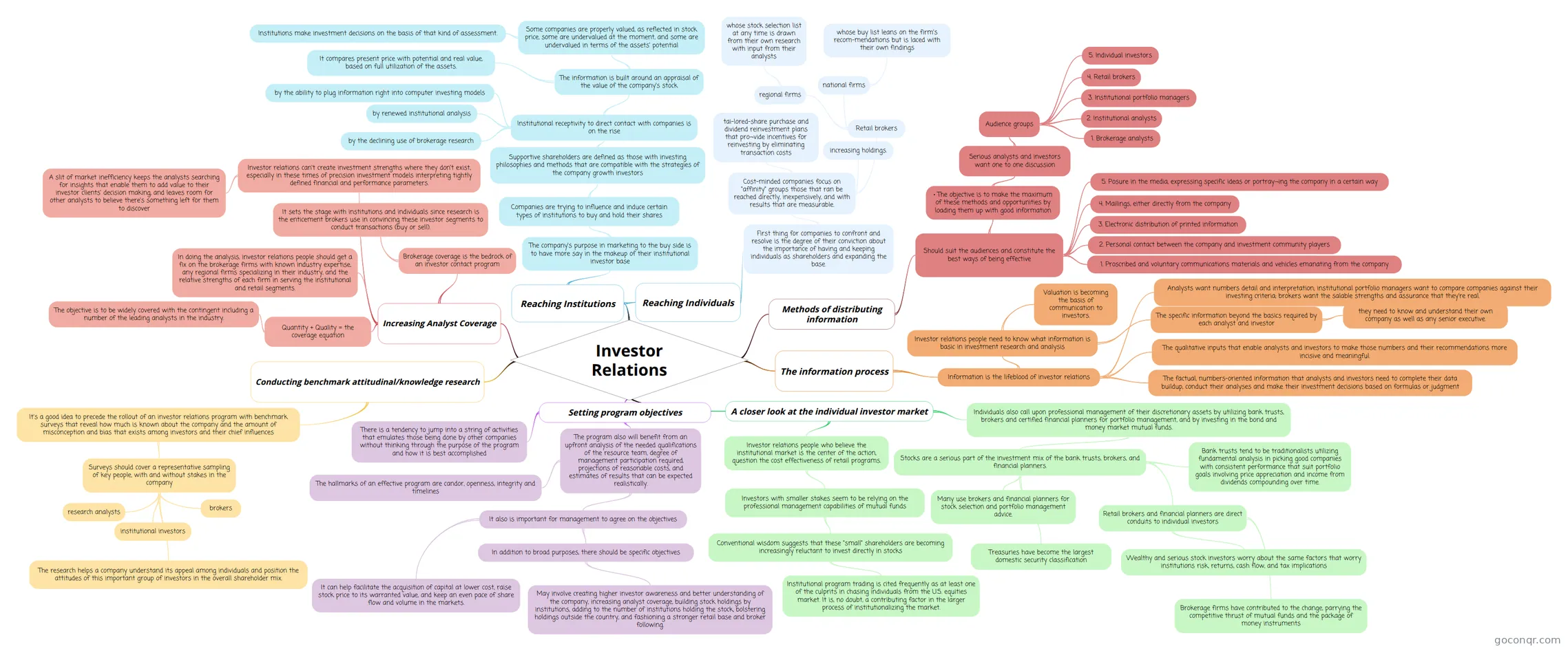
Mind map: Investor relations
Conteúdo do mapa
Investor Relations
A closer look at the individual investor market
- Investor relations people who believe the institutional market is the center of the action, question the cost effectiveness of retail programs.
- Investors with smaller stakes seem to be relying on the professional management capabilities of mutual funds
- Conventional wisdom suggests that these "small" shareholders are becoming increasingly reluctant to invest directly in stocks
- Institutional program trading is cited frequently as at least one of the culprits in chasing individuals from the U.S. equities market. It is, no doubt, a contributing factor in the larger process of institutionalizing the market.
- Conventional wisdom suggests that these "small" shareholders are becoming increasingly reluctant to invest directly in stocks
- Investors with smaller stakes seem to be relying on the professional management capabilities of mutual funds
- Individuals also call upon professional management of their discretionary assets by utilizing bank trusts, brokers and certified financial planners for portfolio management, and by investing in the bond and money market mutual funds.
- Stocks are a serious part of the investment mix of the bank trusts, brokers, and financial planners.
- Bank trusts tend to be traditionalists utilizing fundamental analysis in picking good companies with consistent performance that suit portfolio goals involving price appreciation and income from dividends compounding over time.
- Treasuries have become the largest domestic security classification
- Retail brokers and financial planners are direct conduits to individual investors
- Brokerage firms have contributed to the change, parrying the competitive thrust of mutual funds and the package of money instruments
- Wealthy and serious stock investors worry about the same factors that worry institutions risk, returns, cash flow, and tax implications
- Many use brokers and financial planners for stock selection and portfolio management advice.
- Stocks are a serious part of the investment mix of the bank trusts, brokers, and financial planners.
- Investor relations people who believe the institutional market is the center of the action, question the cost effectiveness of retail programs.
Setting program objectives
- There is a tendency to jump into a string of activities that emulates those being done by other companies without thinking through the purpose of the program and how it is best accomplished
- The program also will benefit from an upfront analysis of the needed qualifications of the resource team, degree of management participation required, projections of reasonable costs, and estimates of results that can be expected realistically.
- It also is important for management to agree on the objectives
- It can help facilitate the acquisition of capital at lower cost, raise stock price to its warranted value, and keep an even pace of share flow and volume in the markets.
- In addition to broad purposes, there should be specific objectives
- May involve creating higher investor awareness and better understanding of the company, increasing analyst coverage, building stock holdings by institutions, adding to the number of institutions holding the stock, bolstering holdings outside the country, and fashioning a stronger retail base and broker following.
- The hallmarks of an effective program are candor, openness, integrity and timelines
- It also is important for management to agree on the objectives
Conducting benchmark attitudinal/knowledge research
- It's a good idea to precede the rollout of an investor relations program with benchmark surveys that reveal how much is known about the company and the amount of misconception and bias that exists among investors and their chief influences
- Surveys should cover a representative sampling of key people, with and without stakes in the company
- research analysts
- institutional investors
- brokers
- The research helps a company understand its appeal among individuals and position the attitudes of this important group of investors in the overall shareholder mix.
- Surveys should cover a representative sampling of key people, with and without stakes in the company
- It's a good idea to precede the rollout of an investor relations program with benchmark surveys that reveal how much is known about the company and the amount of misconception and bias that exists among investors and their chief influences
Increasing Analyst Coverage
- Brokerage coverage is the bedrock of an investor contact program
- It sets the stage with institutions and individuals since research is the enticement brokers use in convincing these investor segments to conduct transactions (buy or sell).
- Quantity + Quality = the coverage equation
- The objective is to be widely covered with the contingent including a number of the leading analysts in the industry.
- In doing the analysis, investor relations people should get a fix on the brokerage firms with known industry expertise, any regional firms specializing in their industry, and the relative strengths of each firm in serving the institutional and retail segments.
- Investor relations can't create investment strengths where they don't exist, especially in these times of precision investment models interpreting tightly defined financial and performance parameters.
- A slit of market inefficiency keeps the analysts searching for insights that enable them to add value to their investor clients' decision making, and leaves room for other analysts to believe there's something left for them to discover
- Brokerage coverage is the bedrock of an investor contact program
Reaching Institutions
- The company's purpose in marketing to the buy side is to have more say in the makeup of their institutional investor base
- Companies are trying to influence and induce certain types of institutions to buy and hold their shares
- Supportive shareholders are defined as those with investing philosophies and methods that are compatible with the strategies of the company growth investors
- Institutional receptivity to direct contact with companies is on the rise
- by the declining use of brokerage research
- by renewed institutional analysis
- by the ability to plug information right into computer investing models
- The information is built around an appraisal of the value of the company's stock
- It compares present price with potential and real value, based on full utilization of the assets.
- Some companies are properly valued, as reflected in stock price, some are undervalued at the moment, and some are undervalued in terms of the assets' potential
- Institutions make investment decisions on the basis of that kind of assessment.
- Institutional receptivity to direct contact with companies is on the rise
- Supportive shareholders are defined as those with investing philosophies and methods that are compatible with the strategies of the company growth investors
- Companies are trying to influence and induce certain types of institutions to buy and hold their shares
- Reaching Individuals
- First thing for companies to confront and resolve is the degree of their conviction about the importance of having and keeping individuals as shareholders and expanding the base.
- Cost-minded companies focus on "affinity" groups those that ran be reached directly, inexpensively, and with results that are measurable.
- tai-lored-share purchase and dividend reinvestment plans that pro¬vide incentives for reinvesting by eliminating transaction costs
- increasing holdings.
- Retail brokers
- regional firms
- whose stock selection list at any time is drawn from their own research with input from their analysts
- national firms
- whose buy list leans on the firm's recom-mendations but is laced with their own findings
- regional firms
- Cost-minded companies focus on "affinity" groups those that ran be reached directly, inexpensively, and with results that are measurable.
- First thing for companies to confront and resolve is the degree of their conviction about the importance of having and keeping individuals as shareholders and expanding the base.
- The company's purpose in marketing to the buy side is to have more say in the makeup of their institutional investor base
The information process
- Information is the lifeblood of investor relations
- The factual, numbers-oriented information that analysts and investors need to complete their data buildup, conduct their analyses and make their investment decisions based on formulas or judgment
- The qualitative inputs that enable analysts and investors to make those numbers and their recommendations more incisive and meaningful.
- Investor relations people need to know what information is basic in investment research and analysis
- The specific information beyond the basics required by each analyst and investor
- they need to know and understand their own company as well as any senior executive.
- Valuation is becoming the basis of communication to investors.
- The specific information beyond the basics required by each analyst and investor
- Analysts want numbers detail and interpretation; institutional portfolio managers want to compare companies against their investing criteria; brokers want the salable strengths and assurance that they're real.
- Information is the lifeblood of investor relations
Methods of distributing information
- Should suit the audiences and constitute the best ways of being effective
- 1. Proscribed and voluntary communications materials and vehicles emanating from the company
- 2. Personal contact between the company and investment community players
- 3. Electronic distribution of printed information
- 4. Mailings, either directly from the company
- 5. Posure in the media, expressing specific ideas or portray¬ing the company in a certain way
- • The objective is to make the maximum of these methods and opportunities by loading them up with good information
- Serious analysts and investors want one to one discussion
- Audience groups
- 1. Brokerage analysts
- 2. Institutional analysts
- 3. Institutional portfolio managers
- 4. Retail brokers
- 5. Individual investors
- Audience groups
- Serious analysts and investors want one to one discussion
- Should suit the audiences and constitute the best ways of being effective
Informações
- Descrição
- Mapa Mental sobre Investor Relations, criado por Samantha Pérez em 20-08-2018.
- Criado por
- Samantha Pérez
- Visualizações
- 1
- Avaliação