
Mapa mental
Persuasion Knowledge Model
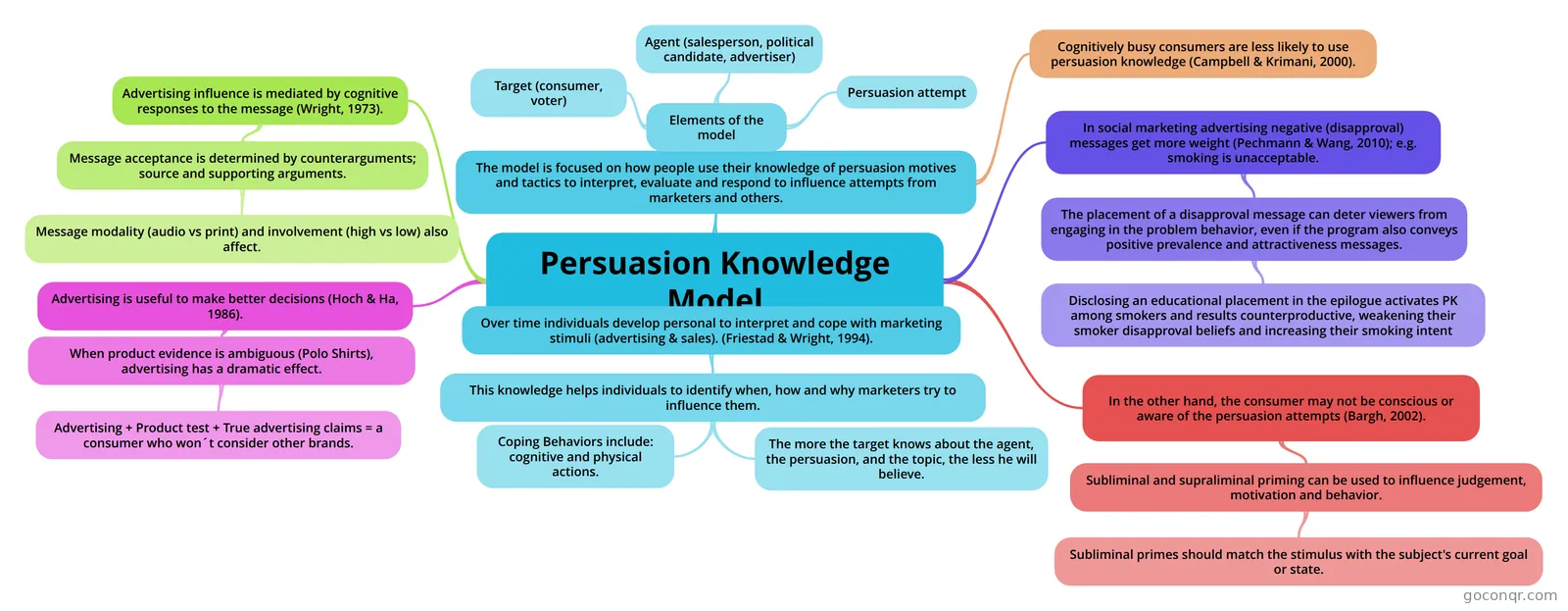
Mind map: Persuasion Knowledge Model
Conteúdo do mapa
Persuasion Knowledge Model
Over time individuals develop personal to interpret and cope with marketing stimuli (advertising & sales). (Friestad & Wright, 1994).
- This knowledge helps individuals to identify when, how and why marketers try to influence them.
- Coping Behaviors include: cognitive and physical actions.
- The more the target knows about the agent, the persuasion, and the topic, the less he will believe.
- This knowledge helps individuals to identify when, how and why marketers try to influence them.
The model is focused on how people use their knowledge of persuasion motives and tactics to interpret, evaluate and respond to influence attempts from marketers and others.
- Elements of the model
- Target (consumer, voter)
- Agent (salesperson, political candidate, advertiser)
- Persuasion attempt
- Cognitively busy consumers are less likely to use persuasion knowledge (Campbell & Krimani, 2000).
- Elements of the model
Advertising influence is mediated by cognitive responses to the message (Wright, 1973).
- Message acceptance is determined by counterarguments; source and supporting arguments.
- Message modality (audio vs print) and involvement (high vs low) also affect.
- Message acceptance is determined by counterarguments; source and supporting arguments.
Advertising is useful to make better decisions (Hoch & Ha, 1986).
- When product evidence is ambiguous (Polo Shirts), advertising has a dramatic effect.
- Advertising + Product test + True advertising claims = a consumer who won´t consider other brands.
- When product evidence is ambiguous (Polo Shirts), advertising has a dramatic effect.
In social marketing advertising negative (disapproval) messages get more weight (Pechmann & Wang, 2010); e.g. smoking is unacceptable.
- The placement of a disapproval message can deter viewers from engaging in the problem behavior, even if the program also conveys positive prevalence and attractiveness messages.
- Disclosing an educational placement in the epilogue activates PK among smokers and results counterproductive, weakening their smoker disapproval beliefs and increasing their smoking intent
- The placement of a disapproval message can deter viewers from engaging in the problem behavior, even if the program also conveys positive prevalence and attractiveness messages.
In the other hand, the consumer may not be conscious or aware of the persuasion attempts (Bargh, 2002).
- Subliminal and supraliminal priming can be used to influence judgement, motivation and behavior.
- Subliminal primes should match the stimulus with the subject's current goal or state.
- Subliminal and supraliminal priming can be used to influence judgement, motivation and behavior.
Informações
- Descrição
- Mapa Mental sobre Persuasion Knowledge Model, criado por Alicia de la Pena em 16-07-2013.
- Criado por
- Alicia de la Pena
- Visualizações
- 163
- Avaliação