
Mapa mental
Transient response
Conteúdo do mapa
Transient response
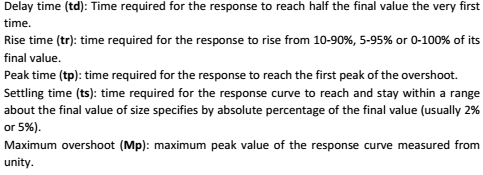
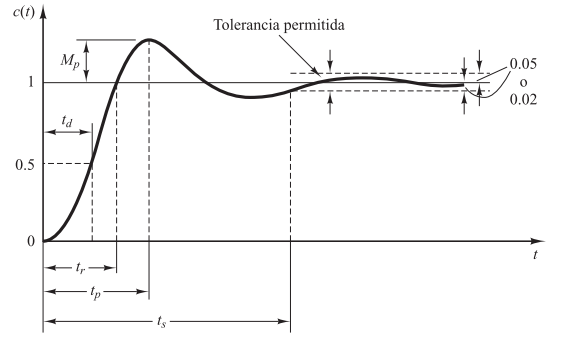
Frequently the performance characteristics of a control system are specified in terms of the transient response
- The transient response of a practical control system often exhibit damped oscillations before reaching steady state
- In specifying the transcient response characteristics of a system it is comon to use the performance's measures
- In specifying the transcient response characteristics of a system it is comon to use the performance's measures
- The transient response of a practical control system often exhibit damped oscillations before reaching steady state
Except for certain applications where oscillations cannot be tolerated, it is desirable that the transient response be sufficiently fast and damped
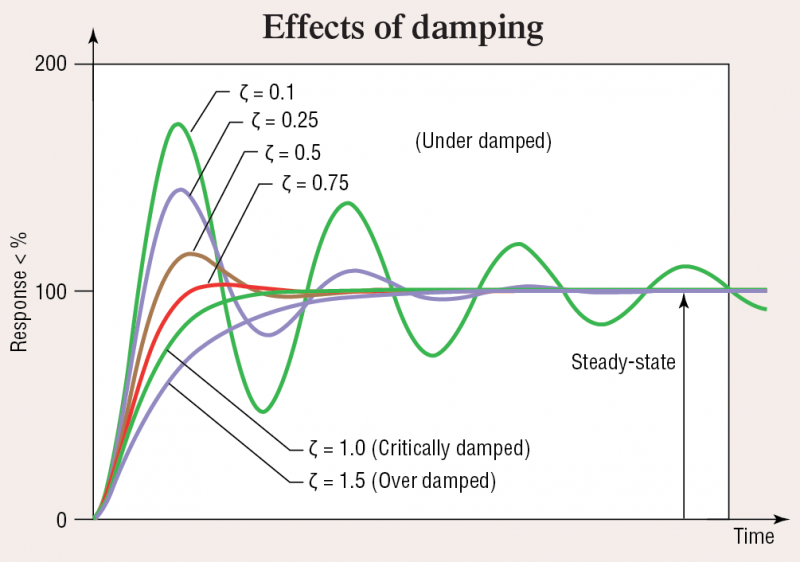
- For a desirable transient response of a second order system, the damping ratio must be between 0.4 and 0.8
The response can be classified as one of three types of damping that describes the output in relation to the steady-state response.
- A critically damped response is that response which reaches the steady-state value the fastest without being underdamped. Here, damping ratio is always equal to one. There should be no oscillation about the steady state value in the ideal case.
- An overdamped response is the response that does not oscillate about the steady-state value but takes longer to reach steady-state than the critically damped case. Here damping ratio is greater than one.
- An underdamped response is one that oscillates within a decaying envelope. The more underdamped the system, the more oscillations and longer it takes to reach steady-state. Here damping ratio is always less than one but greater than zero.
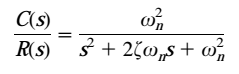
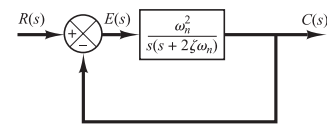
For a second order system the standard transfer function is equal to
Imagens e arquivos do mapa
Informações
- Descrição
- Mapa Mental sobre Transient response, criado por Gustavo Malvaez Olguin em 13-09-2018.
- Criado por
- Gustavo Malvaez Olguin
- Visualizações
- 2
- Avaliação