
Mapa mental
Motor Development
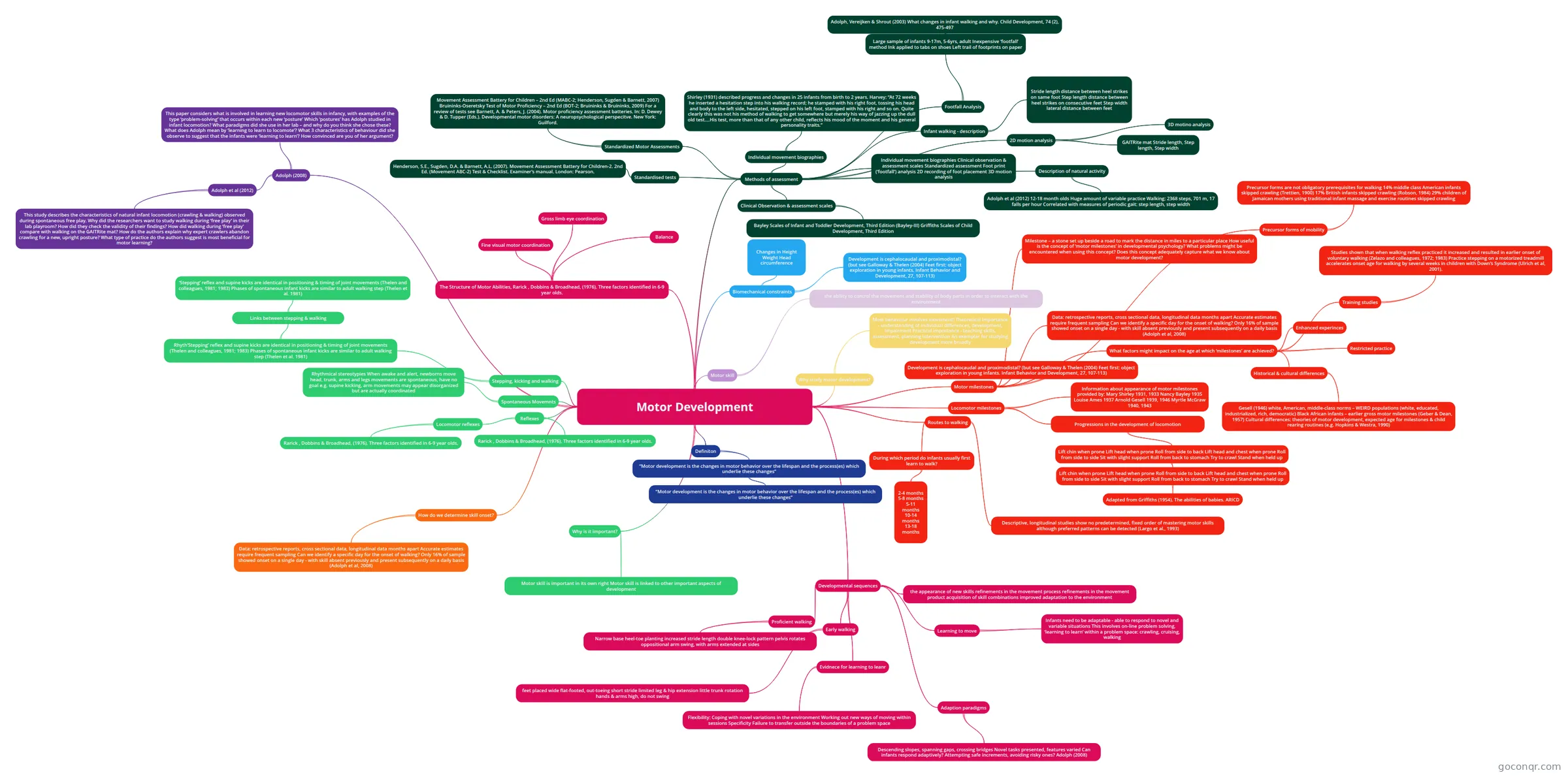
Mind map: Motor development
Conteúdo do mapa
Motor Development
Motor skill
- the ability to control the movement and stability of body parts in order to interact with the environment
Definiton
- “Motor development is the changes in motor behavior over the lifespan and the process(es) which underlie these changes”
- “Motor development is the changes in motor behavior over the lifespan and the process(es) which underlie these changes”
- “Motor development is the changes in motor behavior over the lifespan and the process(es) which underlie these changes”
Why is it important?
- Motor skill is important in its own right Motor skill is linked to other important aspects of development
Why study motor development?
- Most behaviour involves movement! Theoretical importance - understanding of individual differences, development, impairment Practical importance - teaching skills, assessment, planning intervention An exemplar for studying development more broadly
The Structure of Motor Abilities, Rarick , Dobbins & Broadhead, (1976). Three factors identified in 6-9 year olds.
- Fine visual motor coordination
- Balance
- Gross limb eye coordination
Reflexes
- Rarick , Dobbins & Broadhead, (1976). Three factors identified in 6-9 year olds.
- Locomotor reflexes
- Rarick , Dobbins & Broadhead, (1976). Three factors identified in 6-9 year olds.
Spontaneous Movemnts
- Rhythmical stereotypies When awake and alert, newborns move head, trunk, arms and legs movements are spontaneous, have no goal e.g. supine kicking, arm movements may appear disorganized but are actually coordinated
Stepping, kicking and walking
- Rhyth‘Stepping’ reflex and supine kicks are identical in positioning & timing of joint movements (Thelen and colleagues, 1981; 1983) Phases of spontaneous infant kicks are similar to adult walking step (Thelen et al. 1981)
- Links between stepping & walking
- ‘Stepping’ reflex and supine kicks are identical in positioning & timing of joint movements (Thelen and colleagues, 1981; 1983) Phases of spontaneous infant kicks are similar to adult walking step (Thelen et al. 1981)
- Links between stepping & walking
- Rhyth‘Stepping’ reflex and supine kicks are identical in positioning & timing of joint movements (Thelen and colleagues, 1981; 1983) Phases of spontaneous infant kicks are similar to adult walking step (Thelen et al. 1981)
Biomechanical constraints
- Changes in Height Weight Head circumference
- Development is cephalocaudal and proximodistal? (but see Galloway & Thelen (2004) Feet first: object exploration in young infants. Infant Behavior and Development, 27, 107-113)
Motor milestones
- Development is cephalocaudal and proximodistal? (but see Galloway & Thelen (2004) Feet first: object exploration in young infants. Infant Behavior and Development, 27, 107-113)
- Data: retrospective reports, cross sectional data, longitudinal data months apart Accurate estimates require frequent sampling Can we identify a specific day for the onset of walking? Only 16% of sample showed onset on a single day - with skill absent previously and present subsequently on a daily basis (Adolph et al, 2008)
- What factors might impact on the age at which ‘milestones’ are achieved?
- Historical & cultural differences
- Gesell (1946) white, American, middle-class norms – WEIRD populations (white, educated, industrialized, rich, democratic) Black African infants – earlier gross motor milestones (Geber & Dean, 1957) Cultural differences: theories of motor development, expected age for milestones & child rearing routines (e.g. Hopkins & Westra, 1990)
- Enhanced experinces
- Restricted practice
- Training studies
- Studies shown that when walking reflex practiced it increased and resulted in earlier onset of voluntary walking (Zelazo and colleagues, 1972; 1983) Practice stepping on a motorized treadmill accelerates onset age for walking by several weeks in children with Down’s Syndrome (Ulrich et al, 2001).
- Historical & cultural differences
- Milestone – a stone set up beside a road to mark the distance in miles to a particular place How useful is the concept of ‘motor milestones’ in developmental psychology? What problems might be encountered when using this concept? Does this concept adequately capture what we know about motor development?
- Precursor forms of mobility
- Precursor forms are not obligatory prerequisites for walking 14% middle class American infants skipped crawling (Trettien, 1900) 17% British infants skipped crawling (Robson, 1984) 29% children of Jamaican mothers using traditional infant massage and exercise routines skipped crawling
Locomotor milestones
- Information about appearance of motor milestones provided by: Mary Shirley 1931, 1933 Nancy Bayley 1935 Louise Ames 1937 Arnold Gesell 1939, 1946 Myrtle McGraw 1940, 1943
- Progressions in the development of locomotion
- Lift chin when prone Lift head when prone Roll from side to back Lift head and chest when prone Roll from side to side Sit with slight support Roll from back to stomach Try to crawl Stand when held up
- Lift chin when prone Lift head when prone Roll from side to back Lift head and chest when prone Roll from side to side Sit with slight support Roll from back to stomach Try to crawl Stand when held up
- Adapted from Griffiths (1954). The abilities of babies. ARICD
- Lift chin when prone Lift head when prone Roll from side to back Lift head and chest when prone Roll from side to side Sit with slight support Roll from back to stomach Try to crawl Stand when held up
- Lift chin when prone Lift head when prone Roll from side to back Lift head and chest when prone Roll from side to side Sit with slight support Roll from back to stomach Try to crawl Stand when held up
Routes to walking
- Descriptive, longitudinal studies show no predetermined, fixed order of mastering motor skills although preferred patterns can be detected (Largo et al., 1993)
- During which period do infants usually first learn to walk?
- 2-4 months 5-8 months 5-11 months 10-14 months 13-18 months
How do we determine skill onset?
- Data: retrospective reports, cross sectional data, longitudinal data months apart Accurate estimates require frequent sampling Can we identify a specific day for the onset of walking? Only 16% of sample showed onset on a single day - with skill absent previously and present subsequently on a daily basis (Adolph et al, 2008)
Developmental sequences
- the appearance of new skills refinements in the movement process refinements in the movement product acquisition of skill combinations improved adaptation to the environment
- Early walking
- feet placed wide flat-footed, out-toeing short stride limited leg & hip extension little trunk rotation hands & arms high, do not swing
- Proficient walking
- Narrow base heel-toe planting increased stride length double knee-lock pattern pelvis rotates oppositional arm swing, with arms extended at sides
- Learning to move
- Infants need to be adaptable - able to respond to novel and variable situations This involves on-line problem solving, ‘learning to learn’ within a problem space: crawling, cruising, walking
- Adaption paradigms
- Descending slopes, spanning gaps, crossing bridges Novel tasks presented, features varied Can infants respond adaptively? Attempting safe increments, avoiding risky ones? Adolph (2008)
- Evidnece for learning to leanr
- Flexibility: Coping with novel variations in the environment Working out new ways of moving within sessions Specificity Failure to transfer outside the boundaries of a problem space
Methods of assessment
- Individual movement biographies Clinical observation & assessment scales Standardized assessment Foot print (‘footfall’) analysis 2D recording of foot placement 3D motion analysis
- Individual movement biographies
- Shirley (1931) described progress and changes in 25 infants from birth to 2 years. Harvey: “At 72 weeks he inserted a hesitation step into his walking record; he stamped with his right foot, tossing his head and body to the left side, hesitated, stepped on his left foot, stamped with his right and so on. Quite clearly this was not his method of walking to get somewhere but merely his way of jazzing up the dull old test….His test, more than that of any other child, reflects his mood of the moment and his general personality traits.”
- Clinical Observation & assessment scales
- Bayley Scales of Infant and Toddler Development, Third Edition (Bayley-III) Griffiths Scales of Child Development, Third Edition
- Standardized Motor Assessments
- Movement Assessment Battery for Children – 2nd Ed (MABC-2; Henderson, Sugden & Barnett, 2007) Bruininks-Oseretsky Test of Motor Proficiency – 2nd Ed (BOT-2; Bruininks & Bruininks, 2009) For a review of tests see Barnett, A. & Peters, J. (2004). Motor proficiency assessment batteries. In: D. Dewey & D. Tupper (Eds.). Developmental motor disorders: A neuropsychological perspecitve. New York: Guilford.
- Standardised tests
- Henderson, S.E., Sugden, D.A. & Barnett, A.L. (2007). Movement Assessment Battery for Children-2. 2nd Ed. (Movement ABC-2) Test & Checklist. Examiner’s manual. London: Pearson.
- Footfall Analysis
- Large sample of infants 9-17m, 5-6yrs, adult Inexpensive ‘footfall’ method Ink applied to tabs on shoes Left trail of footprints on paper
- Adolph, Vereijken & Shrout (2003) What changes in infant walking and why. Child Development, 74 (2), 475-497
- Large sample of infants 9-17m, 5-6yrs, adult Inexpensive ‘footfall’ method Ink applied to tabs on shoes Left trail of footprints on paper
- Infant walking - description
- Stride length distance between heel strikes on same foot Step length distance between heel strikes on consecutive feet Step width lateral distance between feet
- 2D motion analysis
- GAITRite mat Stride length, Step length, Step width
- 3D motino analysis
- Description of natural activity
- Adolph et al (2012) 12-18 month olds Huge amount of variable practice Walking: 2368 steps, 701 m, 17 falls per hour Correlated with measures of periodic gait: step length, step width
Adolph (2008)
- This paper considers what is involved in learning new locomotor skills in infancy, with examples of the type ‘problem-solving’ that occurs within each new ‘posture’ Which ‘postures’ has Adolph studied in infant locomotion? What paradigms did she use in her lab – and why do you think she chose these? What does Adolph mean by ‘learning to learn to locomote’? What 3 characteristics of behaviour did she observe to suggest that the infants were ‘learning to learn’? How convinced are you of her argument?
- Adolph et al (2012)
- This study describes the characteristics of natural infant locomotion (crawling & walking) observed during spontaneous free play. Why did the researchers want to study walking during ‘free play’ in their lab playroom? How did they check the validity of their findings? How did walking during ‘free play’ compare with walking on the GAITRite mat? How do the authors explain why expert crawlers abandon crawling for a new, upright posture? What type of practice do the authors suggest is most beneficial for motor learning?
Informações
- Descrição
- U24135: Developmental Psychology Mapa Mental sobre Motor Development, criado por Jasmine Stow em 10-10-2018.
- Criado por
- Jasmine Stow
- Visualizações
- 0
- Tags
- Avaliação