
Mapa mental
'But For' Causation
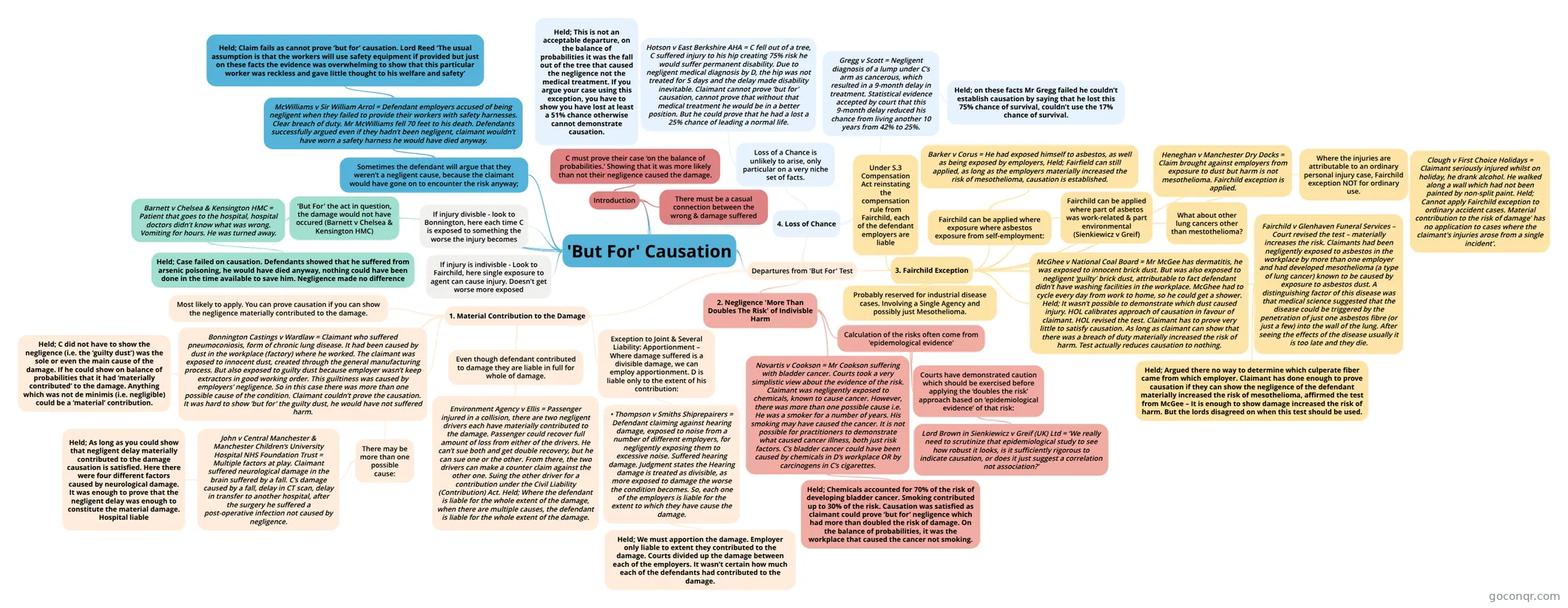
Mind map: 'But For' causation
Conteúdo do mapa
'But For' Causation
Introduction
- There must be a casual connection between the wrong & damage suffered
- C must prove their case ‘on the balance of probabilities.’ Showing that it was more likely than not their negligence caused the damage.
'But For' the act in question, the damage would not have occured (Barnett v Chelsea & Kensington HMC)
- Barnett v Chelsea & Kensington HMC = Patient that goes to the hospital, hospital doctors didn’t know what was wrong. Vomiting for hours. He was turned away.
- Held; Case failed on causation. Defendants showed that he suffered from arsenic poisoning, he would have died anyway, nothing could have been done in the time available to save him. Negligence made no difference
- Barnett v Chelsea & Kensington HMC = Patient that goes to the hospital, hospital doctors didn’t know what was wrong. Vomiting for hours. He was turned away.
Sometimes the defendant will argue that they weren’t a negligent cause, because the claimant would have gone on to encounter the risk anyway;
- McWilliams v Sir William Arrol = Defendant employers accused of being negligent when they failed to provide their workers with safety harnesses. Clear breach of duty. Mr McWilliams fell 70 feet to his death. Defendants successfully argued even if they hadn’t been negligent, claimant wouldn’t have worn a safety harness he would have died anyway.
- Held; Claim fails as cannot prove ‘but for’ causation. Lord Reed ‘The usual assumption is that the workers will use safety equipment if provided but just on these facts the evidence was overwhelming to show that this particular worker was reckless and gave little thought to his welfare and safety’
- McWilliams v Sir William Arrol = Defendant employers accused of being negligent when they failed to provide their workers with safety harnesses. Clear breach of duty. Mr McWilliams fell 70 feet to his death. Defendants successfully argued even if they hadn’t been negligent, claimant wouldn’t have worn a safety harness he would have died anyway.
Departures from 'But For' Test
- 1. Material Contribution to the Damage
- Most likely to apply. You can prove causation if you can show the negligence materially contributed to the damage.
- Bonnington Castings v Wardlaw = Claimant who suffered pneumoconiosis, form of chronic lung disease. It had been caused by dust in the workplace (factory) where he worked. The claimant was exposed to innocent dust, created through the general manufacturing process. But also exposed to guilty dust because employer wasn’t keep extractors in good working order. This guiltiness was caused by employers’ negligence. So in this case there was more than one possible cause of the condition. Claimant couldn’t prove the causation. It was hard to show ‘but for’ the guilty dust, he would have not suffered harm.
- Held; C did not have to show the negligence (i.e. the ‘guilty dust’) was the sole or even the main cause of the damage. If he could show on balance of probabilities that it had ‘materially contributed’ to the damage. Anything which was not de minimis (i.e. negligible) could be a ‘material’ contribution.
- There may be more than one possible cause:
- John v Central Manchester & Manchester Children’s University Hospital NHS Foundation Trust = Multiple factors at play. Claimant suffered neurological damage in the brain suffered by a fall. C’s damage caused by a fall, delay in CT scan, delay in transfer to another hospital, after the surgery he suffered a post-operative infection not caused by negligence.
- Held; As long as you could show that negligent delay materially contributed to the damage causation is satisfied. Here there were four different factors caused by neurological damage. It was enough to prove that the negligent delay was enough to constitute the material damage. Hospital liable
- John v Central Manchester & Manchester Children’s University Hospital NHS Foundation Trust = Multiple factors at play. Claimant suffered neurological damage in the brain suffered by a fall. C’s damage caused by a fall, delay in CT scan, delay in transfer to another hospital, after the surgery he suffered a post-operative infection not caused by negligence.
- Even though defendant contributed to damage they are liable in full for whole of damage.
- Environment Agency v Ellis = Passenger injured in a collision, there are two negligent drivers each have materially contributed to the damage. Passenger could recover full amount of loss from either of the drivers. He can’t sue both and get double recovery, but he can sue one or the other. From there, the two drivers can make a counter claim against the other one. Suing the other driver for a contribution under the Civil Liability (Contribution) Act. Held; Where the defendant is liable for the whole extent of the damage, when there are multiple causes, the defendant is liable for the whole extent of the damage.
- Exception to Joint & Several Liability: Apportionment – Where damage suffered is a divisible damage, we can employ apportionment. D is liable only to the extent of his contribution:
- • Thompson v Smiths Shiprepairers = Defendant claiming against hearing damage, exposed to noise from a number of different employers, for negligently exposing them to excessive noise. Suffered hearing damage. Judgment states the Hearing damage is treated as divisible, as more exposed to damage the worse the condition becomes. So, each one of the employers is liable for the extent to which they have cause the damage.
- Held; We must apportion the damage. Employer only liable to extent they contributed to the damage. Courts divided up the damage between each of the employers. It wasn’t certain how much each of the defendants had contributed to the damage.
- • Thompson v Smiths Shiprepairers = Defendant claiming against hearing damage, exposed to noise from a number of different employers, for negligently exposing them to excessive noise. Suffered hearing damage. Judgment states the Hearing damage is treated as divisible, as more exposed to damage the worse the condition becomes. So, each one of the employers is liable for the extent to which they have cause the damage.
- 2. Negligence 'More Than Doubles The Risk' of Indivisble Harm
- Novartis v Cookson = Mr Cookson suffering with bladder cancer. Courts took a very simplistic view about the evidence of the risk. Claimant was negligently exposed to chemicals, known to cause cancer. However, there was more than one possible cause i.e. He was a smoker for a number of years. His smoking may have caused the cancer. It is not possible for practitioners to demonstrate what caused cancer illness, both just risk factors. C’s bladder cancer could have been caused by chemicals in D’s workplace OR by carcinogens in C’s cigarettes.
- Held; Chemicals accounted for 70% of the risk of developing bladder cancer. Smoking contributed up to 30% of the risk. Causation was satisfied as claimant could prove ‘but for’ negligence which had more than doubled the risk of damage. On the balance of probabilities, it was the workplace that caused the cancer not smoking.
- Calculation of the risks often come from 'epidemological evidence'
- Courts have demonstrated caution which should be exercised before applying the ‘doubles the risk’ approach based on ‘epidemiological evidence’ of that risk:
- Lord Brown in Sienkiewicz v Greif (UK) Ltd = ‘We really need to scrutinize that epidemiological study to see how robust it looks, is it sufficiently rigorous to indicate causation, or does it just suggest a correlation not association?’
- Courts have demonstrated caution which should be exercised before applying the ‘doubles the risk’ approach based on ‘epidemiological evidence’ of that risk:
- Novartis v Cookson = Mr Cookson suffering with bladder cancer. Courts took a very simplistic view about the evidence of the risk. Claimant was negligently exposed to chemicals, known to cause cancer. However, there was more than one possible cause i.e. He was a smoker for a number of years. His smoking may have caused the cancer. It is not possible for practitioners to demonstrate what caused cancer illness, both just risk factors. C’s bladder cancer could have been caused by chemicals in D’s workplace OR by carcinogens in C’s cigarettes.
- 3. Fairchild Exception
- Probably reserved for industrial disease cases. Involving a Single Agency and possibly just Mesothelioma.
- McGhee v National Coal Board = Mr McGee has dermatitis, he was exposed to innocent brick dust. But was also exposed to negligent ‘guilty’ brick dust, attributable to fact defendant didn’t have washing facilities in the workplace. McGhee had to cycle every day from work to home, so he could get a shower. Held; It wasn’t possible to demonstrate which dust caused injury. HOL calibrates approach of causation in favour of claimant. HOL revised the test. Claimant has to prove very little to satisfy causation. As long as claimant can show that there was a breach of duty materially increased the risk of harm. Test actually reduces causation to nothing.
- Fairchild v Glenhaven Funeral Services – Court revised the test – materially increases the risk. Claimants had been negligently exposed to asbestos in the workplace by more than one employer and had developed mesothelioma (a type of lung cancer) known to be caused by exposure to asbestos dust. A distinguishing factor of this disease was that medical science suggested that the disease could be triggered by the penetration of just one asbestos fibre (or just a few) into the wall of the lung. After seeing the effects of the disease usually it is too late and they die.
- Held; Argued there no way to determine which culperate fiber came from which employer. Claimant has done enough to prove causation if they can show the negligence of the defendant materially increased the risk of mesothelioma, affirmed the test from McGee – It is enough to show damage increased the risk of harm. But the lords disagreed on when this test should be used.
- Fairchild can be applied where exposure where asbestos exposure from self-employment:
- Barker v Corus = He had exposed himself to asbestos, as well as being exposed by employers, Held; Fairfield can still applied, as long as the employers materially increased the risk of mesothelioma, causation is established.
- Fairchild can be applied where part of asbetos was work-related & part environmental (Sienkiewicz v Greif)
- What about other lung cancers other than mestothelioma?
- Heneghan v Manchester Dry Docks = Claim brought against employers from exposure to dust but harm is not mesothelioma. Fairchild exception is applied.
- Where the injuries are attributable to an ordinary personal injury case, Fairchild exception NOT for ordinary use.
- Clough v First Choice Holidays = Claimant seriously injured whilst on holiday, he drank alcohol. He walked along a wall which had not been painted by non-split paint. Held; Cannot apply Fairchild exception to ordinary accident cases. Material contribution to the risk of damage’ has no application to cases where the claimant's injuries arose from a single incident’.
- Under S.3 Compensation Act reinstating the compensation rule from Fairchild, each of the defendant employers are liable
- 4. Loss of Chance
- Loss of a Chance is unlikely to arise, only particular on a very niche set of facts.
- Hotson v East Berkshire AHA = C fell out of a tree, C suffered injury to his hip creating 75% risk he would suffer permanent disability. Due to negligent medical diagnosis by D, the hip was not treated for 5 days and the delay made disability inevitable. Claimant cannot prove ‘but for’ causation, cannot prove that without that medical treatment he would be in a better position. But he could prove that he had a lost a 25% chance of leading a normal life.
- Held; This is not an acceptable departure, on the balance of probabilities it was the fall out of the tree that caused the negligence not the medical treatment. If you argue your case using this exception, you have to show you have lost at least a 51% chance otherwise cannot demonstrate causation.
- Hotson v East Berkshire AHA = C fell out of a tree, C suffered injury to his hip creating 75% risk he would suffer permanent disability. Due to negligent medical diagnosis by D, the hip was not treated for 5 days and the delay made disability inevitable. Claimant cannot prove ‘but for’ causation, cannot prove that without that medical treatment he would be in a better position. But he could prove that he had a lost a 25% chance of leading a normal life.
- Gregg v Scott = Negligent diagnosis of a lump under C’s arm as cancerous, which resulted in a 9-month delay in treatment. Statistical evidence accepted by court that this 9-month delay reduced his chance from living another 10 years from 42% to 25%.
- Held; on these facts Mr Gregg failed he couldn’t establish causation by saying that he lost this 75% chance of survival, couldn’t use the 17% chance of survival.
- Loss of a Chance is unlikely to arise, only particular on a very niche set of facts.
- 1. Material Contribution to the Damage
If injury divisble - look to Bonnington, here each time C is exposed to something the worse the injury becomes
If injury is indivisble - Look to Fairchild, here single exposure to agent can cause injury. Doesn't get worse more exposed
Informações
- Descrição
- [Second Year] Tort Law Mapa Mental sobre 'But For' Causation, criado por Kieran Deaville em 29-11-2018.
- Criado por
- Kieran Deaville
- Visualizações
- 0
- Avaliação