
Mapa mental
Patents
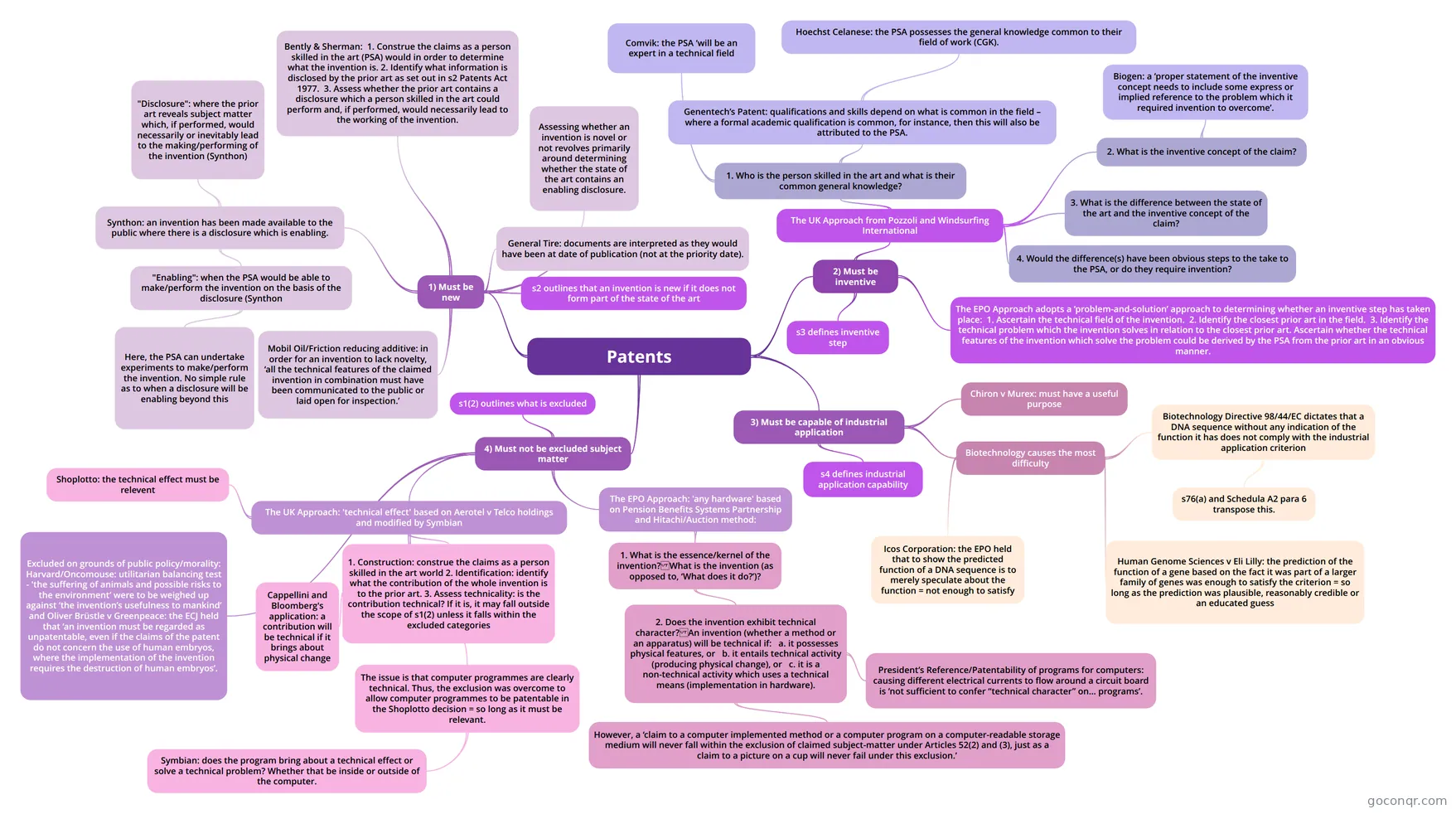
Mind map: Patents
Conteúdo do mapa
Patents
1) Must be new
- Bently & Sherman: 1. Construe the claims as a person skilled in the art (PSA) would in order to determine what the invention is. 2. Identify what information is disclosed by the prior art as set out in s2 Patents Act 1977. 3. Assess whether the prior art contains a disclosure which a person skilled in the art could perform and, if performed, would necessarily lead to the working of the invention.
- General Tire: documents are interpreted as they would have been at date of publication (not at the priority date).
- Assessing whether an invention is novel or not revolves primarily around determining whether the state of the art contains an enabling disclosure.
- Mobil Oil/Friction reducing additive: in order for an invention to lack novelty, ‘all the technical features of the claimed invention in combination must have been communicated to the public or laid open for inspection.’
- Synthon: an invention has been made available to the public where there is a disclosure which is enabling.
- "Disclosure": where the prior art reveals subject matter which, if performed, would necessarily or inevitably lead to the making/performing of the invention (Synthon)
- "Enabling": when the PSA would be able to make/perform the invention on the basis of the disclosure (Synthon
- Here, the PSA can undertake experiments to make/perform the invention. No simple rule as to when a disclosure will be enabling beyond this
- s2 outlines that an invention is new if it does not form part of the state of the art
2) Must be inventive
- s3 defines inventive step
- The UK Approach from Pozzoli and Windsurfing International
- 1. Who is the person skilled in the art and what is their common general knowledge?
- Comvik: the PSA ‘will be an expert in a technical field
- Genentech’s Patent: qualifications and skills depend on what is common in the field – where a formal academic qualification is common, for instance, then this will also be attributed to the PSA.
- Hoechst Celanese: the PSA possesses the general knowledge common to their field of work (CGK).
- 2. What is the inventive concept of the claim?
- Biogen: a ‘proper statement of the inventive concept needs to include some express or implied reference to the problem which it required invention to overcome’.
- 3. What is the difference between the state of the art and the inventive concept of the claim?
- 4. Would the difference(s) have been obvious steps to the take to the PSA, or do they require invention?
- 1. Who is the person skilled in the art and what is their common general knowledge?
- The EPO Approach adopts a ‘problem-and-solution’ approach to determining whether an inventive step has taken place: 1. Ascertain the technical field of the invention. 2. Identify the closest prior art in the field. 3. Identify the technical problem which the invention solves in relation to the closest prior art. Ascertain whether the technical features of the invention which solve the problem could be derived by the PSA from the prior art in an obvious manner.
3) Must be capable of industrial application
- s4 defines industrial application capability
- Chiron v Murex: must have a useful purpose
- Biotechnology causes the most difficulty
- Biotechnology Directive 98/44/EC dictates that a DNA sequence without any indication of the function it has does not comply with the industrial application criterion
- s76(a) and Schedula A2 para 6 transpose this.
- Icos Corporation: the EPO held that to show the predicted function of a DNA sequence is to merely speculate about the function = not enough to satisfy
- Human Genome Sciences v Eli Lilly: the prediction of the function of a gene based on the fact it was part of a larger family of genes was enough to satisfy the criterion = so long as the prediction was plausible, reasonably credible or an educated guess
- Biotechnology Directive 98/44/EC dictates that a DNA sequence without any indication of the function it has does not comply with the industrial application criterion
4) Must not be excluded subject matter
- s1(2) outlines what is excluded
- The EPO Approach: 'any hardware' based on Pension Benefits Systems Partnership and Hitachi/Auction method:
- 1. What is the essence/kernel of the invention? What is the invention (as opposed to, ‘What does it do?’)?
- 2. Does the invention exhibit technical character? An invention (whether a method or an apparatus) will be technical if: a. it possesses physical features, or b. it entails technical activity (producing physical change), or c. it is a non-technical activity which uses a technical means (implementation in hardware).
- President’s Reference/Patentability of programs for computers: causing different electrical currents to flow around a circuit board is ‘not sufficient to confer “technical character” on… programs’.
- However, a ‘claim to a computer implemented method or a computer program on a computer-readable storage medium will never fall within the exclusion of claimed subject-matter under Articles 52(2) and (3), just as a claim to a picture on a cup will never fail under this exclusion.’
- 2. Does the invention exhibit technical character? An invention (whether a method or an apparatus) will be technical if: a. it possesses physical features, or b. it entails technical activity (producing physical change), or c. it is a non-technical activity which uses a technical means (implementation in hardware).
- 1. What is the essence/kernel of the invention? What is the invention (as opposed to, ‘What does it do?’)?
- The UK Approach: 'technical effect' based on Aerotel v Telco holdings and modified by Symbian
- 1. Construction: construe the claims as a person skilled in the art world 2. Identification: identify what the contribution of the whole invention is to the prior art. 3. Assess technicality: is the contribution technical? If it is, it may fall outside the scope of s1(2) unless it falls within the excluded categories
- Cappellini and Bloomberg's application: a contribution will be technical if it brings about physical change
- Shoplotto: the technical effect must be relevent
- The issue is that computer programmes are clearly technical. Thus, the exclusion was overcome to allow computer programmes to be patentable in the Shoplotto decision = so long as it must be relevant.
- Symbian: does the program bring about a technical effect or solve a technical problem? Whether that be inside or outside of the computer.
- 1. Construction: construe the claims as a person skilled in the art world 2. Identification: identify what the contribution of the whole invention is to the prior art. 3. Assess technicality: is the contribution technical? If it is, it may fall outside the scope of s1(2) unless it falls within the excluded categories
- Excluded on grounds of public policy/morality: Harvard/Oncomouse: utilitarian balancing test - 'the suffering of animals and possible risks to the environment’ were to be weighed up against ‘the invention’s usefulness to mankind’ and Oliver Brüstle v Greenpeace: the ECJ held that ‘an invention must be regarded as unpatentable, even if the claims of the patent do not concern the use of human embryos, where the implementation of the invention requires the destruction of human embryos’.
Informações
- Descrição
- Intellectual Property (Patents) Mapa Mental sobre Patents, criado por Abi Simpson em 24-01-2019.
- Criado por
- Abi Simpson
- Visualizações
- 1
- Avaliação