
Mapa mental
MECHANISMS
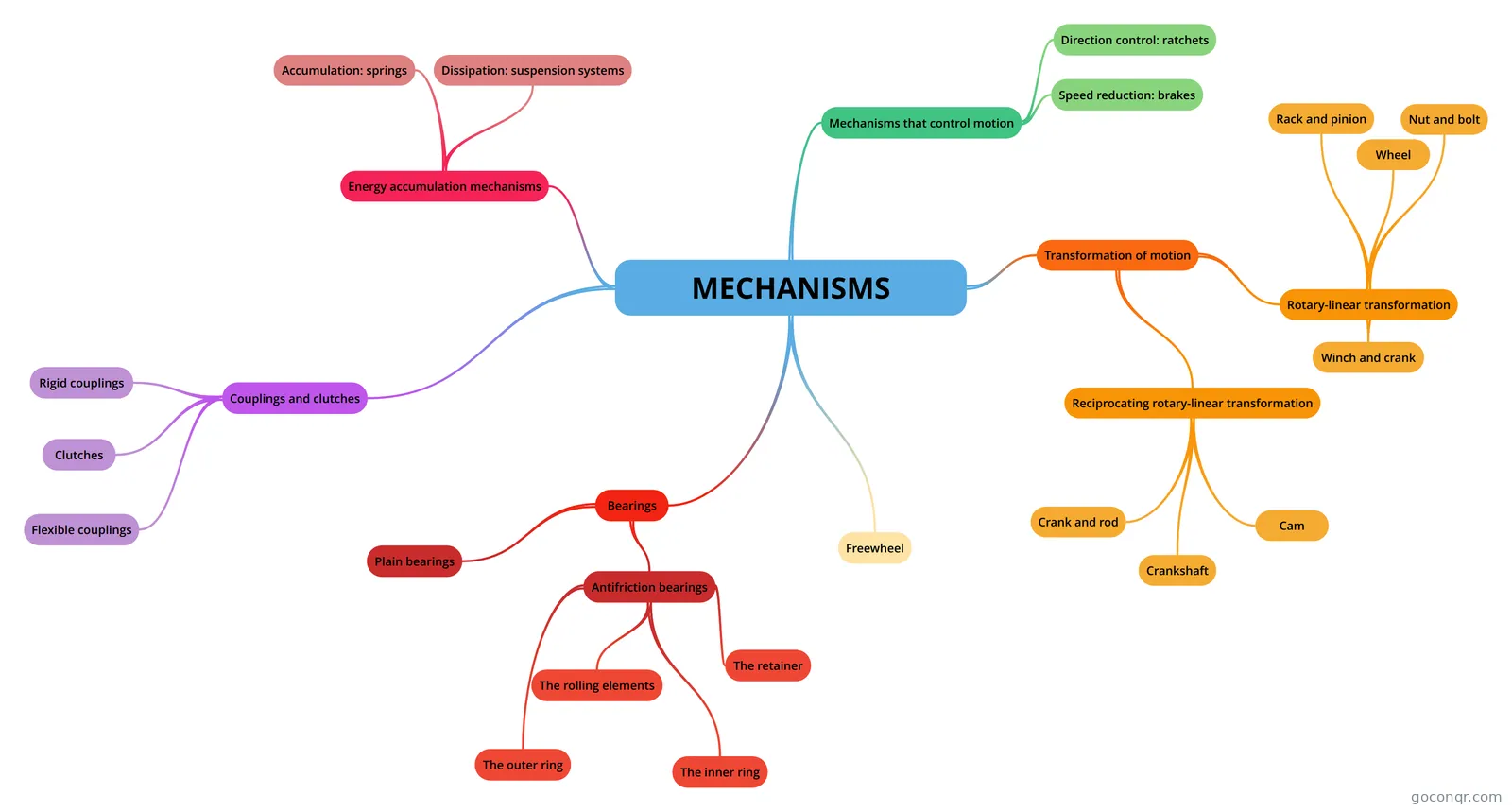
Mind map: mechanisms
Conteúdo do mapa
MECHANISMS
Transformation of motion
- Rotary-linear transformation
- Wheel
- Reduce the contact with the ground and drecrease friction. We need less force to move vehicles with larger wheels and they move more quickly.
- Rack and pinion
- TWO PARTS -Rack: a bar with many teeth.-Pinion: a gear with teeth interlock with the rackWe use this two parts for sliding doors and conveyor belts, etc.
- Nut and bolt
- TWO PARTS -Nut: we turn the bolt to make it forward -Bolt: we turn and tighten the nut in order to hold things together
- Winch and crank
- Is a cylinder that rotates around a horizontal axis. The crank increases the force and the winch transfoms rotary motion into linear. F x d= R x r
- Wheel
- Reciprocating rotary-linear transformation
- Crankshaft
- The rods are connected to cranks and they are connected to the crankshaft. This mechanisms can synchronise the movements of varius parts.
- Crank and rod
- Piston moves a rod forward and backward. We can find this mechanisms in internal combustion engines.
- Cam
- Is an irregulary shaped device that rotates on a shaft. When the cam rotates, it pushes a follower. We can put multiple cams on one shaft: synchronize the movements.
- Crankshaft
- Rotary-linear transformation
Mechanisms that control motion
- Direction control: ratchets
- Is a mechanisms that controls the direction of motion. Some ratchets are reversible. We can find ratchets in watches.
- Speed reduction: brakes
- Use friction to reduce speed. TYPES OF BRAKES -Disk brakes: brakes pads apply pressure to the disc. -Band brakes:A flexible band applies pressure to the outside of the drum. -Drum bakes: A pair of brake shoes apply pressure to the inside of the drum.
- Direction control: ratchets
Energy accumulation mechanisms
- Accumulation: springs
- Are flexible devices that absorb energy. Then we can release the energy. -Compression springs. -Traction springs. -Torsion springs.
- Dissipation: suspension systems
- This system makes driving more comfortable. -Shock absorbers: made with spiral steel springs -Leaf springs: made with long, curved pieces of steel of diferent lenghts and joined in the middle.
- Accumulation: springs
Couplings and clutches
- Clutches
- Form a rigid connection, isn't permanent. -Friction clutch -Jaw clutch
- Rigid couplings
- Form a permanent connection between two shafts.
- Flexible couplings
- Are also useful -Oldham coupling -Cardan joint(Universal joint)
- Clutches
Bearings
- -Plain bearings: are formed by two rings. -Antifriction bearings: are used in machines. -The inner ring: is in contact with the rotating shaft. -The outer ring:is connected to the rest of the mechanism. -The rolling elements: are cylindrical rollers or round balls -The retainer: keeps the rolling elements in position.
- Plain bearings
- -Plain bearings: are formed by two rings. Plain bearings are made of smooth materials.
- Antifriction bearings
- -Antifriction bearings: are used in machines.
- The outer ring
- -The outer ring:is connected to the rest of the mechanism.
- The rolling elements
- .-The rolling elements: are cylindrical rollers or round balls
- The inner ring
- -The inner ring: is in contact with the rotating shaft.
- The retainer
- The retainer: keeps the rolling elements in position.
Freewheel
- transmits motion in one direction, and turns freely in the opposite direction. Uses on bycicles
Informações
- Descrição
- First Certificate of Cambridge Tecnología Mapa Mental sobre MECHANISMS, criado por Esther Sierra em 12-02-2019.
- Criado por
- Esther Sierra
- Visualizações
- 1
- Histórico
-
- Criado por Esther Sierra · 12 fev 2019
- Copiado por Esther Sierra · 12 fev 2019
- Avaliação
Mais sobre Motion Transmission and Transformation