
Mapa mental
Chapter 2
Conteúdo do mapa
Chapter 2
resources are crucial to virtualization
- Processor
- Is in charge of coordinate the processor access by separate the gues systems.
- Memory
- Memory must be carefully managed to enable multiple guests to share a single set of physical memory without allowing separate guest systems to overwrite one another’s data
- Network
- There's a lot of data flowing back and forth it’s critical to ensure that each virtual system receives the appropriate network traffic.
- Storage
- Each virtual guest system must have its own data storage and the virtualization software must keep each guest system’s storage isolated.
- Processor
State
- The value that every resource has at a given moment of time, each of those values is stored in system memory. Virtualization should have the ability to save one guest’s state and restore another guest’s state, each guest system needs to have its state in system memory
Virtualizing Memory
- This in an illusion, virtual memory let a system with a limited amount of physical memory look much larger to application software
Allocating memory the old way
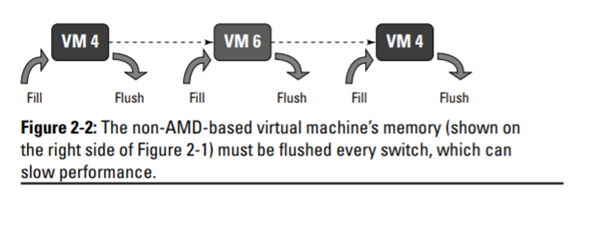
- OS it can only assign unique task IDs, so multiple VM(virtual machine) can have the same ID, there's a simple solution the hypervisor flushes the TLB every time it switch from one VM to another.
A better way for allocate memory
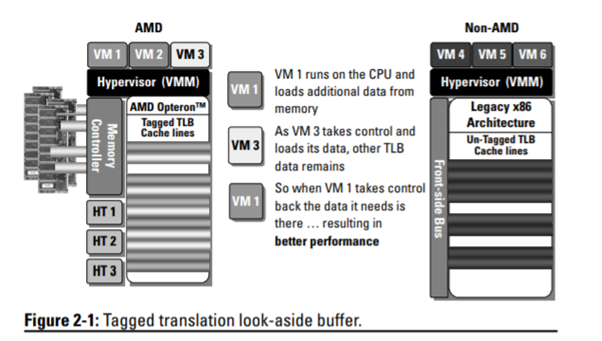
- Add a new tag to the VM specific space that identify the TLBs, this is know as TLBs: translation look-aside buffers, is a memory cache that is used to access a memory location. Each VM has a unique ASID value, known only to the hypervisor and the TLB hardware. The ASID is invisible to the guest OS.
- Shadow Page Tables: This is what connect VM to the actual hardware from memory standpoint, it is map from that Guest physical memory to the actual physical memory plugged into the system (also called Host physical memory).
- Virtualized Page Tables: Modern CPU architects developed, that translate all the way from virtual memory to Guest physical memory to Host physical memory. But unlike Shadow Page Tables, which perform the same function in software, Virtualized Page Tables are built directly into the CPU. this is know as AMD-V
- Add a new tag to the VM specific space that identify the TLBs, this is know as TLBs: translation look-aside buffers, is a memory cache that is used to access a memory location. Each VM has a unique ASID value, known only to the hypervisor and the TLB hardware. The ASID is invisible to the guest OS.
Imagens e arquivos do mapa
Informações
- Descrição
- Mapa Mental sobre Chapter 2, criado por Leonardo Mata Mora em 17-02-2019.
- Criado por
- Leonardo Mata Mora
- Visualizações
- 0
- Avaliação