
1752808
Descrição

Mapa Mental por Fahima Noori, atualizado more than 1 year ago

|
Criado por Fahima Noori
aproximadamente 11 anos atrás
|
|
Management
- As Process
- Social Process, where people is the focus point
- Integrating process - bring harmony between various factors
- Continuous process - constantly identifying the problem and solving them
- George R. Terry
- Social Process, where people is the focus point
- As Activity
- Koontz
- Informational activities - receive and give information
- Decisional activities - all activities is based on decisions
- Inter-personal activities - maintain good relationship with superiors as well as sub-ordinates
- Koontz
- As Disciplin
- It specifies certain code of conduct to be followed by the manager & also various methods for
managing resources efficiently.
- It specifies certain code of conduct to be followed by the manager & also various methods for
managing resources efficiently.
- As Group
- As Science
- Universally acceptance principles
- Experimentation and Observation - Henry Foyal
- Cause and Effect Relationship
- Test of validity and predictability
- Human beings is very hard to predict.
Anotações:
- The main reason for the inexactness of science of management is that it deals with human beings and it is very difficult to predict their behavior accurately.
- Universally acceptance principles
- As Art
- Practical Knowledge
- Personal Skill
- Creativity
- Perfection though practice
- Goal Oriented
- Practical Knowledge
- As Profession
- Specialized Knowledge
- Formal Education and training
- Social Obligation
- Code of Conduct
- Specialized Knowledge
- "Managers are made" >< "Managers are born"
Anotações:
- Manager must have the knowledge of the science and applying is the art. Science is the root and art is the fruit.
- Features :
- Goal-Oriented
- Integrates human, physical and financial resources (Harmony)
- On-going process- Continuous handling of problems and issues
- Universal. wherever more than one personal is engaged on common goal - management is required.
- Group Activity.
- Group Activity.
- Goal-Oriented
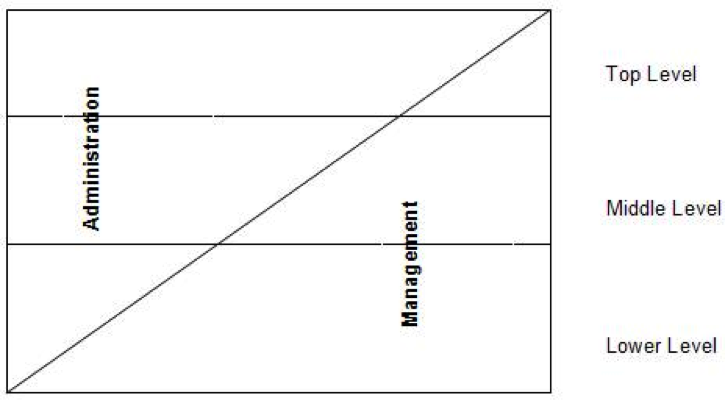
- Levels
- Top: board of directors, chief executive or managing director.
- The branch managers and departmental managers constitute middle level.
- Lower level is also known as supervisory / operative level of management. It consists of
supervisors, foreman, section officers, superintendent etc.
- the managers who are higher up in the hierarchy denote more time on
administrative function & the lower level denote more time on directing and
controlling worker’s performance i.e. management.
- Top: board of directors, chief executive or managing director.
- Objectives:
- 1. Getting Maximum Results with Minimum Efforts
- 2. Increasing the Efficiency of factors of Production
- 3. Maximum Prosperity for Employer & Employees
- 4. Human betterment & Social Justice
- 1. Getting Maximum Results with Minimum Efforts
- Management is an art of getting things done through others by directing their efforts towards
achievement of pre-determined goals.
- Management vs Adminstration
- Management is an art of getting things done through others by directing
their efforts towards achievement of pre-determined goals.
- It is concerned with formulation of broad objectives, plans & policies.
- Is an executing function.
- Is a decision-making function.
- Decides who should do it & how should he should do it.
- Decides what is to be done & when it is to be done.
- Technical and Human skills
- Conceptual and Human skills
- Middel and lower level
- Top level
- It is applicable to business concerns i.e. profit-making organization.
- It is applicable to non-business concerns i.e. clubs, schools, hospitals etc.
- decisions are influenced by the values, opinions, beliefs & decisions of the
managers.
- The administration is influenced by public opinion, govt. policies, religious
organizations, customs etc.
- Management is an art of getting things done through others by directing
their efforts towards achievement of pre-determined goals.
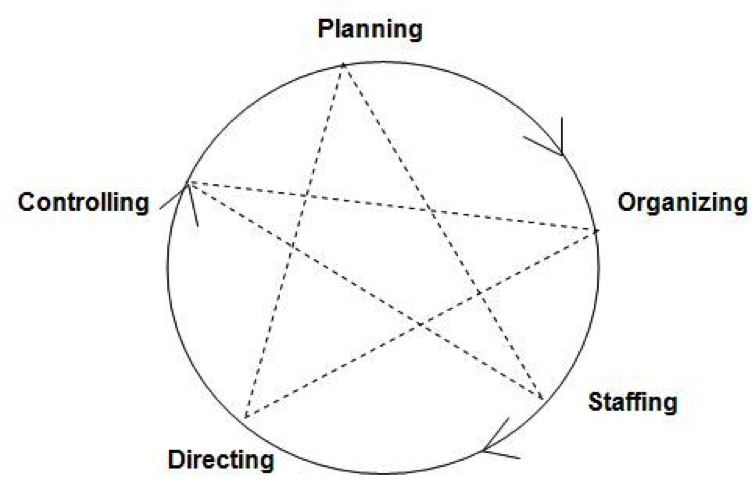
- Functions
- Planning- A plan is a future course of actions.
- Organizing - determining & providing human and non-human
resources to the organizational structure
- Staffing : right man to the right job
- Directing: Supervision, motivation, leadership and communication
- Controlling : measurement of accomplishment against the standards and
correction of deviation if any to ensure achievement of organizational
goals
- Planning- A plan is a future course of actions.
- Principles of Management
- Principles are universal
- Is flexiable
- Have a cause and Effect relationship
- Aims at influencing Human Behavior
- Principles are universal
- Both applied scientific method to this problem that Taylor worked primarily from operative level, from
bottom to upward, while Fayol concentrated on managing director and work downwards, was merely a
reflection of their very different careers
Anexos de mídia
Quer criar seus próprios Mapas Mentais gratuitos com a GoConqr? Saiba mais.