
Mapa mental
P4: Explaining Motion
Conteúdo do mapa
P4: Explaining Motion
Forces & Newton's Third Law
- A force is a push or a pull on an object.
- Normal Contact Forces
- The 'push' forces that 2 touching objects will exert on each other.
- Gravitational
- Attractive forces between the Earth and Sun.
- Electrostatic
- Attraction or repulsion of charges when their electric fields interact
- Magnetic
- Attraction or repulsion between two magnets due to their magnetic fields.
- Normal Contact Forces
- Third Law
- When two objects interact, the forces exert on each other so they are equal and opposite
- When 2 objects interact, both feel a force (interaction force), which can be shown with a pair of vectors (arrows showing the relative size and direction of the forces). The forces that make up the pair are the same type of force and same size, but they go in opposite direction.
- A force is a push or a pull on an object.
Equations
- Weight (N) = Mass (kg) x Gravitational Field Strength (N/kg)
- Average Speed (m/s) = Distance (m) / Time (s)
- Acceleration (m/s2) = Change in Speed (m/s) / Time Taken (s)
- Momentum (kg m/s) = Mass (kg) x Velocity (m/s)
- Change of Momentum (kg m/s) = Resultant Force (N) x Time for which it acts (s)
- Force (N) = Mass (kg) x Acceleration (m/s2)
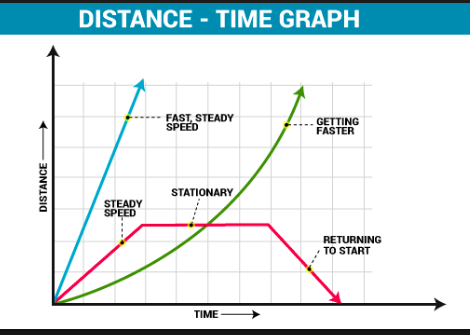
Distance-Time Graphs
- Average Speed = Gradient = Change in the Vertical / Change in the Horizontal
Newton's First Law & Circular Motion
- First law says that a resultant force is needed to change the motion of an object. If the resultant force on a moving object is 0, it will carry on moving at a constant speed.
- If an object travels in a circle and constantly changing direction then a resultant force is acting on the object. This force always acts towards the centre of the circle and is perpendicular to the line of motion of the object. So the object never changes speed but the velocity is constantly changing. E.G. planets orbiting the Sun.
Vehicle Safety
- Seat Belts
- Designed to stretch slightly, slows people down over a long period of time during a crash.
- Air Bags
- Passengers hit the air bag instead of the dashboard in a crash.
- Crumple Zones
- Areas on the front and back of a car which increases the time taken for the whole car to stop and reduces the forces on the car.
- Safety Helmets
- Contains a crushable layer of foam, so in a crash, the foam is compressed which will reduce the force on a cyclist's head.
- Seat Belts
Equations
- Work Done (Nm or J) = Force (N) x Distance (m)
- Gravitational Potential Energy (J) = Mass (kg) x Gravitational field Strength (N/kg) x Height (m)
- Kinetic Energy (J) = 0.5 x Mass (kg) x (Speed)2 (m/s)2
- Power (W) = Energy Transferred (J) / Time (s)
Imagens e arquivos do mapa
Informações
- Descrição
- GCSE Core Science Mapa Mental sobre P4: Explaining Motion, criado por Blerta Morina em 24-04-2019.
- Criado por
- Blerta Morina
- Visualizações
- 9
- Tags
- Avaliação