
Mapa mental
Sentence Processing
Conteúdo do mapa
Sentence Processing
What is Syntax?
- Rules which govern sentence structure
- Noun phrase: "the man"
- Verb phrase: "saw the man"
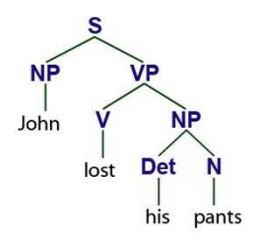
- Tree Diagrams
- Each sentence can be broken down to smaller constituents (nodes)
- Nodes are connected via branches
- Rules which govern sentence structure
Syntatic Ambiguity
- A sentence may have more than one interpretation
- Global Ambiguity
- The ambiguity can never be solved by reading
- "the spy saw the cop with the binoculars"
- Temporary Ambiguity
- The correct interpretation is found by the end of the sentence
- "while Anna dressed the baby threw up"
- Temporal ambiguous noun phrase
- Disamiguating verb phrase
Theories of Parsing
- Garden Path
- Frazier (1970s & 1980s)
- Only one syntatic structure is initially considered
- Sentence meaning is not involved in selection of structure
- Simplest structure is chosen
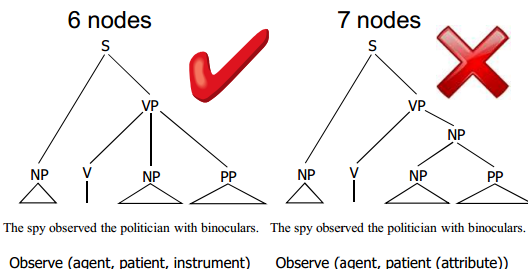
- Minimal Attachment
- You build the simplest tree (fewer nodes)
- So the spy would have the binoculars
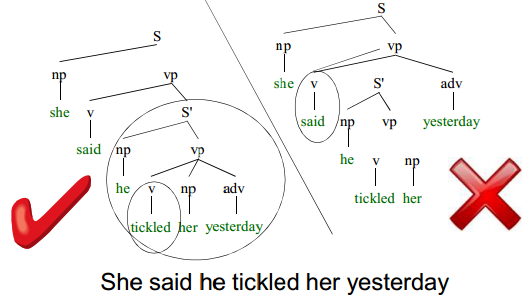
- Late Closure
- Attach the ambiguous word to the most recent constituent
- Easier on working memory
- Minimal Attachment
- Frazier (1970s & 1980s)
- Constraint Satisfaction
- MacDonald et al. (1994)
- All possible trees are accessed
- Competing sentence structures are activated simultaneously
- Tree with most sense = most activation = chosen
- All relevant information immediately available
- Constraints
- Context
- Plausability
- General world knowledge
- Verb bias
- MacDonald et al. (1994)
- Unrestricted Race Model
- Van Gompel, Pickering & Traxler (2000)
- Combines features of garden path and constraint satisfaction
- All sources of info are used to identify a structure
- All other possible structures are ignored
- Unless the favoured structure is disconfirmed by subsequent info
- If the initially chosen structure has to be discarded
- There is an extensive process of re-analysis before a different structure is chosen
- Van Gompel, Pickering & Traxler (2000)
- Garden Path
Theories of FIgurative Language Process
- Standard Pragmatic View
- Irony
- Literal meaning is accessed first
- Mismatch with context detected
- Utterence re-analysed as being ironic
- Mismatch with context detected
- Direct Access View
- Irony
- Ironic meaning can be accessed without accessing literal meaning first
- No additional processing cost for ironic language compared to literal
- Graded Salience Hypothesis
- Ironic meaning accessed straight away for highly familiar ironies
- Literal meaning accessed first, then reanalysis, for unfamiliar
- Ironic meaning accessed straight away for highly familiar ironies
- Context & Knowledge
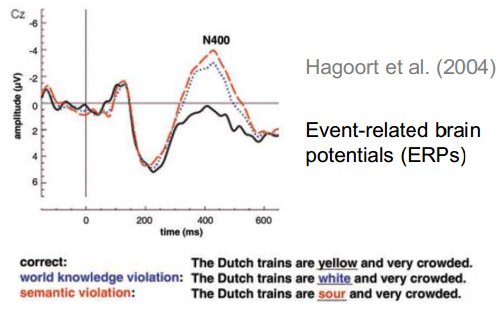
- Hagoort et al. (2004)
- Use EPRs when pps reading
- N400 = spike = word doesnt make sense
- We can decide within 400ms if no sense
- Correct sentence
- No spike as word makes sense fits within context
- World knowledge violation
- 400 ms = spike = no sense
- Semantic violation
- Similar effect, no context relation
- Hagoort et al. (2004)
- Standard Pragmatic View
Imagens e arquivos do mapa
Informações
- Descrição
- Mapa Mental sobre Sentence Processing, criado por alissaburrows em 08-01-2015.
- Criado por
- alissaburrows · jan 2015
- Atualizado
- 19 fev 2016
- Visualizações
- 2
- Avaliação