
Mapa mental
C4: The Periodic Table
Conteúdo do mapa
C4: The Periodic Table
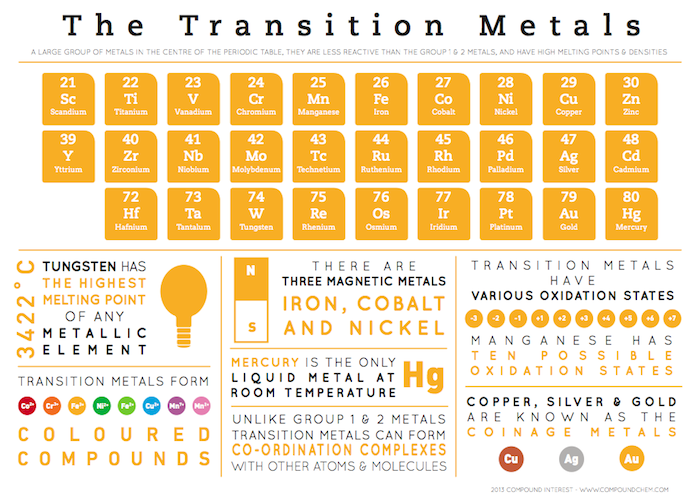
C4f: Transition Elements
- Copper compounds are blue
- iron (ll) compounds are light green
- iron(lll) compounds are orange brown
- Thermal decompostion
- is a reaction where a substance is broken down into two or more substances by heating
- When transition metal carbonates are heated a colour change happens
- They decompose to form a metal oxide and carbon dioxide
- copper(ll) carbonate = copper(ll) oxide + carbon dioxide
- CuCO3 = CuO + CO2
- Precipatation
- Is the reaction between solutions that makes an insoluble solid
- The insoluble solid is known as a Precipitate
- Copper(ll) = Blue
- Cu2+ + 2OH- = Cu(OH)2
- Is the reaction between solutions that makes an insoluble solid
- Lime water = milky CO2
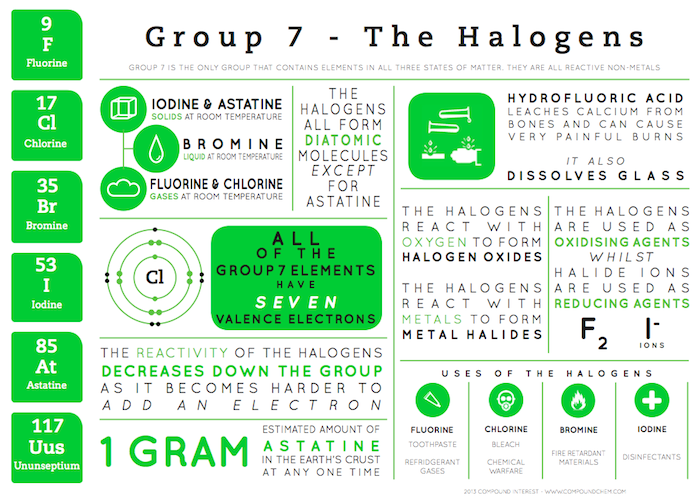
C4e: The Group 7 Elements
- Chlorine
- Green gas at room Temperature
- Uses: To sterilise water, make pesticides and plastics
- Bromine
- Orange solid at room temperature
- Iodine
- Grey solid at room temperture
- Used as an antiseptic
- Halogens react vigorously with alkali metals to form halides
- Lithium + Chlorine = Lithium Chloride
- 2Li (s) + Cl (g) = 2LiCl (s)
- Displacement Reactions
- Chlorine will displace bromides and iodides
- Bromine will displace iodides
- Potassium bromide + chlorine = potassium chloride + bromine
- 2KBr + Cl2 = 2KCl + Br2
- Group 7 atoms gain one electron to form a negative ion with a stable structure
- Reduction is the reaction that takes place: eg
- F2 + 2e- = 2f-
- Reduction is the reaction that takes place: eg
- Chlorine
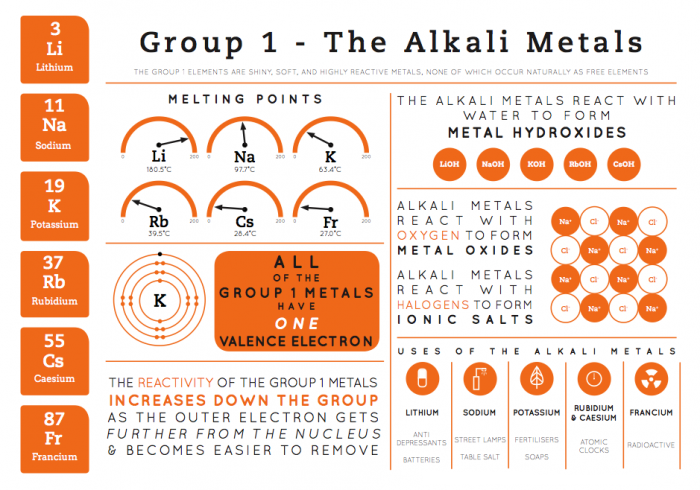
C4d: The Group 1 Elements
- These are all Alkali Metals
- They have to be stored under Oil because they:
- React with Air
- React Vigourously with water
- Alkali Metals react with a metal to produce a hydrogen and a hydroxide
- 2Li (s) + 2H2O (l) =2LiOH (aq) + H2 (g)
- Lithium reacts gently, Sodium reacts more violently, Potassium reacts even more violently
- Flame Tests
- 1. A piece of nichrome wire is dipped in water
- 2. The wire is dipped in a solid compound then put into a Bunsen flame
- 3. Each compound will produce a different coloured flame
- Lithium = red
- Sodium = Yellow
- Potassium = Lilac
- Group 1 metals all lose one electron so a positive ion is made
- Oxidation is the reaction that takes place: eg
- Li = Li+ + e-
- Oxidation is the reaction that takes place: eg
C4c: The Periodic table & Covalent Bonding
- Groups are columns
- Periods are rows
- The electronic structure is 2.8.8.2
- 3 Types of Bonding
- Metallic = metals only
- Ionic = Metals and non metals
- Covalent = non metals
- Covalent Bonding
- Non metals sharing electrons
- Water
- Is liquid at room temperature
- low melting point
- Carbon Dioxide
- Gas at room temperature
- low melting point
- Simple bonded molecules have low melting points because they have weak intermolecular forces
- No conducted electricity because there are no free electrons
- Molecules
- Hydrogen = two hydrogen atoms share a pair of electrons
- Methane= carbon atom shares a pair of electrons with 4 hydrogen atoms
- Mendeleev made the periodic table - but left gaps for unknown elements
C4b: Ionic Bonding
- Ion is a charged atom
- Positive ion is made when an atom loses an electron
- Negative ion is when an atom gains an electron
- Ionic Bonding
- 1. metal atom loses all outer shell electrons to become a positive ion
- 2. non-metal atom gains electrons to fill its outer shell and become a negative ion
- 3. positive and negative ions are attracted to each other (ionic bond)
- Structure
- Giant ionic lattices
- Positive and negative ions strongly attracted to each other
- Properties
- High melting points
- can conduct electricity when molten
- can't conduct electricity when solid
- Ions with different charges make ion compounds which have equal amounts of positive an d negative charge
C4a: Atomic Structure
- Structure
- Electron (-1) around the nucleus
- Protons (+1) in the nucleus
- Neutrons (0) in the nucleus
- Mass Number = total protons and neutrons
- Atomic Number = total protons
- Isotopes
- Atoms of the same element same atomic number but different mass number
- Different number of neutrons
- Same number of protons and electrons
- Electronic configuration
- 2.8.8.2
- Structure
C4h: Purifying and Testing Water
- Uses of Water
- Coolent
- Solvent
- Raw material
- Water treatment
- 1. Sedimentation - the insoluble particles sink
- 2. Filtration to remove fine particles
- 3. Chlorination - to kill microorganisms
- Tap water isn't pure - it must be distilled but that is expensive and uses a lot of energy
- Pollutants in water
- Nitrates from run off fertilisers
- Lead compounds from old pipes in the plumbing
- Pesticides from spraying crops near water supplis
- Dissolved Ions
- Silver nitrate used to detect halide ions
- Bromides = cream precipitate
- Sodium sulfate + barium chloride = barium sulfate + sodium chloride
- Na2SO4 + BaCl2 = BaSO4 + 2NaCl
- Iodides = pale yellow precipitate
- Chlorides = white precipitate
- Bromides = cream precipitate
- Silver nitrate used to detect halide ions
- Uses of Water
C4g: Metal Structure and properties
- Transitional Metals
- Iron is used to make steel
- Copper is used to make electrical wiring
- Lustrous: Jewellery
- Hard + High Density: Drill Bits
- High Tensile Strength: Bridges
- Conducters of heat + electricity
- Structure
- High melting points
- High boiling points
- Lots of energy needed to break bonds
- Positive metal ions in a sea of delocalised electrons
- Held together by metallic bonds
- Superconductors
- Metals are able to conduct electricity because electrons flow easily through them
- At -200 degrees some metals can become superconductors
- It has no resistant to the flow of electricity
- Used for:
- Powerful elctromagnets
- Very fast electronic circuits
- Power transmission that doesn't lose energy
- Costly to maintain temperture
- Transitional Metals
Imagens e arquivos do mapa
Informações
- Descrição
- Mapa Mental sobre C4: The Periodic Table, criado por PoppyOliver em 10-01-2015.
- Criado por
- PoppyOliver
- Visualizações
- 19
- Avaliação