
The Periodic Table
355 resources created by 305 users
This Chemistry page on GoConqr gathers community-made mind maps, quizzes, flashcards and notes on The Periodic Table, from the history of the table and Mendeleev to the alkali metals, the halogens, periodic trends and transition metals. It's built for school students revising a topic and teachers after ready-made material. There are over 2,300 resources here, including more than 160 quizzes, over 1,200 mind maps and more than 800 flashcards, mostly at secondary level. Pick a group or trend, try a quiz, then see what you remember.
Top The Periodic Table resources
-
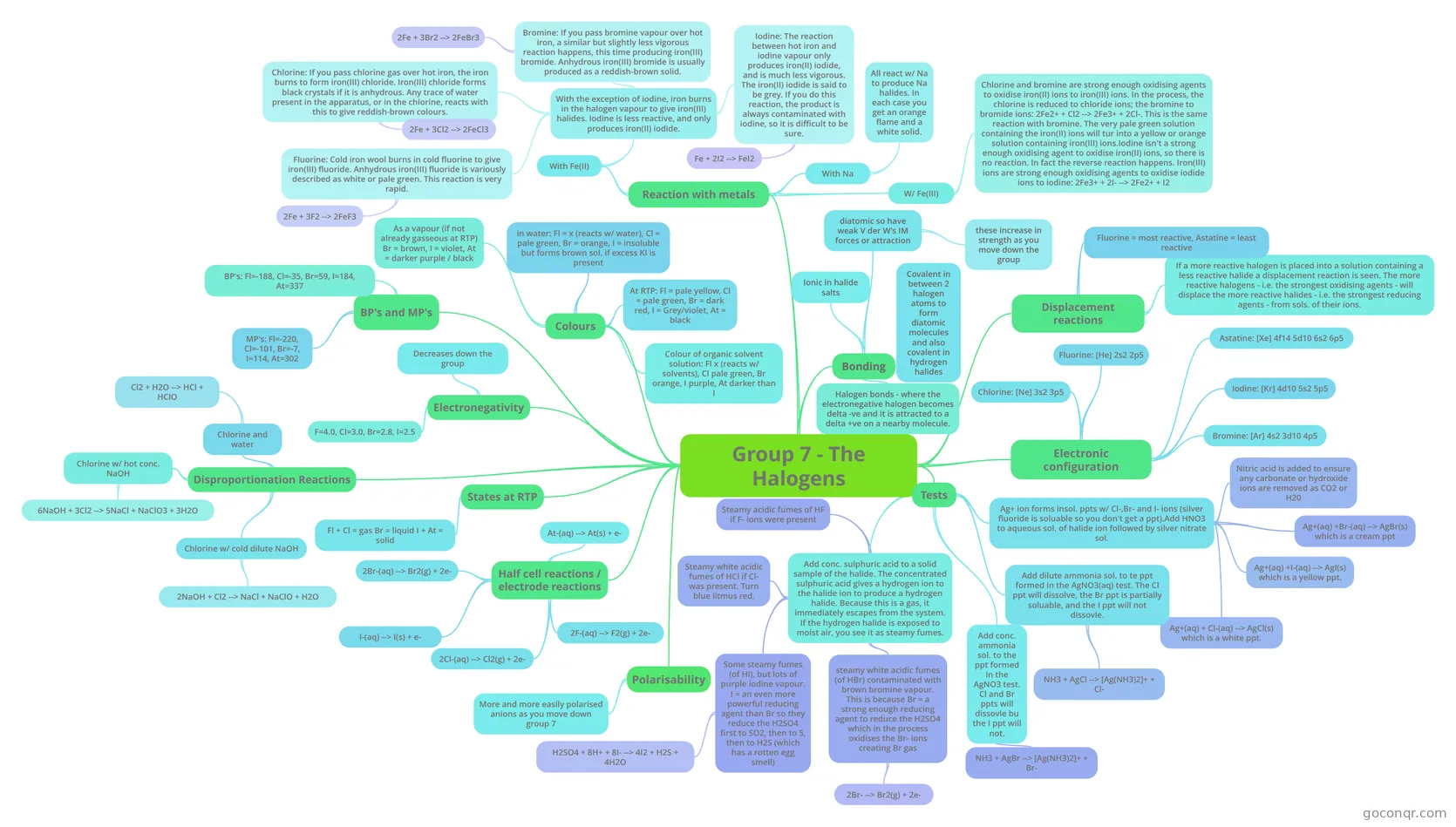 Mind map Group 7 - The Halogens Everything there is to now about halogens
-
Mind map Periodicity Summary mind map of all the important aspects of the Periodicity in IB Chemistry; both Standard Level and H...
-
41 cardsAQA Chem C2 GCSE AQA Chemistry (C2) CGSE Student checklist.
-
104 cardschemistry revision-year 9 C1 - Atomic Structure & the Periodic Table C2 - Bonding, Structure, & Properties of Matter C3 - Quantitativ...
-
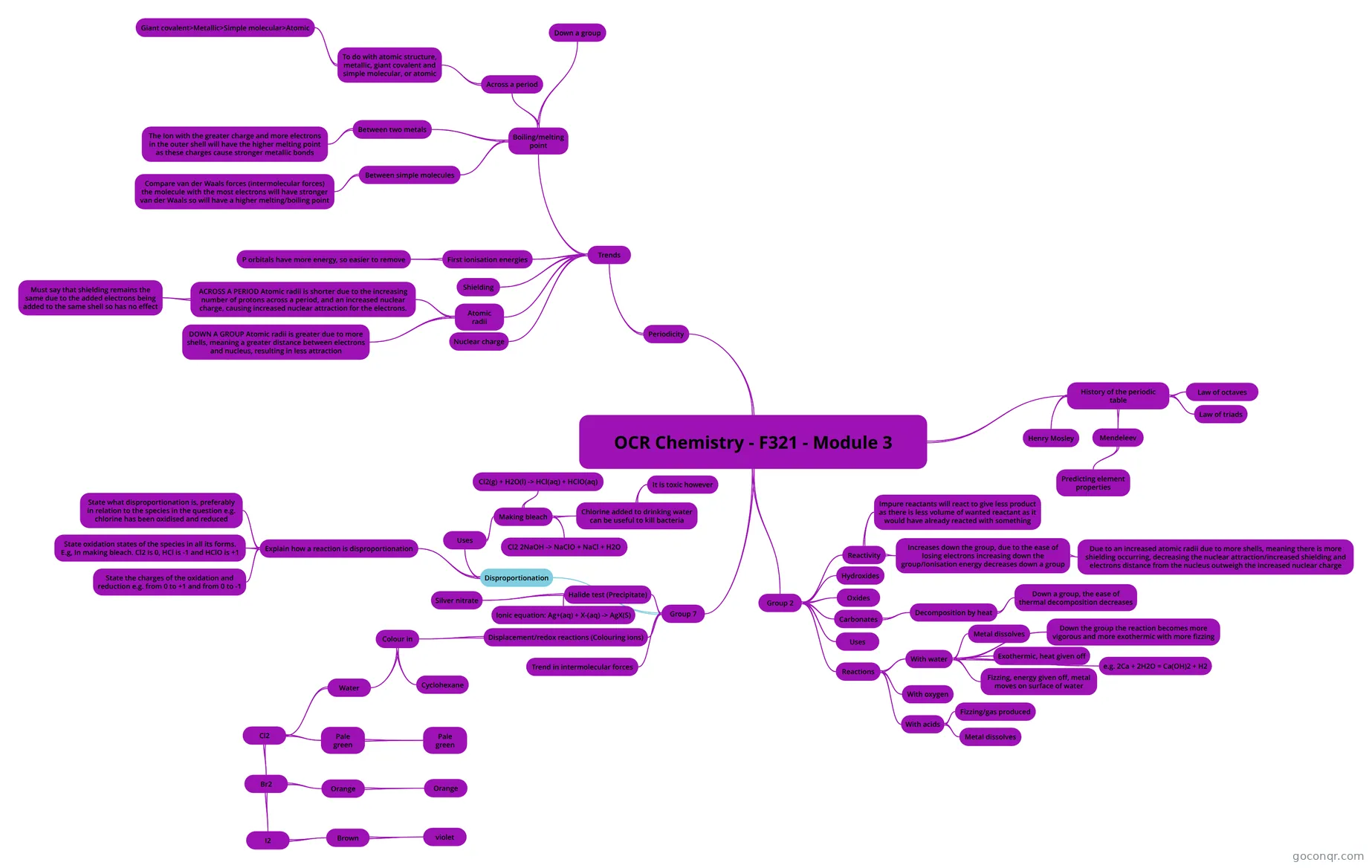 Mind map OCR Chemistry - F321 - Module 3
-
Mind map OCR 21st Century C4
-
22 questionsC4 Quiz An element contains all the same type of atoms.
-
Mind map The periodic table and its development
Quizzes
See all 59 quizzes-
22 questionsC4 Quiz An element contains all the same type of atoms.
-
15 questionsOCR As level Chemistry- Periodicity Chapter 7 Chemistry- periodicity
-
10 questionsPeriodic Table Chemistry Quiz Alkali metals all exist as diatomic molecules
-
10 questionsThe Periodic Table Which statement about elements is correct?
-
32 questionsChemistry for gateway unit #4 to help study for test
-
20 questionsPeriodic Table - First 20 Elements By Atomic Number What is the 4th element?
-
15 questionsPeriod Table Elements 1-15 What is the first Element in the Periodic Table?
-
9 questionsElement Group: Halogens Halogens are found in Group 16, Periods 2-4 of the Periodic Table.
Mind maps
See all 119 mind maps-
Group 7 - The Halogens Everything there is to now about halogens
-
Periodicity Summary mind map of all the important aspects of the Periodicity in IB Chemistry; both Standard Level and H...
-
OCR Chemistry - F321 - Module 3
-
OCR 21st Century C4
-
The periodic table and its development
-
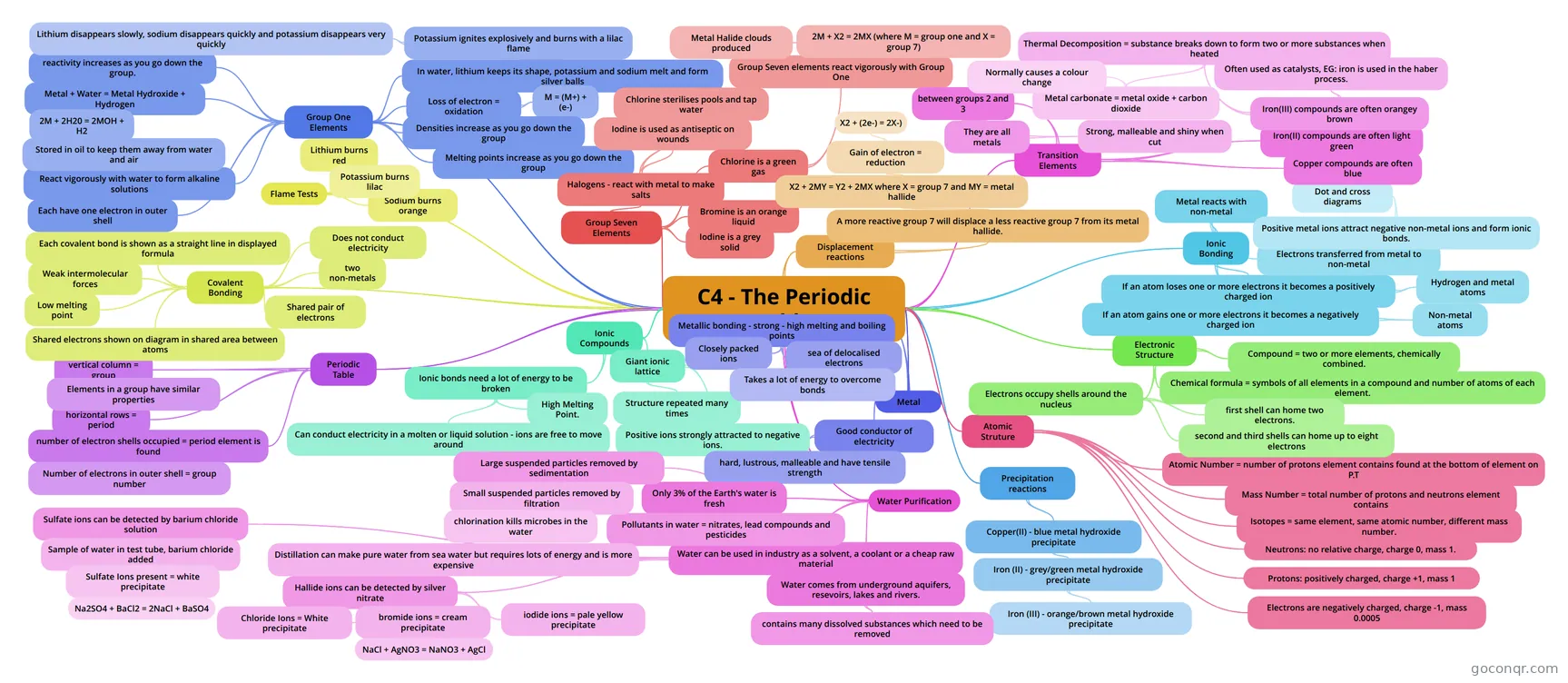 C4 - The Periodic Table
-
science revision yr 8 revision for the periodic table
-
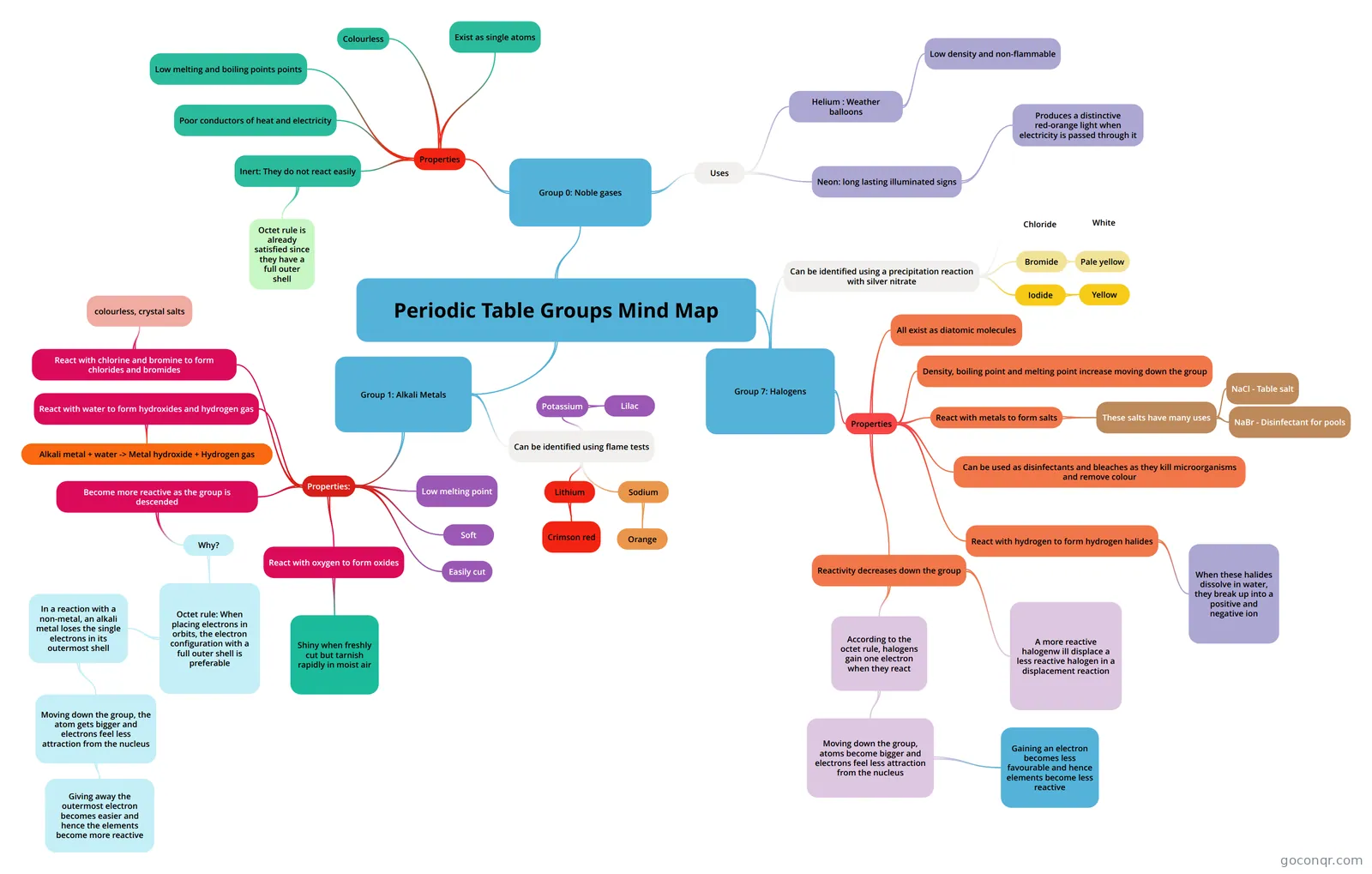 Periodic Table Groups Mind Map We begin our learning series on the Periodic Table with this overview mind map which presents Groups 0,1 an...
Flashcards
See all 139 flashcards-
41 cardsAQA Chem C2 GCSE AQA Chemistry (C2) CGSE Student checklist.
-
104 cardschemistry revision-year 9 C1 - Atomic Structure & the Periodic Table C2 - Bonding, Structure, & Properties of Matter C3 - Quantitativ...
-
26 cardsGroup 7 Halogens What are the 5 group 7 halogen molecules? Give a description of the first four at room temperature
-
10 cardsIB Chemistry - Topic 3: Periodicity (KEY TERMS) The Periodic Table
-
5 cardsTrends across period 3 Trends in melting and boiling point across period 3
-
20 cardsThe First 20 Elements On The Periodic Table Test on names and symbols
-
10 cardsMCAT Chemistry: Periodic Table Practicing parts of the periodic table in preparation for the MCAT medical test.
-
7 cardsThe Periodic Table
Notes
See all 32 notes-
The Early Periodic Table C3.1 By the 1860's over 50 elements had been discovered. So scientists attempted to sort the elements into a logical sequence. There were two main scientists that contributed to sorting the elements. These were, ...
-
Group 7 - Halogens Group 7 elements are known as 'Halogens' Group 7 is made up of fluorine, chlorine, bromine, iodine and astatine All Group 7 elements have 7 electrons in their outer shell so they all react by gaining one electron to f...
-
Group 1 - Alkali metals Group 1 metals are known as the 'alkali metals'. Group 1 metals include lithium, sodium and potassium. As you go down group 1, the alkali metals become more reactive - the outer electron is more easily lost beca...
-
Groups of the periodic table- Halogens The halogens or halogen elements are a group in the periodic table consisting of five chemically related elements, fluorine (F), chlorine (Cl), bromine (Br), iodine (I), and astatine (At). In the modern IUPAC nomencla...
-
Periodic table continued The Periodic Table first desgined by Mendeleev is arranged in a specific style to suit the increasing atomic mass (which is arranged in periods) and similar properties (which are put in groups)We call the vertical col...
-
Elements and isotopes There are about 100 elements which all materials are made of. More are still being 'discovered'. It is laid out so that elements with similar properties form columns. The modern periodic table shows the elements in or...
-
Baron's AP CHEM 2013 Important ConceptsPeriodic TableAtomic SymbolsAtomic Masses Atomic Numbers Isotope Masses, Mass Number Metals, Nonmetals, and Metalloids Ionization Energy Electron Affinity Diagonal Variation of Physical Properties Io...
-
Elements and the periodic table Chemistry is the area of science that deals with what materials are made of, and with the changes materials undergo. Elements cannot be broken down chemically into simpler substances, compunds can as they consist of t...
Slides
More Chemistry topics
About The Periodic Table
GoConqr OriginalWhat the resources cover
The unit spans the whole route through the periodic table. Early resources look at how the table developed: the mind map History of the Periodic Table explains that in the early 1800s chemists could only use atomic mass, with no idea of atomic structure. The MENDELEEV mind map follows on from there. Then come the groups: Group 1, Group 2, Group 7 and the transition metals, each with mind maps, notes and flashcards.
Trends and periodicity
Several mind maps pull the trends together. Periodic Trends covers electronegativity, ionic radius, first ionisation energy and atomic radius. Periodicity goes further, with trends across Period 3, oxides, chlorides, complexes, coloured compounds and variable oxidation states. Flashcard decks such as Trends across period 3 help with the key terms.
Where to start
- Begin with The Periodic Table mind map or the notes on the early periodic table to get the overall layout.
- Move to a single group, such as the Group 1 - Alkali metals mind map, then Group 7 - The Halogens.
- Turn to Periodic Trends once the groups feel familiar.
- Finish with the transition metals and periodicity maps if your course goes that far.
Using quizzes and maps together
Read a mind map first, then close it and take a quiz on the same topic. Quizzes such as The First 20 Elements Quiz, Halogens and Group 2 Elements show quickly which branches you skipped. Go back to the map for those and check again. The listed resources mention GCSE, IGCSE, A-level and IB courses, so check which matches yours.
Where it fits
This unit sits in the strand Atoms, Bonding and the Periodic Table, within Chemistry. Teachers can use the ready-made slide sets and maps in lessons. Choose one resource today and see how far you get.
Frequently asked questions
Which resource should I open first?
Start with the mind map called The Periodic Table or the notes on the early periodic table. They give you the overall layout. After that, pick a group, such as the Group 1 - Alkali metals mind map, and work towards the trends.
What do the mind maps on this page cover?
They cover the history of the table, Mendeleev, Group 1, Group 2, Group 7, transition metals and periodic trends. The Periodicity mind map goes further, with Period 3 trends, oxides, chlorides, complexes and coloured compounds.
Are these resources free to use?
Yes. Every resource listed here is free to open, study and take, with no account needed. A free account also saves your quiz scores and lets you make your own quizzes, mind maps, flashcards and notes.
Which exams do the resources suit?
The listed resources mention GCSE Chemistry, AQA GCSE Chemistry, IGCSE Chemistry, A-level Chemistry and IB Chemistry, along with a few others such as MCAT. Nearly all of the material is at secondary level.
Who made these resources?
They were made by GoConqr users, not by GoConqr itself. That means styles and depth vary, so it helps to compare a mind map, a set of notes and a quiz on the same topic.
Is there something for learning the first elements?
Yes. There are several quizzes and flashcard decks on the first 20 elements, including The First 20 Elements On The Periodic Table, plus a quiz on elements 1-36 and one on symbol abbreviations.