
Mapa mental
Chapter 5: Ethernet
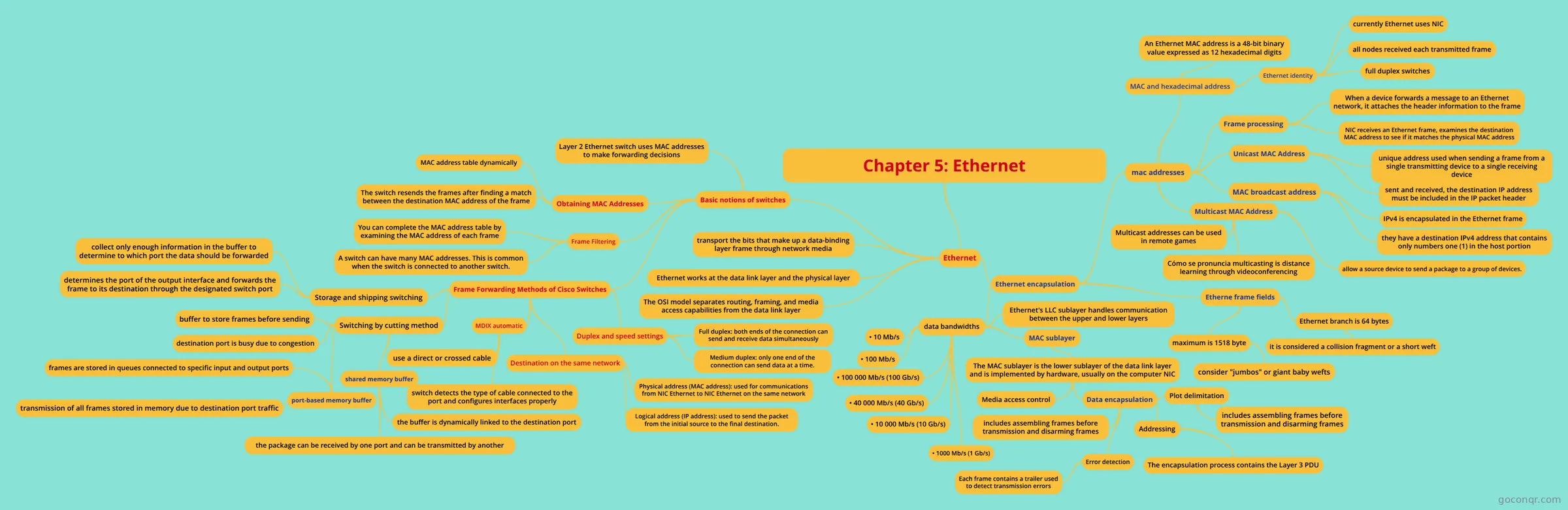
Mind map: Ethernet
Conteúdo do mapa
Chapter 5: Ethernet
Ethernet
- transport the bits that make up a data-binding layer frame through network media
- Ethernet works at the data link layer and the physical layer
- The OSI model separates routing, framing, and media access capabilities from the data link layer
- Ethernet encapsulation
- data bandwidths
- • 10 Mb/s
- • 100 Mb/s
- • 1000 Mb/s (1 Gb/s)
- • 10 000 Mb/s (10 Gb/s)
- • 40 000 Mb/s (40 Gb/s)
- • 100 000 Mb/s (100 Gb/s)
- Ethernet's LLC sublayer handles communication between the upper and lower layers
- MAC sublayer
- The MAC sublayer is the lower sublayer of the data link layer and is implemented by hardware, usually on the computer NIC
- Data encapsulation
- includes assembling frames before transmission and disarming frames
- Plot delimitation
- includes assembling frames before transmission and disarming frames
- Addressing
- The encapsulation process contains the Layer 3 PDU
- Error detection
- Each frame contains a trailer used to detect transmission errors
- Media access control
- Data encapsulation
- The MAC sublayer is the lower sublayer of the data link layer and is implemented by hardware, usually on the computer NIC
- Etherne frame fields
- Ethernet branch is 64 bytes
- it is considered a collision fragment or a short weft
- maximum is 1518 byte
- consider "jumbos" or giant baby wefts
- Ethernet branch is 64 bytes
- mac addresses
- MAC and hexadecimal address
- An Ethernet MAC address is a 48-bit binary value expressed as 12 hexadecimal digits
- Ethernet identity
- all nodes received each transmitted frame
- currently Ethernet uses NIC
- full duplex switches
- Frame processing
- When a device forwards a message to an Ethernet network, it attaches the header information to the frame
- NIC receives an Ethernet frame, examines the destination MAC address to see if it matches the physical MAC address
- Unicast MAC Address
- unique address used when sending a frame from a single transmitting device to a single receiving device
- sent and received, the destination IP address must be included in the IP packet header
- MAC broadcast address
- they have a destination IPv4 address that contains only numbers one (1) in the host portion
- IPv4 is encapsulated in the Ethernet frame
- Multicast MAC Address
- allow a source device to send a package to a group of devices.
- Multicast addresses can be used in remote games
- Cómo se pronuncia multicasting is distance learning through videoconferencing
- MAC and hexadecimal address
- data bandwidths
- Basic notions of switches
- Layer 2 Ethernet switch uses MAC addresses to make forwarding decisions
- Obtaining MAC Addresses
- MAC address table dynamically
- The switch resends the frames after finding a match between the destination MAC address of the frame
- Frame Filtering
- You can complete the MAC address table by examining the MAC address of each frame
- A switch can have many MAC addresses. This is common when the switch is connected to another switch.
- Frame Forwarding Methods of Cisco Switches
- Storage and shipping switching
- collect only enough information in the buffer to determine to which port the data should be forwarded
- determines the port of the output interface and forwards the frame to its destination through the designated switch port
- Switching by cutting method
- buffer to store frames before sending
- destination port is busy due to congestion
- port-based memory buffer
- frames are stored in queues connected to specific input and output ports
- transmission of all frames stored in memory due to destination port traffic
- shared memory buffer
- the buffer is dynamically linked to the destination port
- the package can be received by one port and can be transmitted by another
- Duplex and speed settings
- Full duplex: both ends of the connection can send and receive data simultaneously
- Medium duplex: only one end of the connection can send data at a time.
- MDIX automatic
- switch detects the type of cable connected to the port and configures interfaces properly
- use a direct or crossed cable
- Destination on the same network
- Physical address (MAC address): used for communications from NIC Ethernet to NIC Ethernet on the same network
- Logical address (IP address): used to send the packet from the initial source to the final destination.
- Storage and shipping switching