
Mapa mental
CONFLICT & CO-OPERATION
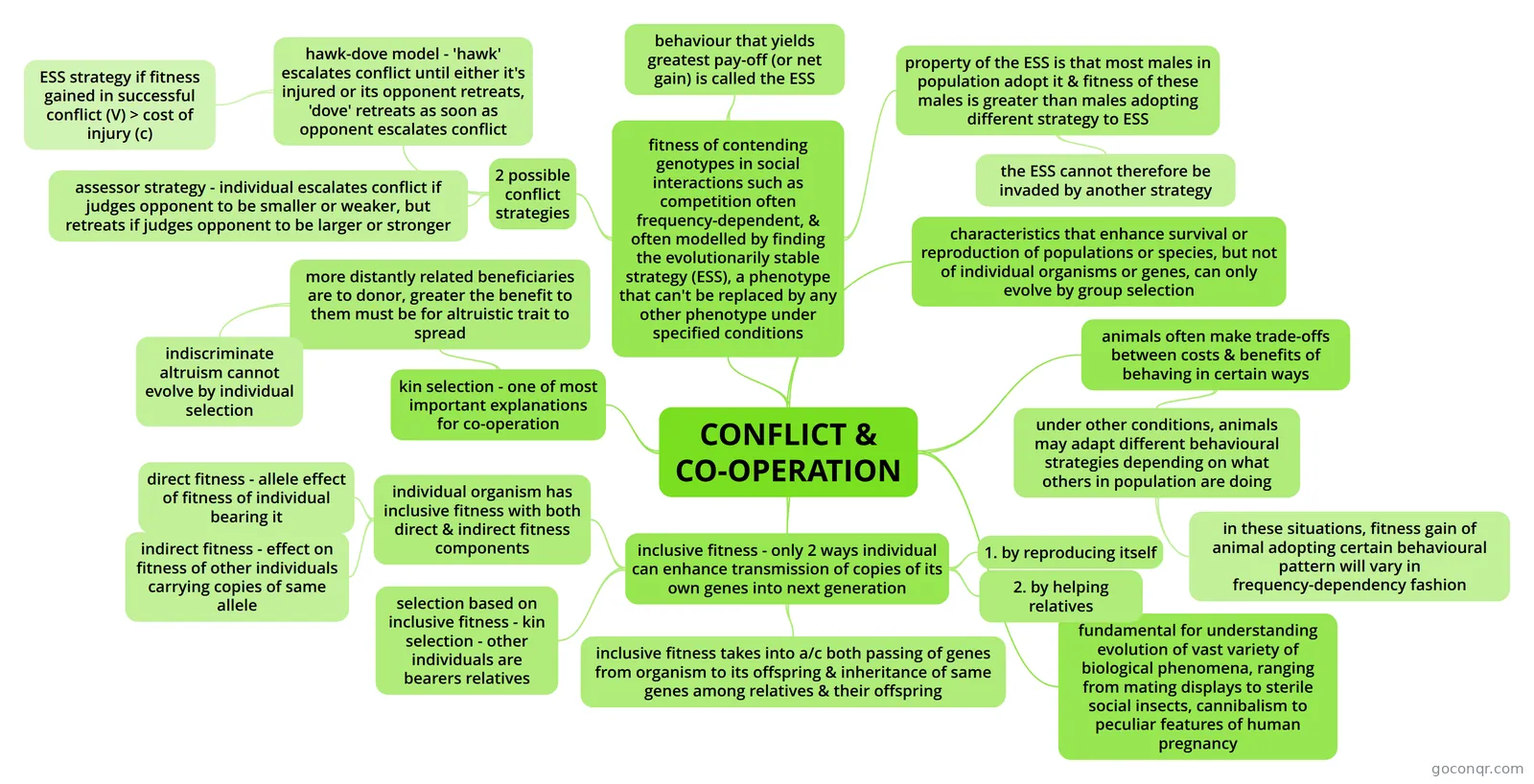
Mind map: Conflict and co-operation
Conteúdo do mapa
CONFLICT & CO-OPERATION
fundamental for understanding evolution of vast variety of biological phenomena, ranging from mating displays to sterile social insects, cannibalism to peculiar features of human pregnancy
characteristics that enhance survival or reproduction of populations or species, but not of individual organisms or genes, can only evolve by group selection
inclusive fitness - only 2 ways individual can enhance transmission of copies of its own genes into next generation
- 1. by reproducing itself
- 2. by helping relatives
- inclusive fitness takes into a/c both passing of genes from organism to its offspring & inheritance of same genes among relatives & their offspring
- individual organism has inclusive fitness with both direct & indirect fitness components
- direct fitness - allele effect of fitness of individual bearing it
- indirect fitness - effect on fitness of other individuals carrying copies of same allele
- selection based on inclusive fitness - kin selection - other individuals are bearers relatives
kin selection - one of most important explanations for co-operation
- more distantly related beneficiaries are to donor, greater the benefit to them must be for altruistic trait to spread
- indiscriminate altruism cannot evolve by individual selection
- more distantly related beneficiaries are to donor, greater the benefit to them must be for altruistic trait to spread
fitness of contending genotypes in social interactions such as competition often frequency-dependent, & often modelled by finding the evolutionarily stable strategy (ESS), a phenotype that can't be replaced by any other phenotype under specified conditions
- 2 possible conflict strategies
- hawk-dove model - 'hawk' escalates conflict until either it's injured or its opponent retreats, 'dove' retreats as soon as opponent escalates conflict
- ESS strategy if fitness gained in successful conflict (V) > cost of injury (c)
- assessor strategy - individual escalates conflict if judges opponent to be smaller or weaker, but retreats if judges opponent to be larger or stronger
- hawk-dove model - 'hawk' escalates conflict until either it's injured or its opponent retreats, 'dove' retreats as soon as opponent escalates conflict
- behaviour that yields greatest pay-off (or net gain) is called the ESS
- property of the ESS is that most males in population adopt it & fitness of these males is greater than males adopting different strategy to ESS
- the ESS cannot therefore be invaded by another strategy
- 2 possible conflict strategies
animals often make trade-offs between costs & benefits of behaving in certain ways
- under other conditions, animals may adapt different behavioural strategies depending on what others in population are doing
- in these situations, fitness gain of animal adopting certain behavioural pattern will vary in frequency-dependency fashion
- under other conditions, animals may adapt different behavioural strategies depending on what others in population are doing
Informações
- Descrição
- Mapa Mental sobre CONFLICT & CO-OPERATION, criado por tomking304 em 09-09-2013.
- Criado por
- tomking304
- Visualizações
- 27
- Avaliação