
Mapa mental
Hermeneutics
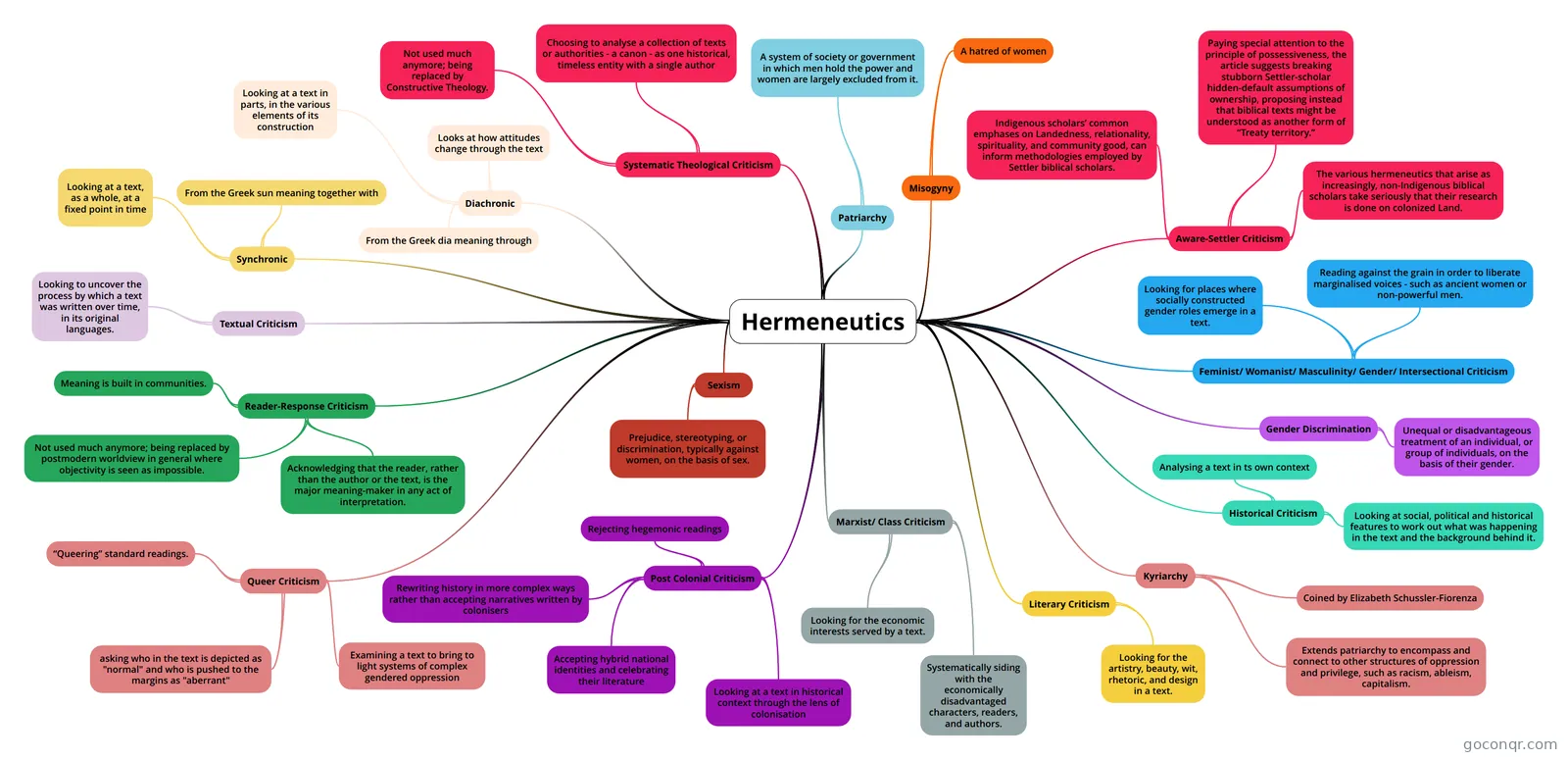
Mind map: hermeneutics
Conteúdo do mapa
Hermeneutics
Aware-Settler Criticism
- Paying special attention to the principle of possessiveness, the article suggests breaking stubborn Settler-scholar hidden-default assumptions of ownership, proposing instead that biblical texts might be understood as another form of “Treaty territory.”
- The various hermeneutics that arise as increasingly, non-Indigenous biblical scholars take seriously that their research is done on colonized Land.
- Indigenous scholars’ common emphases on Landedness, relationality, spirituality, and community good, can inform methodologies employed by Settler biblical scholars.
Feminist/ Womanist/ Masculinity/ Gender/ Intersectional Criticism
- Looking for places where socially constructed gender roles emerge in a text.
- Reading against the grain in order to liberate marginalised voices - such as ancient women or non-powerful men.
Gender Discrimination
- Unequal or disadvantageous treatment of an individual, or group of individuals, on the basis of their gender.
Historical Criticism
- Analysing a text in ts own context
- Looking at social, political and historical features to work out what was happening in the text and the background behind it.
Kyriarchy
- Extends patriarchy to encompass and connect to other structures of oppression and privilege, such as racism, ableism, capitalism.
- Coined by Elizabeth Schussler-Fiorenza
Literary Criticism
- Looking for the artistry, beauty, wit, rhetoric, and design in a text.
Marxist/ Class Criticism
- Looking for the economic interests served by a text.
- Systematically siding with the economically disadvantaged characters, readers, and authors.
Misogyny
- A hatred of women
Patriarchy
- A system of society or government in which men hold the power and women are largely excluded from it.
Post Colonial Criticism
- Looking at a text in historical context through the lens of colonisation
- Rejecting hegemonic readings
- Accepting hybrid national identities and celebrating their literature
- Rewriting history in more complex ways rather than accepting narratives written by colonisers
Queer Criticism
- Examining a text to bring to light systems of complex gendered oppression
- asking who in the text is depicted as "normal" and who is pushed to the margins as "aberrant"
- “Queering” standard readings.
Reader-Response Criticism
- Acknowledging that the reader, rather than the author or the text, is the major meaning-maker in any act of interpretation.
- Meaning is built in communities.
- Not used much anymore; being replaced by postmodern worldview in general where objectivity is seen as impossible.
Sexism
- Prejudice, stereotyping, or discrimination, typically against women, on the basis of sex.
Systematic Theological Criticism
- Choosing to analyse a collection of texts or authorities - a canon - as one historical, timeless entity with a single author
- Not used much anymore; being replaced by Constructive Theology.
Textual Criticism
- Looking to uncover the process by which a text was written over time, in its original languages.
Synchronic
- Looking at a text, as a whole, at a fixed point in time
- From the Greek sun meaning together with
Diachronic
- Looking at a text in parts, in the various elements of its construction
- From the Greek dia meaning through
- Looks at how attitudes change through the text
Informações
- Descrição
- bachelors WOMEN AND GENDER Mapa Mental sobre Hermeneutics, criado por Emily Carter em 22-12-2019.
- Criado por
- Emily Carter
- Visualizações
- 3
- Avaliação
Mais sobre Biblical Interpretation and Hermeneutics