
The Bible: Introduction and Interpretation
482 resources created by 408 users
This Religion and theology page on GoConqr gathers community-made quizzes, mind maps, flashcards and notes on the Bible, from Moses, Joshua and King David to covenants, hermeneutics and biblical criticism. It's built for school students, university students and professional candidates revising a topic or filling gaps, and for teachers after ready-made material. There are over 450 resources here, including more than 80 quizzes, over 180 mind maps and over 140 flashcard decks. Pick a topic, try a quiz to find your gaps, then build your own revision set.
Select topic
- Books and Structure of the Bible24
- Biblical Canon and Translations8
- Old Testament27
- New Testament18
- Biblical History, Stories and Characters32
- Biblical Covenants50
- Bible Verses and Quotations20
- Biblical Inspiration and Authority10
- Biblical Interpretation and Hermeneutics20
- Biblical Criticism9
- Biblical Vocabulary13
Top The Bible: Introduction and Interpretation resources
-
95 questionsDeclaration of Faith
-
99 cardsGlobal University: Intro to Hermeneutics Identify a consideration that must be made if we wish to base a decision on a passage of scripture (What mu...
-
Mind map Old Testament Marco Lam's OT Mindmap
-
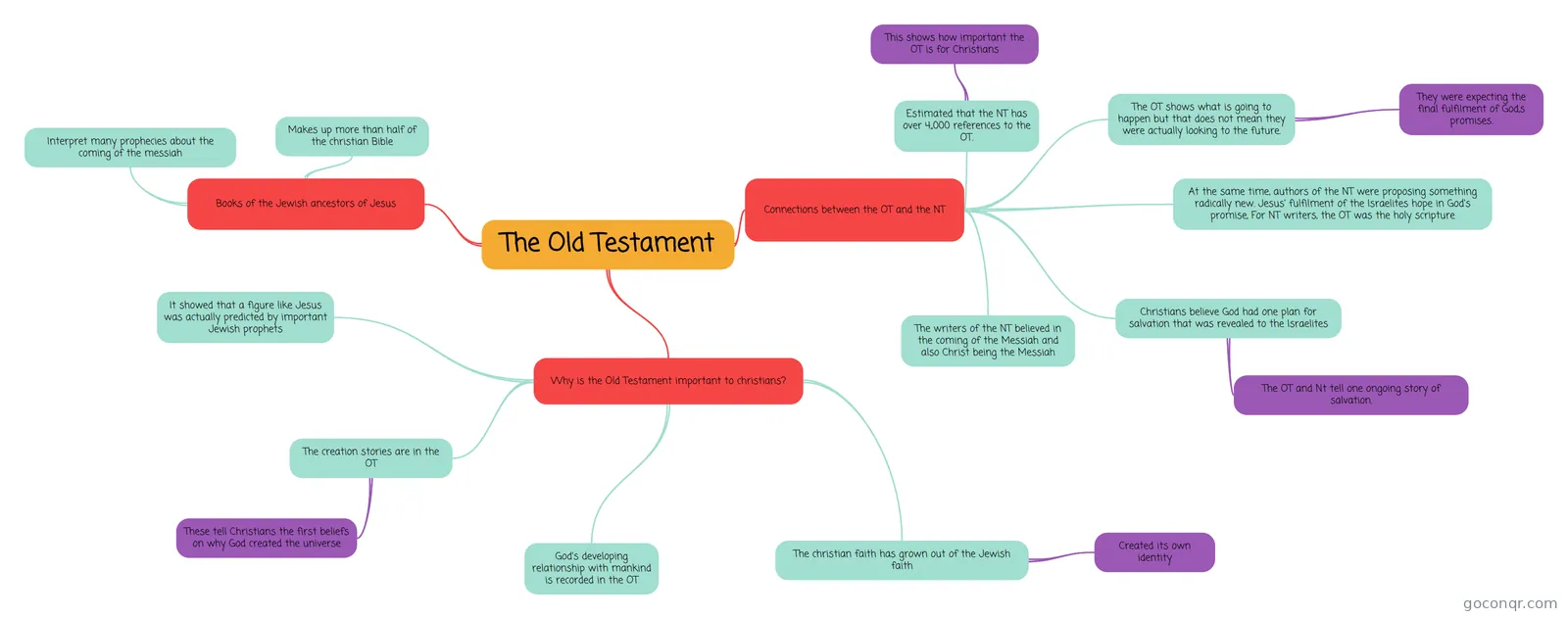 Mind map The Old Testament
-
45 questionsFinal Test - 1 Where did Moses receive the 10 Commandments from God?
-
14 questionsIntroduction to Bible Interpretation What are the types of literature in the Bible? (the THREE literary types)
-
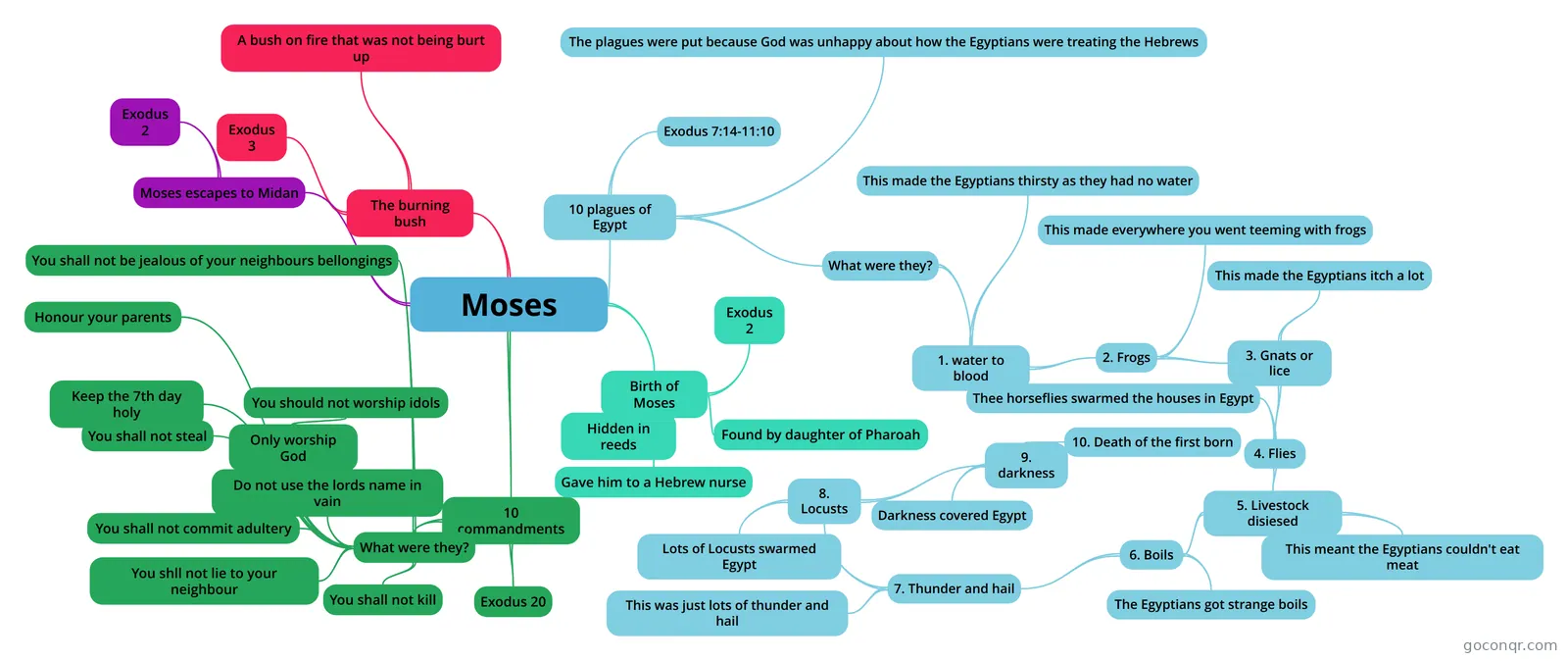 Mind map Moses
-
Mind map Joshua The story
Quizzes
See all 103 quizzes-
95 questionsDeclaration of Faith
-
45 questionsFinal Test - 1 Where did Moses receive the 10 Commandments from God?
-
14 questionsIntroduction to Bible Interpretation What are the types of literature in the Bible? (the THREE literary types)
-
6 questionsGrade 9 Religion end of the year What is a covenant?
-
5 questionsHow Much Do You Know About King David? David was 25 years old when he became king.
-
124 questionsScripture Mid Term Catholics believe that the bible is
-
112 questionsTheology Final 2023 What city is named the City of David?
-
158 questionsBIBLE The collection of writings called "Torah" is also known as
Mind maps
See all 193 mind maps
Flashcards
See all 146 flashcards-
99 cardsGlobal University: Intro to Hermeneutics Identify a consideration that must be made if we wish to base a decision on a passage of scripture (What mu...
-
43 cardsREL Final Study Guide Terms
-
51 cardsUnderstanding Religion Unit 3 Study Guide
-
51 cardsTest I Vocabulary
-
18 cardsbible verses John 3:16 For God so loved the world, that He gave his one and only Son that whoever believes in Him shall ...
-
47 cardsTest III Review Why did Israel want a King?
-
43 cardsReligion Exam First 5 Books of Bible
-
68 cardsRE Revision The Ten Plagues 1 =
Flowcharts
Notes
See all 28 notes-
Dr. Jordan B. Peterson - The Psychological Significance of the Biblical Stories - Detailed Summary Notes Part 8 - The Phenomenology of the Divine He discusses Milton's "Paradise Lost" and how it relates to Tower of Babel. (Around 24:00). Tower of Babel is like 2008 financial crisis. "Too big to fail." (Around 28:0...
-
Nov.27th - 2013 JAMES- Author: James was a brother of Jesus that did not believe until after the resurrection. Became a leader during the Jerusalem council in Acts 15. (Was also in charge at the Jerusalem council) Also one of t...
-
Word Bank Archive Chapter 1 Pg. 20 Allegory/allegorical - reading that is primarily symbolic, as opposed to literal. (I.e. "the staff of heaven" is not an actual physical staff, but represents authority) Neo-Platonic - a mystical...
-
unit 2 Literal vs contextual A literal reader is someone who reads the bible word for word. A literal reader will have a hard time finding the hidden message. A contextual reader is a reader who is good at ...
-
Biblical Miracles Lot's Wife Read the account in Genesis 19:1-26 Lot was the only righteous man in the whole of Sodom and Gomorrah, and God warned him and his family to flees the town, as he was soon to destroy it. Lot's wife turned to...
-
The Bible2 Who decided what went in it:-Jesus didn't write it so didn't decide what went in it.-no single person or group decided what went in-Bishop Athanasins' Christian group produced a list and was approved as the new becaus...
-
Key Stories + Themes Key Stories and Themes Page 1 Page 2Google Docs has comprehension questions. Relate questions to themes and key stories. The following are examples from the Bible that fit under each theme. The relationship between a ...
-
Religion Notes Unit 4.2 pages 76-77A guide is a person who knows the place well and can show us around and explain. A guide could also be a book that has been written to guide us using by reading. using pictures and so on. In the sa...
Slides
Topics in The Bible: Introduction and Interpretation
More Religion and theology topics
About The Bible: Introduction and Interpretation
GoConqr OriginalWhat this unit covers
This unit brings together material on reading and understanding the Bible. Much of it is about the Old Testament. The mind map The Old Testament looks at why these books matter, noting that they make up more than half of the Christian Bible and help readers interpret prophecies about the messiah. Other maps follow people and stories, such as Moses, Joshua and The Story of Jacob and Esau.
Interpretation and method
A second strand deals with how to read a passage. The flashcard deck Global University: Intro to Hermeneutics asks what we must consider before basing a decision on scripture. The quiz Introduction to Bible Interpretation tests the three literary types: narrative, discourse and poetry. For more advanced study there are resources on source criticism, redaction criticism, the historical critical method and typology.
Where to start
- Open The Old Testament mind map for the big picture.
- Take the Introduction to the Bible quiz to see what you already know.
- Move to Introduction to Bible Interpretation and the hermeneutics flashcards.
- Finish with a story-based quiz such as How Much Do You Know About King David? or the Joseph Bible Quiz.
Using quizzes and maps together
Read a mind map first, then close it and take a quiz on the same topic. Wrong answers show which branch to revisit. The quiz Declaration of Faith, for example, asks about inspiration meaning "breathed by God", which pairs well with the map Meaning of Inspired scriptures. Flashcards then help fix vocabulary such as covenant and canon. Some resources mention GCSE Religious Studies, so school students will find revision-friendly sets too.
Where it sits
This unit belongs to the Bible strand within Religion and theology. Every resource was made by GoConqr users, so styles vary. Pick one that suits your level, try it, and then make a set of your own.
Frequently asked questions
Which resource should I open first?
Start with the mind map The Old Testament. It gives a quick overview of why the books matter and how they connect to the wider Bible. Then try the Introduction to the Bible quiz to check what stuck, and move on to interpretation material once the basics feel familiar.
What do the mind maps cover?
There are over 180 mind maps. Many cover Old Testament stories and figures, including Moses, Joshua, Jacob and Esau, and the covenants. Others deal with ideas such as the biblical canon, hermeneutics, redaction criticism, inspired scriptures and the historical critical method.
Are the resources free to use?
Yes. Every resource listed here is free to open, study and take, with no account needed. If you create a free account, your quiz scores are saved and you can make your own quizzes, mind maps, flashcards and notes.
Who made these resources?
They were made by GoConqr users, not by GoConqr itself. Over 370 contributors have added material, so you will see different styles, from class revision sets to lecture-based flashcards and notes. Check that a set matches your course before relying on it.
Which levels and exams do they suit?
The mix leans towards school students, with university students and professional candidates also catered for. Some resources mention GCSE Religious Studies. Others are lecture-based, covering topics like hermeneutics and source criticism, so they suit more advanced study.
What if I can't find my topic?
Try a nearby resource first. For example, the notes on Biblical Miracles or the Key Stories and Themes notes may cover what you need. You can also build your own quiz, map or flashcards on the missing topic with a free account.