
Mapa mental
Connectivity
Conteúdo do mapa
Connectivity
A generic term for connecting devices to each other in order to transfer data back and forth. It often refers to network connections, which embraces bridges, routers, switches and gateways as well as backbone networks.
- Bandwidth is the amount of data that can be carried at a time. (It is not a measure of how fast data travels). Measured in bit per second.
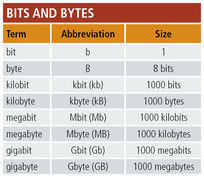
- BIT(B) = 0/1 NIBBLE = 4 bits BYTE = 8 KILOBYTE = 8000 bits MEGABYTE = 8,000,000 bits GIGABYTES = 8,000 ,000,000 bits TERABYTE = 8,000,000,000,000 bits PETABYTE = 8,000,000,000,000,000 bits
- Bandwidth is the amount of data that can be carried at a time. (It is not a measure of how fast data travels). Measured in bit per second.
Download speed is faster than upload speed as internet providers see that there are more people downloading than people uploading so they increase the speed of download to entice customers.
- Uploading is the process of putting web pages, images and files onto a web server. Downloading is the process of getting web pages, images and files from a web server.
- Network medium- The physical channel used for transmission in the network. Wire, fiber and air are the three media.
- Download speed or receiving speed means the rate that information travels from the internet to your device. So, viewing a web page, downloading a program or receiving an e-mail, would be examples of downloading. Upload speed or send speed means the rate that information travels from your device to the internet. Sending an email or sending a file would be examples of uploading.
- Connection speed is the speed that data is transferred between your device and the internet. The connection speed of data is measured in megabits per second or Mbps.
Broadband
- A high speed connection to the internet that superseded the use of dial-up connections.
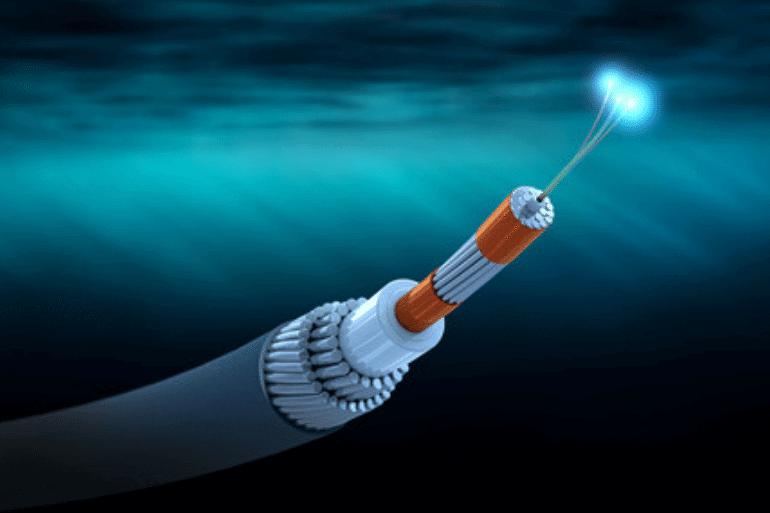
- There are cables placed undersea for connection purposes. America, China and Europe have more undersea cables since there are more people that use the internet in those regions.
- A submarine communications cable is a cable laid on the sea bed between land-based stations to carry telecommunication signals across stretches of ocean and sea.
Fiber optic vs Copper wires
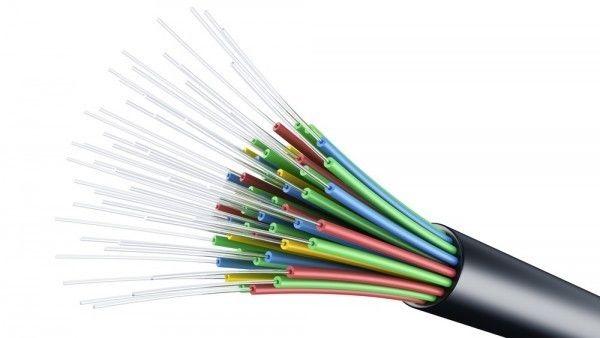
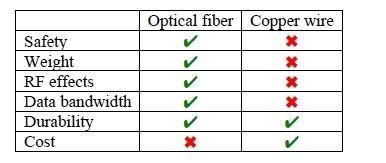
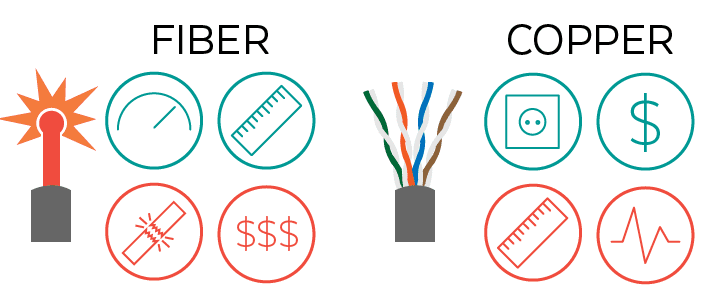
- Fiber optic cables transmit data at much higher speed than copper wires. This is because the speed of light is greater than the speed of electrons. Fiber optic cables have a much larger bandwidth of over 60 Tbps in comparison to 10 Gbps bandwidth of copper wires. Fiber optic cables are not affected by electromagnetic interferences and power fluctuations. They are minimally affected by power failures.. Fiber cables are thin and lightweight. A fiber cable weighs around 4 lbs/1000 ft as compared to 39 lbs/1000 ft weight of copper cable. The life cycle of fiber cables is 30-50 years, which is much higher than copper cables.
- Fiber optic cabling is a newer technology with not much expertise. So, installation and maintenance is not as easy as copper wires. Copper cables and connectors are much cheaper than fiber optic cables and connectors. Also, copper has excellent resale value. Since any technology is constrained to cost, need for deployment of fiber optic cables has to be justified before installation.
- Wifi
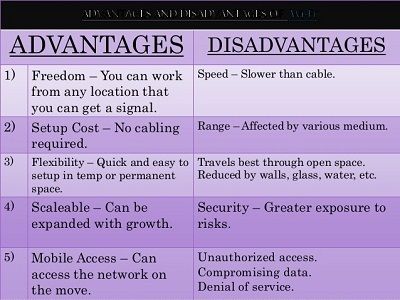
- Disadvantage- Wi-Fi network speed is not powerful as the cable network. Signal depends on the distance and the interference walls and other objects.
- ADVANTAGES- Convenience, Mobility, Productivity, Cost, Easy installation,.
- Wifi
Imagens e arquivos do mapa

Informações
- Descrição
- Computing Mind Map on Connectivity
- Criado por
- Chenai Quartey
- Visualizações
- 9
- Avaliação