
Mapa mental
Working Scientifically
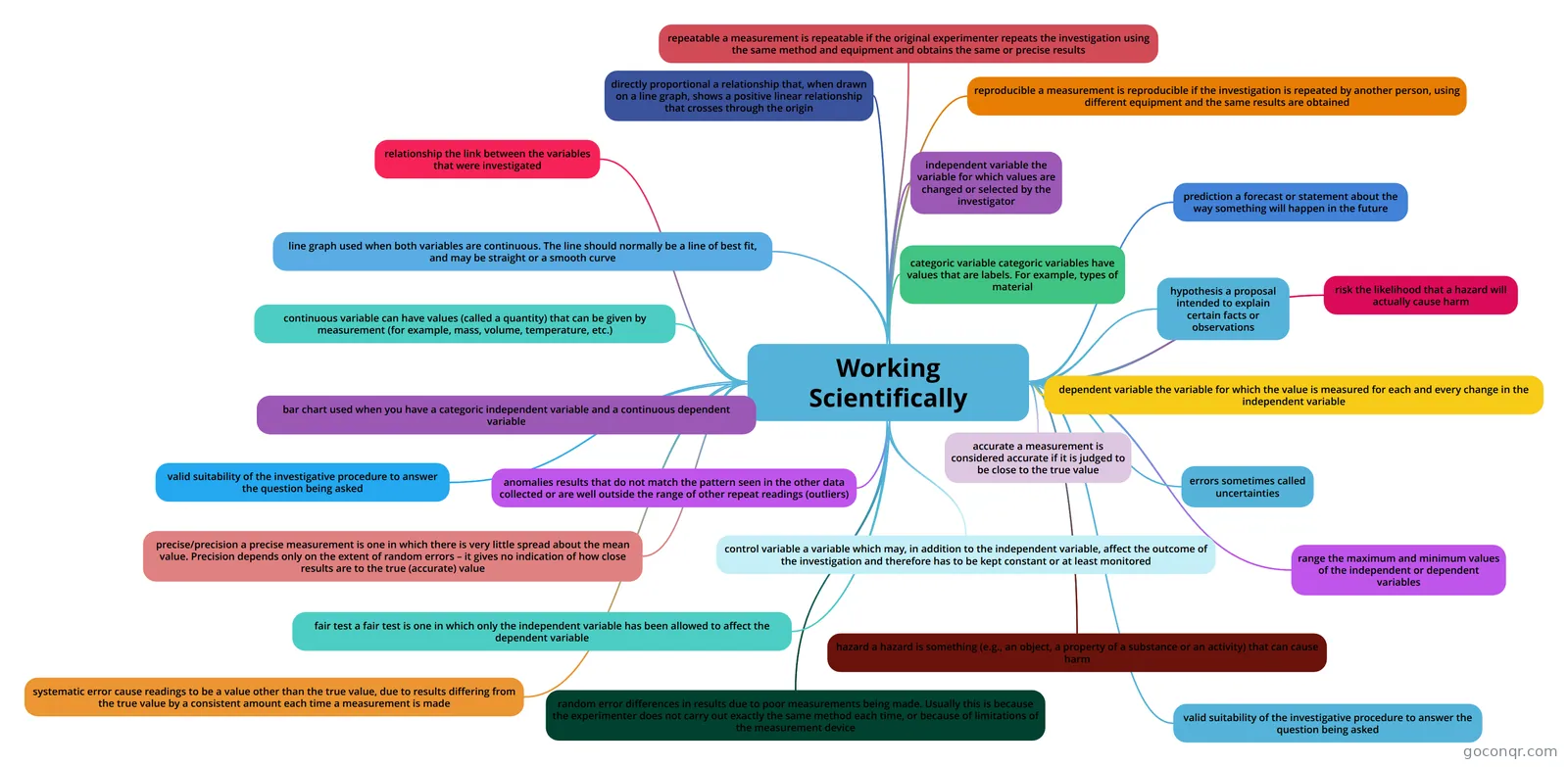
Mind map: Working Scientifically
Conteúdo do mapa
Working Scientifically
accurate a measurement is considered accurate if it is judged to be close to the true value
anomalies results that do not match the pattern seen in the other data collected or are well outside the range of other repeat readings (outliers)
bar chart used when you have a categoric independent variable and a continuous dependent variable
categoric variable categoric variables have values that are labels. For example, types of material
continuous variable can have values (called a quantity) that can be given by measurement (for example, mass, volume, temperature, etc.)
control variable a variable which may, in addition to the independent variable, affect the outcome of the investigation and therefore has to be kept constant or at least monitored
dependent variable the variable for which the value is measured for each and every change in the independent variable
directly proportional a relationship that, when drawn on a line graph, shows a positive linear relationship that crosses through the origin
errors sometimes called uncertainties
fair test a fair test is one in which only the independent variable has been allowed to affect the dependent variable
hazard a hazard is something (e.g., an object, a property of a substance or an activity) that can cause harm
hypothesis a proposal intended to explain certain facts or observations
independent variable the variable for which values are changed or selected by the investigator
line graph used when both variables are continuous. The line should normally be a line of best fit, and may be straight or a smooth curve
precise/precision a precise measurement is one in which there is very little spread about the mean value. Precision depends only on the extent of random errors – it gives no indication of how close results are to the true (accurate) value
prediction a forecast or statement about the way something will happen in the future
random error differences in results due to poor measurements being made. Usually this is because the experimenter does not carry out exactly the same method each time, or because of limitations of the measurement device
range the maximum and minimum values of the independent or dependent variables
relationship the link between the variables that were investigated
repeatable a measurement is repeatable if the original experimenter repeats the investigation using the same method and equipment and obtains the same or precise results
reproducible a measurement is reproducible if the investigation is repeated by another person, using different equipment and the same results are obtained
risk the likelihood that a hazard will actually cause harm
systematic error cause readings to be a value other than the true value, due to results differing from the true value by a consistent amount each time a measurement is made
valid suitability of the investigative procedure to answer the question being asked
valid suitability of the investigative procedure to answer the question being asked
Informações
- Descrição
- Mapa Mental sobre Working Scientifically, criado por M Gardam em 22-04-2020.
- Criado por
- M Gardam
- Visualizações
- 0
- Avaliação