
Mapa mental
Radioactivity/particles
Conteúdo do mapa
Radioactivity/particles
Units of measurement
- Becquerel (Bq: measure of reactivity
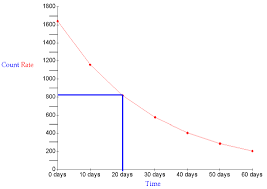
- Radiation emitted by radioactive source will decrease over time
- Half life: time it takes for radiation emitted by a source to decrease by half
- Half life is different from for different sources of radiation
- Half life: time it takes for radiation emitted by a source to decrease by half
- Radiation emitted by radioactive source will decrease over time
- Centimetre (cm)
- Hour (h)
- Second (s)
- Minute (Min)
- Becquerel (Bq: measure of reactivity
Protons (+ve) and neutrons are in the nuclei of an atom.
- Electrons (-ve) orbit the atom in shells
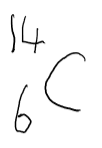
- Atomic mass, number of protons + neutrons
- Isotope of an element is the same No. of protons and electrons but different number of neutrons
- Number of protons (and the same as number of electrons)
- Atomic mass, number of protons + neutrons
- Electrons (-ve) orbit the atom in shells
Types of radiation
- Alpha
- 2 neutrons, 2 protons, helium nucleus
- Cant even penetrate paper
- Causes atom to go down 2 on atomic number and down 4 on atomic mass
- Will change to element with atomic number 2 less than it was
- Beta
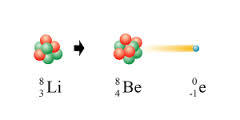
- Electrons, emitted when neutron turns to proton and an electrons
- Can't penetrate aluminium
- Radiation causes neutron to split into proton and electron
- Electron is emitted, protons stays in atom
- Atomic number up 1: element becomes element w/ next atomic number up
- Mass number stays same
- Electrons, emitted when neutron turns to proton and an electrons
- Gamma
- Electromagnetic wave, can be emitted alongside other radiations
- Can't penetrate lead
- No specific effect on atomic/mass number
- They're all ionising: they damage cells
- Geiger-Muller detector beeps in presence of ionising radiation
- More radiation: more frequent beeps
- Geiger-Muller detector beeps in presence of ionising radiation
- Radiation emitted from unstable nuclei of an atom (full & trying to unload)
- Alpha
Uses of radioactivity
- Tracers: radioactive source put into system (piping): builds up where blockage detected
- Radiotherapy: radiation destroys unwanted (cancerous) cells
- Medical tracers: radioactive source is put into body and builds up at blockage
- Carbon dating: amount of radiation from object measured, half life of carbon is used to see age of object
Dangers of ionising radiation: mutations, damage cells/tissues
- Radioactive waste: poisons ecosystems, contaminates ground
Gold foil experiment
- Alpha radiation was beamed at a sheet of gold foil, a sheet of zinc sulphide surrounding the foil showed where the alpha particles ended up; a few went straight through, many were deflected at angles, some were deflected straight back.
- Rutherford
- The nuclear model of an atom is the one we all know: a central nucleus with positive protons and neutral neutrons surrounded by orbiting negative electrons. Before the Geiger Marsden experiment, the 'plum pudding' model of an atom was believed: a positive sphere contained negative electrons dotted inside. If this was true the alpha particles would have gone straight through the sheet of gold and all come out the other side. What actually happened was that some were deflected at different angles, this showed that the positive alpha particles were being repelled by a positive charge and others were going through the space between the charged areas. The faster they hit it the faster they were repelled. This is where the idea was formed of a nucleus and orbiting electrons.
Fission: uranium 235 has large nucleus, split in 2 when neutron fired at it
- releases large amounts of energy as products created move rapidly
- Leaves 2 daughter nuclei, at same time neutrons are emitted
- Neutrons hit other U-235 atoms around and chain reaction begins
- Generating electricity with fission
- In nuclear power stations, nuclei are split by having neutrons fired at them, these release other neutrons as well as a large amount of energy. The energy is used to create electricity, and the radioactive by-products are disposed of. Control rods can absorb neutrons. If there are two many neutrons the chain reaction could get out of control, so the control rods are lowered in to the reaction to absorb some neutrons and control the reaction. The moderator slows neutrons down so that they are at the right speed to split nuclei, the moderator is usually water.
- Generating electricity with fission
- Neutrons hit other U-235 atoms around and chain reaction begins
Imagens e arquivos do mapa

Informações
- Descrição
- Mapa Mental sobre Radioactivity/particles, criado por Isaac Franks em 09-03-2015.
- Criado por
- Isaac Franks
- Visualizações
- 3
- Avaliação