
Mapa mental
Oligopoly
Conteúdo do mapa
Oligopoly
A market dominated by a few producers, each whom has some control over the market
- High three to five market concentration ratio
Characteristics
- A few large firms selling similar products
- A high concentration ratio
- Each firm has branded and differentiated products
- Significant barriers to entry
- Firms are INTERDEPENDENT
- when firms must consider the likely reaction of their competitors to their own pricing strategies - leads to uncertainty
- Abnormal profits in the LR
Examples
- Supermarkets
- Fast Food
- Broadcasting
- Bookstores
- Hotel industry
- Soft Drinks
- Banking
- Travel Industry
- Electrical Retail
- Cinemas
Behaviour
- Price Competition
- Risky - price curs lead rivals to do the same
- Price wars
- A price war may be sparked by a firm which thinks it has the potential to keep prices lower than its rivals and for a longer period of time
- price wars often happen when new firms enter and means that SR profit max is temporarily departed from
- Interdependence may also lead to long periods of price stability
- Collusion
- Use to Escape the uncertainty and interdependence of oligopolies
- Formal Collusion (Cartel)
- An agreement between firms on price and output with the intention of maximising their joint profits
- The firm produce separately but sell at one agreed price (effectively a joint monopoly)
- Price fixing agreements or Cartels are ILLEGAL
- Office of Fair Trading can fine firms up to 10% of their turnover for every year a cartel is found to be in operation
- The frequency of anti-cartel cases brought by regulators in recent years suggests firms continue to be tempted by the gains from collusion
- Hard to prove a cartel therefore firms risk engaging in collusion
- doesn't ELIMINATE the uncertainty and interdepentence
- Temptation to cheat therefore cartel will collapse
- Analysed by the GAME THEORY - There is an incentive to cheat because joint profit maximisation doesn't mean each firm is maximising profit on their own
- GAME THEORY - Method of analysing situations in which players are interdependent
- DOMINANT STRATEGY - where a single strategy is best for a player irrespective of what strategy the other player adopts(cheats) - Doesn't create market profit Maximum
- PRISONERS DILEMMA - a game where, given that neither player knows the strategy of the other , the optimum strategy for each player leads to a worse situation than if they had known the strategy of the other player and had been able to cooperate and coordinate their starategy
- Consumers may gain from cartels owing to guaranteed supply and relative price stability , but owing to high prices ,consumer welfare and economic efficiency will be low
- Significant possibility that a collusive agreement between firms will fall apart
- Informal collusion (tacit collusion)
- Because with cartel there is an incentive to cheat they break down over time. however informal collusion is possible
- TACIT COLLUSION - situation occurring when firms refrain from competing on price, but without communication or formal agreement between them, come to charge high prices
- Normally takes the form of PRICE LEADERSHIP
- PRICE LEADERSHIP - occurs when firms with lower market share follow the pricing changes prompted by the firm with the dominant position in the market
- Tacit collusion is more common than formal collusion
- Examples - building societies and petrol retailers
- Non-Price competition
- Why oligopolies do compete on price
- The Kinked demand Curve
- Price Wars - they will be self defeating
- Aim - to win new customers and increase loyalty of existing customers
- Types
- Persuasive Advertising
- Brand imaging
- Packaging
- After sale service
- Free Gifts
- Competitions
- Why oligopolies do compete on price
- Price Competition
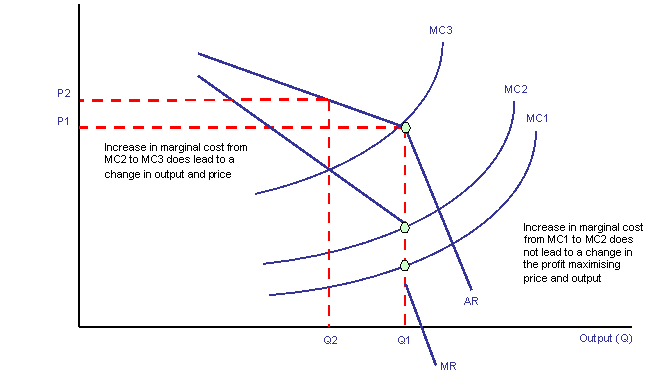
Kinked Demand Curve
- When increasing the price from p1 to p2 firms are trying to market share and expect firms to not follow suit this leads to expectations for demand to be relatively price elastic in response to a price increase , therefore leading to a more than proportionate fall in demand (Q1 to Q2)
- When cutting prices from P1 to P2, they think rivals will immediately cut prices and each firm will gain increased market share, However the oligopolist fails to gain market share from rivals. this means the demand curve is relatively in elastic. Therefore the fall from P1 to P3 may result in a less than proportionate increase in D
- The demand curve is 'kinked' at the original price (P1)
- In fear of both a Price increase and price decrease will reduce profits they leave prices unchanged . This causes PRICE RIGIDITY and firm have to put more reliance on NON-PRICE COMPETITION
- The kink in the D curve this means that MC has a DISCONTINUITY at Q1. This means that a small change in MC does not alter the Profit maximising output in this gap.
- A demand curve made up of two parts suggesting that oligopolies follow each others' price reductions BUT NOT price rises
Imagens e arquivos do mapa
Informações
- Descrição
- Mapa Mental sobre Oligopoly, criado por NatalieJayne16 em 18-03-2015.
- Criado por
- NatalieJayne16
- Visualizações
- 0
- Avaliação