
Mapa mental
Cognitive dissonance
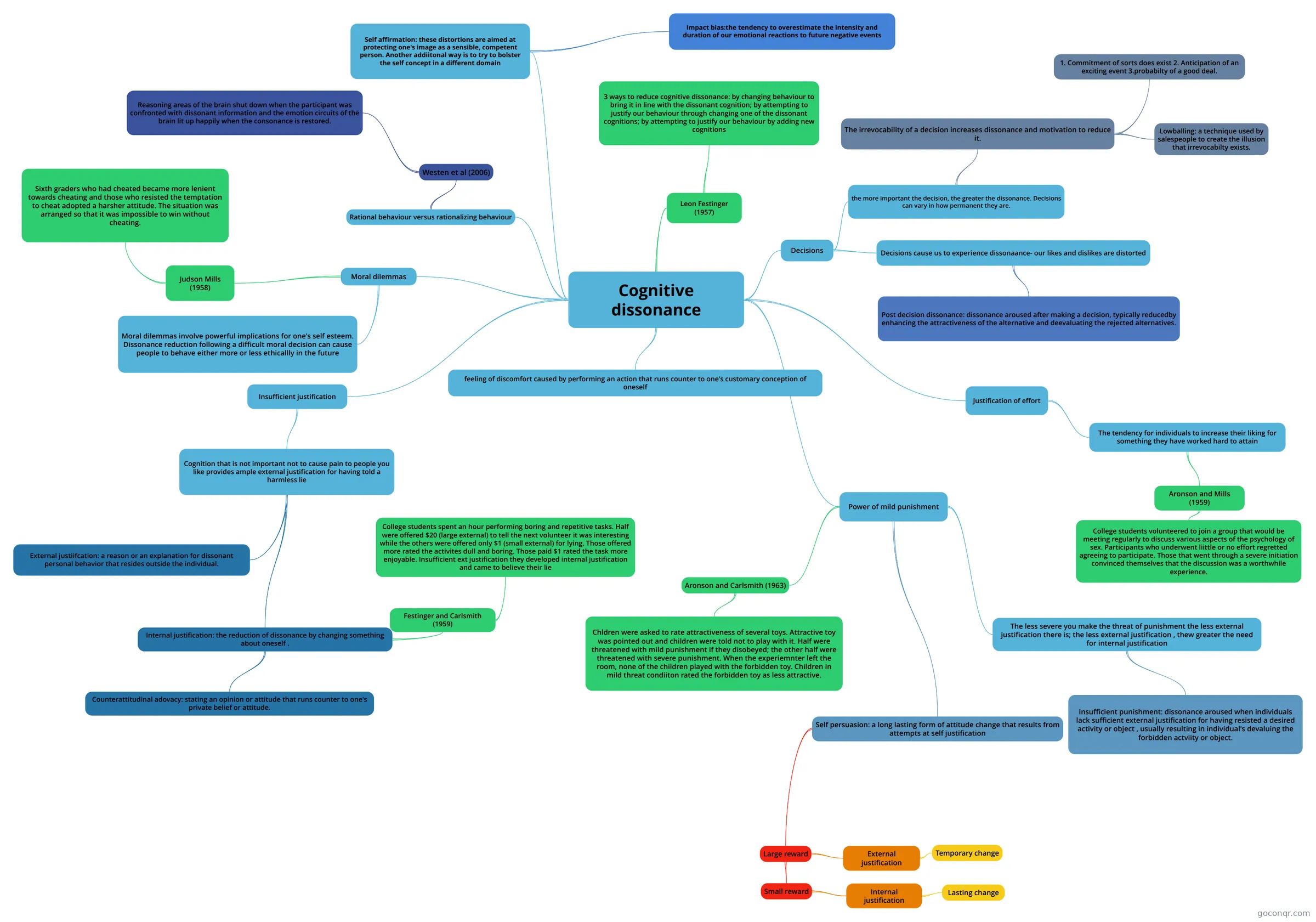
Mind map: cognitive dissonance
Conteúdo do mapa
Cognitive dissonance
feeling of discomfort caused by performing an action that runs counter to one's customary conception of oneself
Leon Festinger (1957)
- 3 ways to reduce cognitive dissonance: by changing behaviour to bring it in line with the dissonant cognition; by attempting to justify our behaviour through changing one of the dissonant cognitions; by attempting to justify our behaviour by adding new cognitions
Self affirmation: these distortions are aimed at protecting one's image as a sensible, competent person. Another addiitonal way is to try to bolster the self concept in a different domain
- Impact bias:the tendency to overestimate the intensity and duration of our emotional reactions to future negative events
Rational behaviour versus rationalizing behaviour
- Westen et al (2006)
- Reasoning areas of the brain shut down when the participant was confronted with dissonant information and the emotion circuits of the brain lit up happily when the consonance is restored.
- Westen et al (2006)
Decisions
- Decisions cause us to experience dissonaance- our likes and dislikes are distorted
- Post decision dissonance: dissonance aroused after making a decision, typically reducedby enhancing the attractiveness of the alternative and deevaluating the rejected alternatives.
- the more important the decision, the greater the dissonance. Decisions can vary in how permanent they are.
- The irrevocability of a decision increases dissonance and motivation to reduce it.
- Lowballing: a technique used by salespeople to create the illusion that irrevocabilty exists.
- 1. Commitment of sorts does exist 2. Anticipation of an exciting event 3.probabilty of a good deal.
- The irrevocability of a decision increases dissonance and motivation to reduce it.
- Decisions cause us to experience dissonaance- our likes and dislikes are distorted
Moral dilemmas
- Moral dilemmas involve powerful implications for one's self esteem. Dissonance reduction following a difficult moral decision can cause people to behave either more or less ethicallly in the future
- Judson Mills (1958)
- Sixth graders who had cheated became more lenient towards cheating and those who resisted the temptation to cheat adopted a harsher attitude. The situation was arranged so that it was impossible to win without cheating.
Justification of effort
- The tendency for individuals to increase their liking for something they have worked hard to attain
- Aronson and Mills (1959)
- College students volunteered to join a group that would be meeting regularly to discuss various aspects of the psychology of sex. Participants who underwent liittle or no effort regretted agreeing to participate. Those that went through a severe initiation convinced themselves that the discussion was a worthwhile experience.
- Aronson and Mills (1959)
- The tendency for individuals to increase their liking for something they have worked hard to attain
Insufficient justification
- Cognition that is not important not to cause pain to people you like provides ample external justification for having told a harmless lie
- External justiifcation: a reason or an explanation for dissonant personal behavior that resides outside the individual.
- Internal justification: the reduction of dissonance by changing something about oneself .
- Counterattitudinal adovacy: stating an opinion or attitude that runs counter to one's private belief or attitude.
- Festinger and Carlsmith (1959)
- College students spent an hour performing boring and repetitive tasks. Half were offered $20 (large external) to tell the next volunteer it was interesting while the others were offered only $1 (small external) for lying. Those offered more rated the activites dull and boring. Those paid $1 rated the task more enjoyable. Insufficient ext justification they developed internal justification and came to believe their lie
- Cognition that is not important not to cause pain to people you like provides ample external justification for having told a harmless lie
Power of mild punishment
- The less severe you make the threat of punishment the less external justification there is; the less external justification , thew greater the need for internal justification
- Insufficient punishment: dissonance aroused when individuals lack sufficient external justification for having resisted a desired activity or object , usually resulting in individual's devaluing the forbidden actviity or object.
- Aronson and Carlsmith (1963)
- Chldren were asked to rate attractiveness of several toys. Attractive toy was pointed out and children were told not to play with it. Half were threatened with mild punishment if they disobeyed; the other half were threatened with severe punishment. When the experiemnter left the room, none of the children played with the forbidden toy. Children in mild threat condiiton rated the forbidden toy as less attractive.
- Self persuasion: a long lasting form of attitude change that results from attempts at self justification
- Large reward
- External justification
- Temporary change
- Small reward
- Internal justification
- Lasting change
- Internal justification
- External justification
- Large reward
- The less severe you make the threat of punishment the less external justification there is; the less external justification , thew greater the need for internal justification
Informações
- Descrição
- Costs and Benefits of Dissonance Reduction
- Criado por
- Purplenile
- Visualizações
- 174
- Tags
- Avaliação