
Mapa mental
Passing off and goodwill
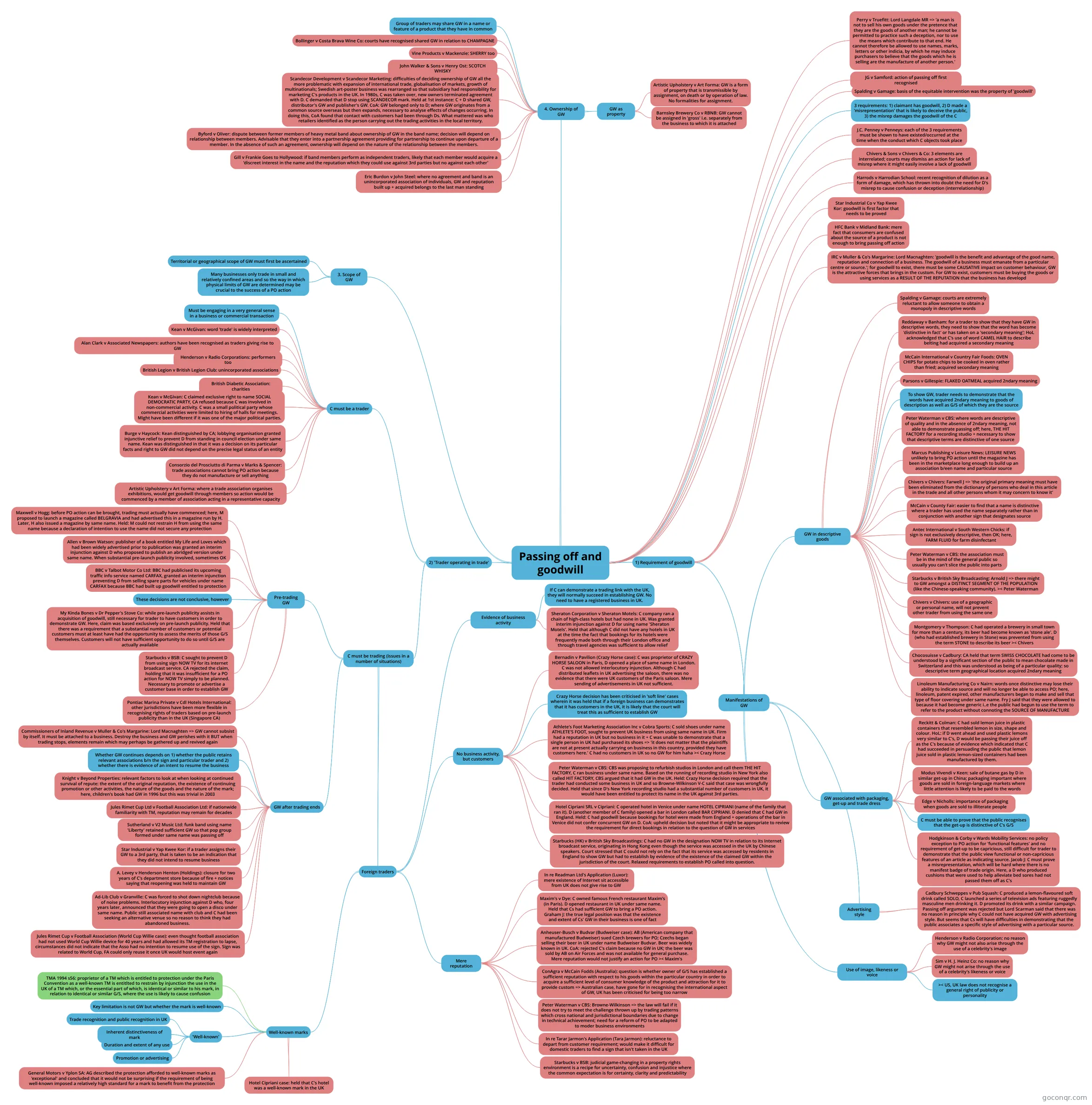
Mind map: Passing off and goodwill
Conteúdo do mapa
Passing off and goodwill
Perry v Truefitt: Lord Langdale MR => 'a man is not to sell his own goods under the pretence that they are the goods of another man; he cannot be permitted to practice such a deception, nor to use the means which contribute to that end. He cannot therefore be allowed to use names, marks, letters or other indicia, by which he may induce purchasers to believe that the goods which he is selling are the manufacture of another person.'
JG v Samford: action of passing off first recognised
Spalding v Gamage: basis of the equitable intervention was the property of 'goodwill'
1) Requirement of goodwill
- Star Industrial Co v Yap Kwee Kor: goodwill is first factor that needs to be proved
- HFC Bank v Midland Bank: mere fact that consumers are confused about the source of a product is not enough to bring passing off action
- IRC v Muller & Co's Margarine: Lord Macnaghten: 'goodwill is the benefit and advantage of the good name, reputation and connection of a business. The goodwill of a business must emanate from a particular centre or source.'; for goodwill to exist, there must be some CAUSATIVE impact on customer behaviour, GW is the attractive forces that brings in the custom. For GW to exist, customers must be buying the goods or using services as a RESULT OF THE REPUTATION that the business has developd
- Manifestations of GW
- GW in descriptive goods
- Spalding v Gamage: courts are extremely reluctant to allow someone to obtain a monopoly in descriptive words
- Reddaway v Banham: for a trader to show that they have GW in descriptive words, they need to show that the word has become 'distinctive in fact' or has taken on a 'secondary meaning'; HoL acknowledged that C's use of word CAMEL HAIR to describe belting had acquired a secondary meaning
- McCain International v Country Fair Foods: OVEN CHIPS for potato chips to be cooked in oven rather than fried; acquired secondary meaning
- Parsons v Gillespie: FLAKED OATMEAL acquired 2ndary meaning
- To show GW, trader needs to demonstrate that the words have acquired 2ndary meaning to goods of description as well as G/S of which they are the source
- Peter Waterman v CBS: where words are descriptive of quality and in the absence of 2ndary meaning, not able to demonstrate passing off; here, THE HIT FACTORY for a recording studio + necessary to show that descriptive terms are distinctive of one source
- Marcus Publishing v Leisure News: LEISURE NEWS unlikely to bring PO action until the magazine has been in the marketplace long enough to build up an association b/een name and particular source
- Chivers v Chivers: Farwell J => 'the original primary meaning must have been eliminated from the dictionary of persons who deal in this article in the trade and all other persons whom it may concern to know it'
- McCain v County Fair: easier to find that a name is distinctive where a trader has used the name separately rather than in conjunction with another sign that designates source
- Antec International v South Western Chicks: if sign is not exclusively descriptive, then OK; here, FARM FLUID for farm disinfectant
- Peter Waterman v CBS: the association must be in the mind of the general public so usually you can't slice the public into parts
- Starbucks v British Sky Broadcasting: Arnold J => there might to GW amongst a DISTINCT SEGMENT OF THE POPULATION (like the Chinese-speaking community). >< Peter Waterman
- Chivers v Chivers: use of a geographic or personal name, will not prevent other trader from using the same one
- Montgomery v Thompson: C had operated a brewery in small town for more than a century, its beer had become known as 'stone ale'. D (who had established brewery in Stone) was prevented from using the term STONE to describe its beer >< Chivers
- Chocosuisse v Cadbury: CA held that term SWISS CHOCOLATE had come to be understood by a significant section of the public to mean chocolate made in Switzerland and this was understood as being of a particular quality; so descriptive term geographical location acquired 2ndary meaning
- Linoleum Manufacturing Co v Nairn: words once distinctive may lose their ability to indicate source and will no longer be able to access PO; here, linoleum, patent expired, other manufacturers began to make and sell that type of floor covering under same name. Fry J said that they were allowed to because it had become generic i..e the public had begun to use the term to refer to the product without connoting the SOURCE OF MANUFACTURE
- GW associated with packaging, get-up and trade dress
- Reckitt & Colman: C had sold lemon juice in plastic containers that resembled lemon in size, shape and colour. HoL: if D went ahead and used plastic lemons very similar to C's, D would be passing their juice off as the C's because of evidence which indicated that C had succeeded in persuading the public that lemon juice sold in plastic lemon-sized containers had been manufactured by them.
- Modus Vivendi v Keen: sale of butane gas by D in similar get-up in China; packaging important where goods are sold in foreign-language markets where little attention is likely to be paid to the words
- Edge v Nicholls: importance of packaging when goods are sold to illiterate people
- C must be able to prove that the public recognises that the get-up is distinctive of C's G/S
- Hodgkinson & Corby v Wards Mobility Services: no policy exception to PO action for 'functional features' and no requirement of get-up to be capricious, still difficult for trader to demonstrate that the public view functional or non-capricious features of an article as indicating source. Jacob J: C must prove a misrepresentation, which will be hard where there is no manifest badge of trade origin. Here, a D who produced cushions that were used to help alleviate bed sores had not passed them off as C's
- Advertising style
- Cadbury Schweppes v Pub Squash: C produced a lemon-flavoured soft drink called SOLO, C launched a series of television ads featuring ruggedly masculine men drinking it. D promoted its drink with a similar campaign. Passing off argument was rejected but Lord Scarman said that there was no reason in principle why C could not have acquired GW with advertising style. But seems that Cs will have difficulties in demonstrating that the public associates a specific style of advertising with a particular source.
- Use of image, likeness or voice
- Henderson v Radio Corporation: no reason why GW might not also arise through the use of a celebrity's image
- Sim v H. J. Heinz Co: no reason why GW might not arise through the use of a celebrity's likeness or voice
- >< US, UK law does not recognise a general right of publicity or personality
- GW in descriptive goods
3 requirements: 1) claimant has goodwill, 2) D made a 'misrepresentation' that is likely to deceive the public, 3) the misrep damages the goodwill of the C
J.C. Penney v Penneys: each of the 3 requirements must be shown to have existed/occurred at the time when the conduct which C objects took place
Chivers & Sons v Chivers & Co: 3 elements are interrelated; courts may dismiss an action for lack of misrep where it might easily involve a lack of goodwill
Harrods v Harrodian School: recent recognition of dilution as a form of damage, which has thrown into doubt the need for D's misrep to cause confusion or deception (interrelationship)
2) 'Trader operating in trade'
- C must be a trader
- Must be engaging in a very general sense in a business or commercial transaction
- Kean v McGivan: word 'trade' is widely interpreted
- Alan Clark v Associated Newspapers: authors have been recognised as traders giving rise to GW
- Henderson v Radio Corporations: performers too
- British Legion v British Legion Club: unincorporated associations
- British Diabetic Association: charities
- Kean v McGivan: C claimed exclusive right to name SOCIAL DEMOCRATIC PARTY, CA refused because C was involved in non-commercial activity. C was a small political party whose commercial activities were limited to hiring of halls for meetings. Might have been different if it was one of the major political parties.
- Burge v Haycock: Kean distinguished by CA; lobbying organisation granted injunctive relief to prevent D from standing in council election under same name. Kean was distinguished in that it was a decision on its particular facts and right to GW did not depend on the precise legal status of an entity
- Consorzio del Prosciutto di Parma v Marks & Spencer: trade associations cannot bring PO action because they do not manufacture or sell anything
- Artistic Upholstery v Art Forma: where a trade association organises exhibitions, would get goodwill through members so action would be commenced by a member of association acting in a representative capacity
- C must be trading (issues in a number of situations)
- Pre-trading GW
- Maxwell v Hogg: before PO action can be brought, trading must actually have commenced; here, M proposed to launch a magazine called BELGRAVIA and had advertised this in a magazine run by H. Later, H also issued a magazine by same name. Held: M could not restrain H from using the same name because a declaration of intention to use the name did not secure any protection
- Allen v Brown Watson: publisher of a book entitled My Life and Loves which had been widely advertised prior to publication was granted an interim injunction against D who proposed to publish an abridged version under same name. When substantial pre-launch publicity involved, sometimes OK
- BBC v Talbot Motor Co Ltd: BBC had publicised its upcoming traffic info service named CARFAX, granted an interim injunction preventing D from selling spare parts for vehicles under name CARFAX because BBC had built up goodwill entitled to protection
- These decisions are not conclusive, however
- My Kinda Bones v Dr Pepper's Stove Co: while pre-launch publicity assists in acquisition of goodwill, still necessary for trader to have customers in order to demonstrate GW. Here, claim was based exclusively on pre-launch publicity. Held that there was a requirement that a substantial number of customers or potential customers must at least have had the opportunity to assess the merits of those G/S themselves. Customers will not have sufficient opportunity to do so until G/S are actually available
- Starbucks v BSB: C sought to prevent D from using sign NOW TV for its internet broadcast service. CA rejected the claim, holding that it was insufficient for a PO action for NOW TV simply to be planned. Necessary to promote or advertise a customer base in order to establish GW
- Pontiac Marina Private v Cdl Hotels International: other jurisdictions have been more flexible in recognising rights of traders based on pre-launch publicity than in the UK (Singapore CA)
- GW after trading ends
- Commissioners of Inland Revenue v Muller & Co's Margarine: Lord Macnaghten => GW cannot subsist by itself. It must be attached to a business. Destroy the business and GW perishes with it BUT when trading stops, elements remain which may perhaps be gathered up and revived again
- Whether GW continues depends on 1) whether the public retains relevant associations b/n the sign and particular trader and 2) whether there is evidence of an intent to resume the business
- Knight v Beyond Properties: relevant factors to look at when looking at continued survival of repute: the extent of the original reputation, the existence of continuing promotion or other activities, the nature of the goods and the nature of the mark; here, children's book had GW in 1996 but this was trivial in 2003
- Jules Rimet Cup Ltd v Football Association Ltd: if nationwide familiarity with TM, reputation may remain for decades
- Sutherland v V2 Music Ltd: funk band using name 'Liberty' retained sufficient GW so that pop group formed under same name was passing off
- Star Industrial v Yap Kwee Kor: if a trader assigns their GW to a 3rd party, that is taken to be an indication that they did not intend to resume business
- A. Levey v Henderson Henton (Holdings): closure for two years of C's department store because of fire + notices saying that reopening was held to maintain GW
- Ad-Lib Club v Granville: C was forced to shot down nightclub because of noise problems. Interlocutory injunction against D who, four years later, announced that they were going to open a disco under same name. Public still associated name with club and C had been seeking an alternative venue so no reason to think they had abandoned business.
- Jules Rimet Cup v Football Association (World Cup Willie case): even thought football association had not used World Cup Willie device for 40 years and had allowed its TM registration to lapse, circumstances did not indicate that the Asso had no intention to resume use of the sign. Sign was related to World Cup, FA could only reuse it once UK would host event again
- Foreign traders
- Evidence of business activity
- If C can demonstrate a trading link with the UK, they will normally succeed in establishing GW. No need to have a registered business in UK.
- Sheraton Corporation v Sheraton Motels: C company ran a chain of high-class hotels but had none in UK. Was granted interim injunction against D for using name 'Sheraton Motels'. Held that although C did not have any hotels in UK at the time the fact that bookings for its hotels were frequently made both through their London office and through travel agencies was sufficient to allow relief
- No business activity, but customers
- Bernadin v Pavilion (Crazy Horse case): C was proprietor of CRAZY HORSE SALOON in Paris, D opened a place of same name in London. C was not allowed interlocutory injunction. Although C had distributed leaflets in UK advertising the saloon, there was no evidence that there were UK customers of the Paris saloon. Mere sending of advertisements in UK not sufficient.
- Crazy Horse decision has been criticised in 'soft line' cases wherein it was held that if a foreign business can demonstrates that it has customers in the UK, it is likely that the court will treat this as sufficient to establish GW
- Athlete's Foot Marketing Association Inc v Cobra Sports: C sold shoes under name ATHLETE'S FOOT, sought to prevent UK business from using same name in UK. Firm had a reputation in UK but no business in it + C was unable to demonstrate that a single person in UK had purchased its shoes => 'it does not matter that the plaintiffs are not at present actually carrying on business in this country, provided they have customers here.' C had no customers in UK so no GW for him haha >< Crazy Horse
- Peter Waterman v CBS: CBS was proposing to refurbish studios in London and call them THE HIT FACTORY, C ran business under same name. Based on the running of recording studio in New York also called HIT FACTORY, CBS argued that it had GW in the UK. Held: Crazy Horse decision required that the trader had conducted some business in UK and so Browne-Wilkinson V-C said that case was wrongfully decided. Held that since D's New York recording studio had a substantial number of customers in UK, it would have been entitled to protect its name in the UK against 3rd parties.
- Hotel Cipriani SRL v Cipriani: C operated hotel in Venice under name HOTEL CIPRIANI (name of the family that ran it). D (another member of C family) opened a bar in London called BAR CIPRIANI. D denied that C had GW in England. Held: C had goodwill because bookings for hotel were made from England + operations of the bar in Venice did not confer concurrent GW on D. CoA: upheld decision but noted that it might be appropriate to review the requirement for direct bookings in relation to the question of GW in services
- Starbucks (HK) v British Sky Broadcastings: C had no GW in the designation NOW TV in relation to its Internet broadcast service, originating in Hong Kong even though the service was accessed in the UK by Chinese speakers. Court stressed that C could not rely on the fact that its service was accessed by residents in England to show GW but had to establish by evidence of the existence of the claimed GW within the jurisdiction of the court. Relaxed requirements to establish PO called into question.
- Mere reputation
- In re Readman Ltd's Application (Luxor): mere existence of Internet sit accessible from UK does not give rise to GW
- Maxim's v Dye: C owned famous French restaurant Maxim's (in Paris). D opened restaurant in UK under same name. Held that Cs had sufficient GW to bring a PO action. Graham J: the true legal position was that the existence and extent of Cs' GW in their business is one of fact
- Anheuser-Busch v Budvar (Budweiser case): AB (American company that manufactured Budweiser) sued Czech brewers for PO; Czechs began selling their beer in UK under name Budweiser Budvar. Beer was widely known in UK. CoA: rejected C's claim because no GW in UK; the beer was sold by AB on Air Forces and was not available for general purchase. Mere reputation would not justify an action for PO >< Maxim's
- ConAgra v McCain Fodds (Australia): question is whether owner of G/S has established a sufficient reputation with respect to his goods within the particular country in order to acquire a sufficient level of consumer knowledge of the product and attraction for it to provide custom => Australian case, have gone for in recognising the international aspect of GW, UK has been criticised for being too narrow
- Peter Waterman v CBS: Browne-Wilkinson => the law will fail if it does not try to meet the challenge thrown up by trading patterns which cross national and jurisdictional boundaries due to change in technical achievement; need for a reform of PO to be adapted to moder business environments
- In re Tarar Jarmon's Application (Tara Jarmon): reluctance to depart from customer requirement; would make it difficult for domestic traders to find a sign that isn't taken in the UK
- Starbucks v BSB: judicial game-changing in a property rights environment is a recipe for uncertainty, confusion and injustice where the common expectation is for certainty, clarity and predictability
- Well-known marks
- TMA 1994 s56: proprietor of a TM which is entitled to protection under the Paris Convention as a well-known TM is entitlted to restrain by injunction the use in the UK of a TM which, or the essential part of which, is identical or similar to his mark, in relation to identical or similar G/S, where the use is likely to cause confusion
- Key limitation is not GW but whether the mark is well-known
- 'Well-known'
- Trade recognition and public recognition in UK
- Inherent distinctiveness of mark
- Duration and extent of any use
- Promotion or advertising
- General Motors v Yplon SA: AG described the protection afforded to well-known marks as 'exceptional' and concluded that it would not be surprising if the requirement of being well-known imposed a relatively high standard for a mark to benefit from the protection
- Hotel Cipriani case: held that C's hotel was a well-known mark in the UK
- Evidence of business activity
- Pre-trading GW
- C must be a trader
3. Scope of GW
- Territorial or geographical scope of GW must first be ascertained
- Many businesses only trade in small and relatively confined areas and so the way in which physical limits of GW are determined may be crucial to the success of a PO action
4. Ownership of GW
- Group of traders may share GW in a name or feature of a product that they have in common
- Bollinger v Costa Brava Wine Co: courts have recognised shared GW in relation to CHAMPAGNE
- Vine Products v Mackenzie: SHERRY too
- John Walker & Sons v Henry Ost: SCOTCH WHISKY
- Scandecor Development v Scandecor Marketing: difficulties of deciding ownership of GW all the more problematic with expansion of international trade, globalisation of markets, growth of multinationals; Swedish art-poster business was rearranged so that subsidiary had responsibility for marketing C's products in the UK. In 1980s, C was taken over, new owners terminated agreement with D. C demanded that D stop using SCANDECOR mark. Held at 1st instance: C + D shared GW, distributor's GW and publisher's GW. CoA: GW belonged only to D; where GW originates from a common source overseas but then expands, necessary to analyse effects of changes occurring. In doing this, CoA found that contact with customers had been through Ds. What mattered was who retailers identified as the person carrying out the trading activities in the local territory.
- Byford v Oliver: dispute between former members of heavy metal band about ownership of GW in the band name; decision will depend on relationship between members. Advisable that they enter into a partnership agreement providing for partnership to continue upon departure of a member. In the absence of such an agreement, ownership will depend on the nature of the relationship between the members.
- Gill v Frankie Goes to Hollywood: if band members perform as independent traders, likely that each member would acquire a 'discreet interest in the name and the reputation which they could use against 3rd parties but no against each other'
- Eric Burdon v John Steel: where no agreement and band is an unincorporated association of individuals, GW and reputation built up + acquired belongs to the last man standing
- GW as property
- Artistic Upholstery v Art Forma: GW is a form of property that is transmissible by assignment, on death or by operation of law. No formalities for assignment.
- Barnsley Brewery Co v RBNB: GW cannot be assigned in 'gross' i.e. separately from the business to which it is attached
Informações
- Descrição
- Law second year Intellectual property law (Trade marks: passing off) Mapa Mental sobre Passing off and goodwill, criado por Emilie Schou em 17-04-2015.
- Criado por
- Emilie Schou
- Visualizações
- 1
- Avaliação