
Mapa mental
Brain and Evolution
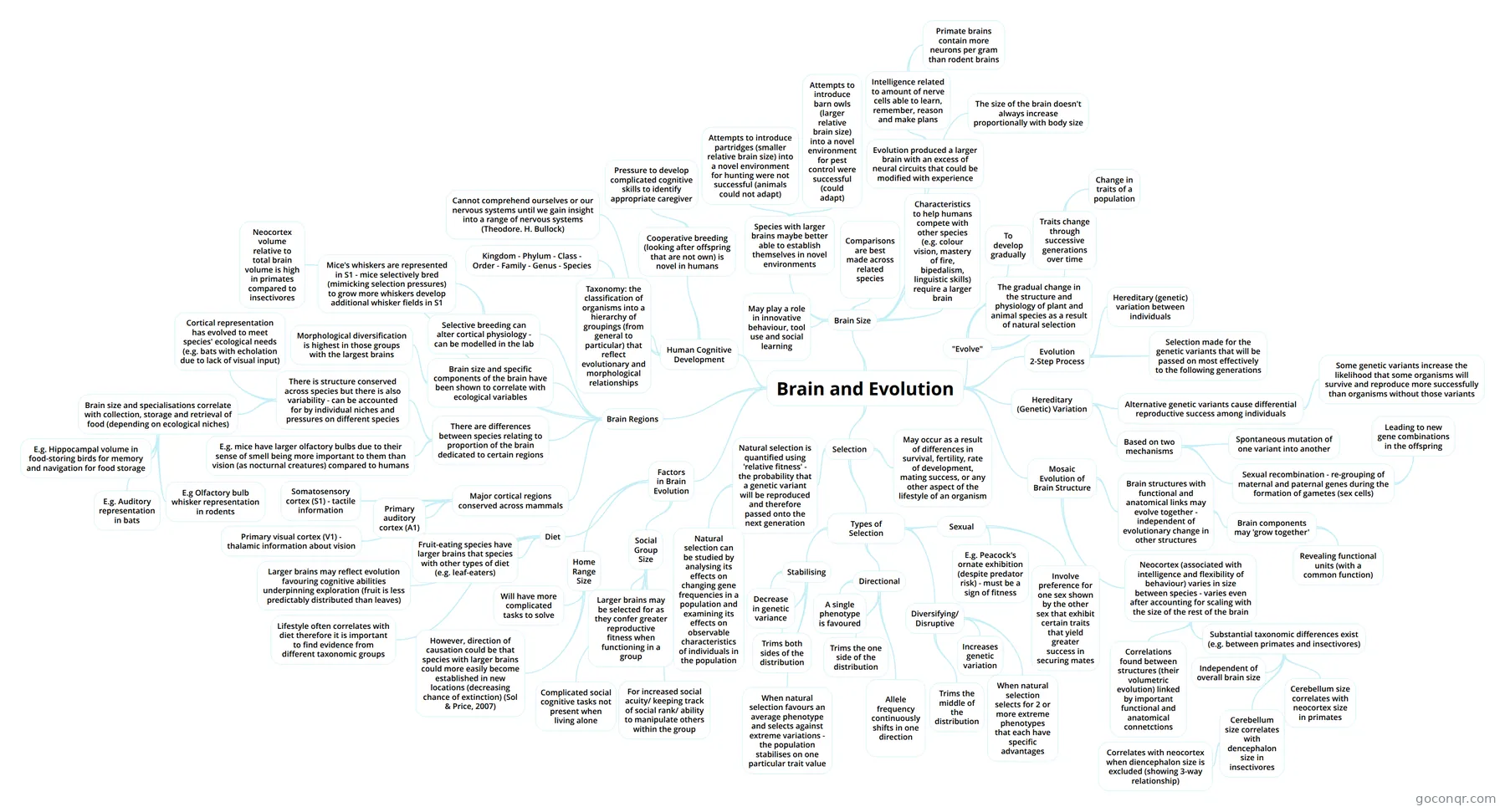
Mind map: Brain and evolution
Conteúdo do mapa
Brain and Evolution
"Evolve"
- To develop gradually
- The gradual change in the structure and physiology of plant and animal species as a result of natural selection
- Traits change through successive generations over time
- Change in traits of a population
Brain Size
- May play a role in innovative behaviour, tool use and social learning
- Species with larger brains maybe better able to establish themselves in novel environments
- Attempts to introduce partridges (smaller relative brain size) into a novel environment for hunting were not successful (animals could not adapt)
- Attempts to introduce barn owls (larger relative brain size) into a novel environment for pest control were successful (could adapt)
- Comparisons are best made across related species
- Characteristics to help humans compete with other species (e.g. colour vision, mastery of fire, bipedalism, linguistic skills) require a larger brain
- Evolution produced a larger brain with an excess of neural circuits that could be modified with experience
- Intelligence related to amount of nerve cells able to learn, remember, reason and make plans
- Primate brains contain more neurons per gram than rodent brains
- Intelligence related to amount of nerve cells able to learn, remember, reason and make plans
- The size of the brain doesn't always increase proportionally with body size
Evolution 2-Step Process
- Hereditary (genetic) variation between individuals
- Selection made for the genetic variants that will be passed on most effectively to the following generations
Hereditary (Genetic) Variation
- Based on two mechanisms
- Spontaneous mutation of one variant into another
- Sexual recombination - re-grouping of maternal and paternal genes during the formation of gametes (sex cells)
- Leading to new gene combinations in the offspring
- Alternative genetic variants cause differential reproductive success among individuals
- Some genetic variants increase the likelihood that some organisms will survive and reproduce more successfully than organisms without those variants
- Based on two mechanisms
Selection
- May occur as a result of differences in survival, fertility, rate of development, mating success, or any other aspect of the lifestyle of an organism
- Natural selection is quantified using 'relative fitness' - the probability that a genetic variant will be reproduced and therefore passed onto the next generation
- Natural selection can be studied by analysing its effects on changing gene frequencies in a population and examining its effects on observable characteristics of individuals in the population
- Types of Selection
- Stabilising
- Decrease in genetic variance
- Trims both sides of the distribution
- When natural selection favours an average phenotype and selects against extreme variations - the population stabilises on one particular trait value
- Directional
- A single phenotype is favoured
- Trims the one side of the distribution
- Allele frequency continuously shifts in one direction
- Diversifying/ Disruptive
- Increases genetic variation
- Trims the middle of the distribution
- When natural selection selects for 2 or more extreme phenotypes that each have specific advantages
- Sexual
- Involve preference for one sex shown by the other sex that exhibit certain traits that yield greater success in securing mates
- E.g. Peacock's ornate exhibition (despite predator risk) - must be a sign of fitness
- Stabilising
Brain Regions
- Brain size and specific components of the brain have been shown to correlate with ecological variables
- Morphological diversification is highest in those groups with the largest brains
- There are differences between species relating to proportion of the brain dedicated to certain regions
- There is structure conserved across species but there is also variability - can be accounted for by individual niches and pressures on different species
- Cortical representation has evolved to meet species' ecological needs (e.g. bats with echolation due to lack of visual input)
- Brain size and specialisations correlate with collection, storage and retrieval of food (depending on ecological niches)
- E.g. Hippocampal volume in food-storing birds for memory and navigation for food storage
- E.g Olfactory bulb whisker representation in rodents
- E.g. Auditory representation in bats
- E.g. mice have larger olfactory bulbs due to their sense of smell being more important to them than vision (as nocturnal creatures) compared to humans
- There is structure conserved across species but there is also variability - can be accounted for by individual niches and pressures on different species
- Major cortical regions conserved across mammals
- Somatosensory cortex (S1) - tactile information
- Primary visual cortex (V1) - thalamic information about vision
- Primary auditory cortex (A1)
- Selective breeding can alter cortical physiology - can be modelled in the lab
- Mice's whiskers are represented in S1 - mice selectively bred (mimicking selection pressures) to grow more whiskers develop additional whisker fields in S1
- Neocortex volume relative to total brain volume is high in primates compared to insectivores
- Brain size and specific components of the brain have been shown to correlate with ecological variables
Human Cognitive Development
- Cooperative breeding (looking after offspring that are not own) is novel in humans
- Pressure to develop complicated cognitive skills to identify appropriate caregiver
- Taxonomy: the classification of organisms into a hierarchy of groupings (from general to particular) that reflect evolutionary and morphological relationships
- Kingdom - Phylum - Class - Order - Family - Genus - Species
- Cannot comprehend ourselves or our nervous systems until we gain insight into a range of nervous systems (Theodore. H. Bullock)
- Cooperative breeding (looking after offspring that are not own) is novel in humans
Factors in Brain Evolution
- Diet
- Fruit-eating species have larger brains that species with other types of diet (e.g. leaf-eaters)
- Larger brains may reflect evolution favouring cognitive abilities underpinning exploration (fruit is less predictably distributed than leaves)
- Lifestyle often correlates with diet therefore it is important to find evidence from different taxonomic groups
- Home Range Size
- Will have more complicated tasks to solve
- However, direction of causation could be that species with larger brains could more easily become established in new locations (decreasing chance of extinction) (Sol & Price, 2007)
- Social Group Size
- Larger brains may be selected for as they confer greater reproductive fitness when functioning in a group
- Complicated social cognitive tasks not present when living alone
- For increased social acuity/ keeping track of social rank/ ability to manipulate others within the group
- Diet
Mosaic Evolution of Brain Structure
- Brain structures with functional and anatomical links may evolve together - independent of evolutionary change in other structures
- Brain components may 'grow together'
- Revealing functional units (with a common function)
- Brain components may 'grow together'
- Neocortex (associated with intelligence and flexibility of behaviour) varies in size between species - varies even after accounting for scaling with the size of the rest of the brain
- Substantial taxonomic differences exist (e.g. between primates and insectivores)
- Independent of overall brain size
- Cerebellum size correlates with neocortex size in primates
- Cerebellum size correlates with dencephalon size in insectivores
- Correlates with neocortex when diencephalon size is excluded (showing 3-way relationship)
- Correlations found between structures (their volumetric evolution) linked by important functional and anatomical connetctions
- Substantial taxonomic differences exist (e.g. between primates and insectivores)
- Brain structures with functional and anatomical links may evolve together - independent of evolutionary change in other structures
Informações
- Descrição
- Mapa Mental sobre Brain and Evolution, criado por hsmailes em 27-04-2015.
- Criado por
- hsmailes
- Visualizações
- 2
- Avaliação