
Mapa mental
A DISCUSSION OF THE NOTIONAL-FUNCTIONAL SYLLABUS
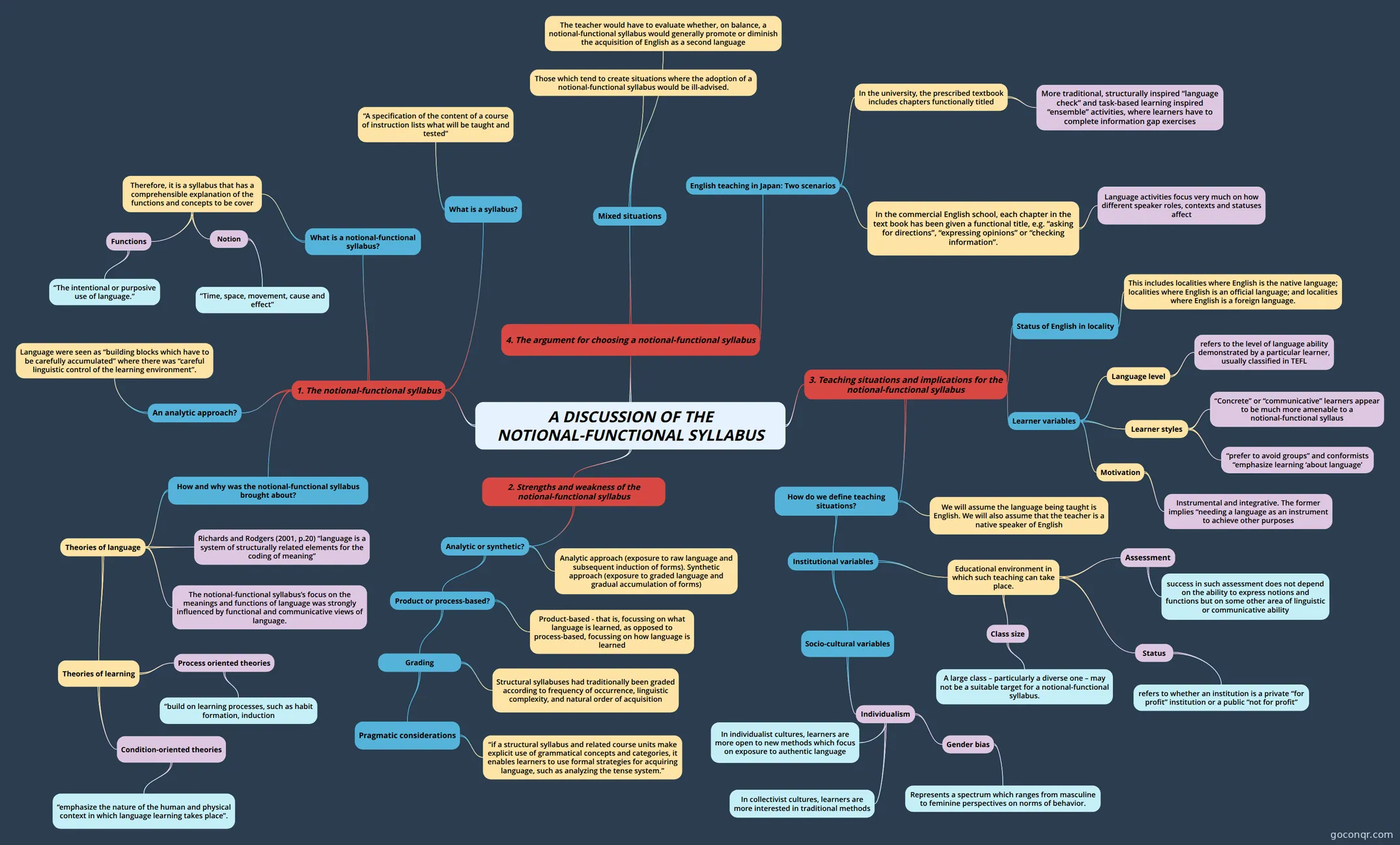
Mind map: notional-functional syllabus
Conteúdo do mapa
A DISCUSSION OF THE NOTIONAL-FUNCTIONAL SYLLABUS
1. The notional-functional syllabus
- What is a syllabus?
- “A specification of the content of a course of instruction lists what will be taught and tested”
- What is a notional-functional syllabus?
- Therefore, it is a syllabus that has a comprehensible explanation of the functions and concepts to be cover
- Notion
- “Time, space, movement, cause and effect”
- Functions
- “The intentional or purposive use of language.”
- Notion
- Therefore, it is a syllabus that has a comprehensible explanation of the functions and concepts to be cover
- How and why was the notional-functional syllabus brought about?
- Theories of language
- Richards and Rodgers (2001, p.20) “language is a system of structurally related elements for the coding of meaning”
- The notional-functional syllabus’s focus on the meanings and functions of language was strongly influenced by functional and communicative views of language.
- Theories of learning
- Process oriented theories
- “build on learning processes, such as habit formation, induction
- Condition-oriented theories
- “emphasize the nature of the human and physical context in which language learning takes place”.
- Process oriented theories
- Theories of language
- An analytic approach?
- Language were seen as “building blocks which have to be carefully accumulated” where there was “careful linguistic control of the learning environment”.
- What is a syllabus?
2. Strengths and weakness of the notional-functional syllabus
- Analytic or synthetic?
- Analytic approach (exposure to raw language and subsequent induction of forms). Synthetic approach (exposure to graded language and gradual accumulation of forms)
- Product or process-based?
- Product-based - that is, focussing on what language is learned, as opposed to process-based, focussing on how language is learned
- Grading
- Structural syllabuses had traditionally been graded according to frequency of occurrence, linguistic complexity, and natural order of acquisition
- Pragmatic considerations
- “if a structural syllabus and related course units make explicit use of grammatical concepts and categories, it enables learners to use formal strategies for acquiring language, such as analyzing the tense system.”
- Analytic or synthetic?
3. Teaching situations and implications for the notional-functional syllabus
- How do we define teaching situations?
- We will assume the language being taught is English. We will also assume that the teacher is a native speaker of English
- Institutional variables
- Educational environment in which such teaching can take place.
- Class size
- A large class – particularly a diverse one – may not be a suitable target for a notional-functional syllabus.
- Assessment
- success in such assessment does not depend on the ability to express notions and functions but on some other area of linguistic or communicative ability
- Status
- refers to whether an institution is a private “for profit” institution or a public “not for profit”
- Class size
- Socio-cultural variables
- Individualism
- In collectivist cultures, learners are more interested in traditional methods
- In individualist cultures, learners are more open to new methods which focus on exposure to authentic language
- Gender bias
- Represents a spectrum which ranges from masculine to feminine perspectives on norms of behavior.
- Individualism
- Educational environment in which such teaching can take place.
- Learner variables
- Language level
- refers to the level of language ability demonstrated by a particular learner, usually classified in TEFL
- Learner styles
- “Concrete” or “communicative” learners appear to be much more amenable to a notional-functional syllaus
- “prefer to avoid groups” and conformists “emphasize learning ‘about language’
- Motivation
- Instrumental and integrative. The former implies “needing a language as an instrument to achieve other purposes
- Language level
- Status of English in locality
- This includes localities where English is the native language; localities where English is an official language; and localities where English is a foreign language.
- How do we define teaching situations?
4. The argument for choosing a notional-functional syllabus
- Mixed situations
- Those which tend to create situations where the adoption of a notional-functional syllabus would be ill-advised.
- The teacher would have to evaluate whether, on balance, a notional-functional syllabus would generally promote or diminish the acquisition of English as a second language
- English teaching in Japan: Two scenarios
- In the commercial English school, each chapter in the text book has been given a functional title, e.g. “asking for directions”, “expressing opinions” or “checking information”.
- Language activities focus very much on how different speaker roles, contexts and statuses affect
- In the university, the prescribed textbook includes chapters functionally titled
- More traditional, structurally inspired “language check” and task-based learning inspired “ensemble” activities, where learners have to complete information gap exercises
- In the commercial English school, each chapter in the text book has been given a functional title, e.g. “asking for directions”, “expressing opinions” or “checking information”.
- Mixed situations
Informações
- Descrição
- TRENDS IN EDUCATION. By Mayra Aucapiña
- Criado por
- mayra aucapiña
- Visualizações
- 60
- Tags
- Avaliação