
Mapa mental
Judicial Precedent
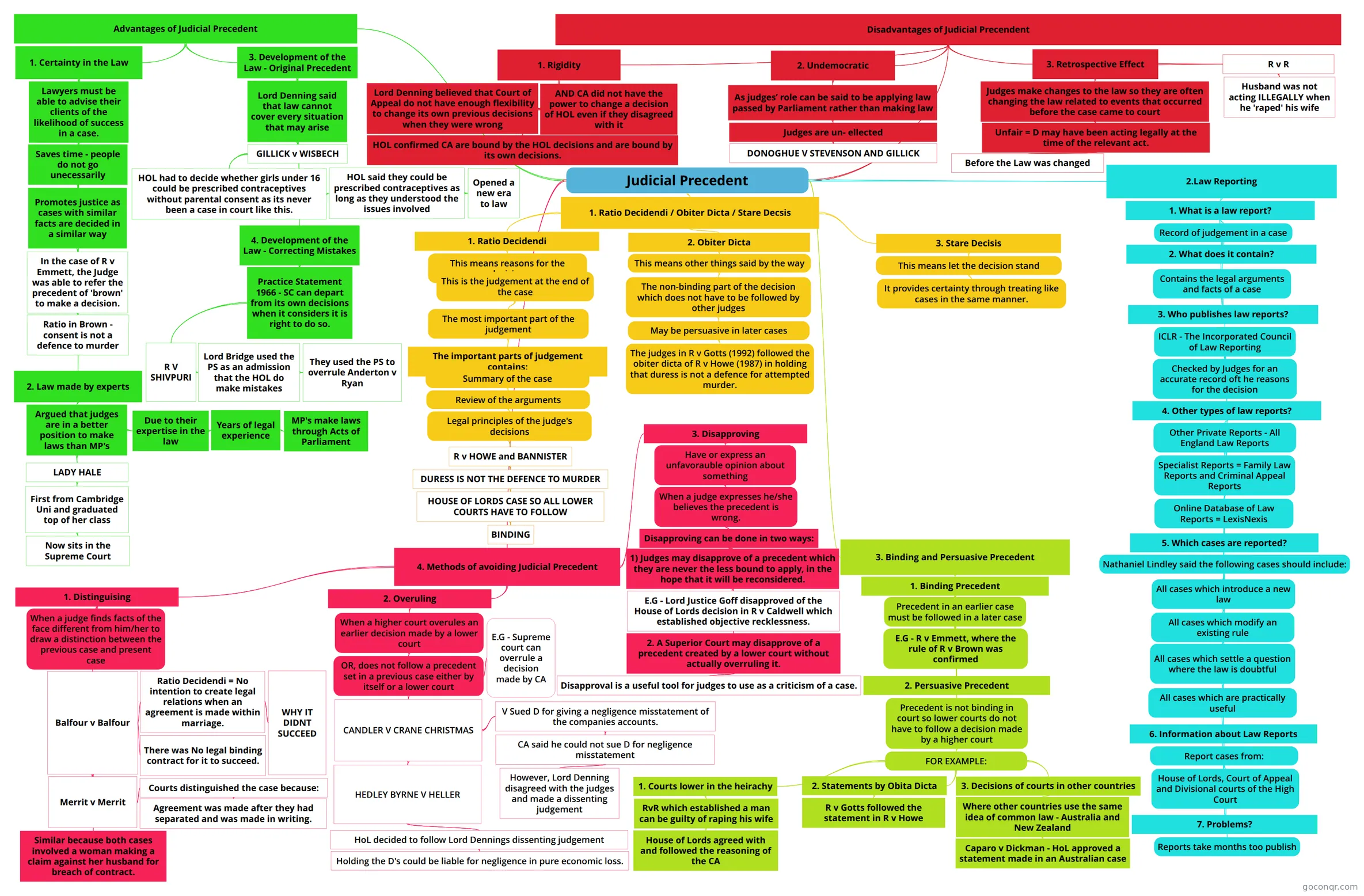
Mind map: Judicial precedent
Conteúdo do mapa
Judicial Precedent
1. Ratio Decidendi / Obiter Dicta / Stare Decsis
- 1. Ratio Decidendi
- This means reasons for the decision
- This is the judgement at the end of the case
- The most important part of the judgement
- The important parts of judgement contains:
- Summary of the case
- Review of the arguments
- Legal principles of the judge's decisions
- R v HOWE and BANNISTER
- DURESS IS NOT THE DEFENCE TO MURDER
- HOUSE OF LORDS CASE SO ALL LOWER COURTS HAVE TO FOLLOW
- BINDING
- HOUSE OF LORDS CASE SO ALL LOWER COURTS HAVE TO FOLLOW
- DURESS IS NOT THE DEFENCE TO MURDER
- R v HOWE and BANNISTER
- Legal principles of the judge's decisions
- Review of the arguments
- Summary of the case
- The important parts of judgement contains:
- The most important part of the judgement
- This is the judgement at the end of the case
- This means reasons for the decision
- 2. Obiter Dicta
- This means other things said by the way
- The non-binding part of the decision which does not have to be followed by other judges
- May be persuasive in later cases
- The judges in R v Gotts (1992) followed the obiter dicta of R v Howe (1987) in holding that duress is not a defence for attempted murder.
- May be persuasive in later cases
- The non-binding part of the decision which does not have to be followed by other judges
- This means other things said by the way
- 3. Stare Decisis
- This means let the decision stand
- It provides certainty through treating like cases in the same manner.
- This means let the decision stand
- 1. Ratio Decidendi
2.Law Reporting
- 1. What is a law report?
- Record of judgement in a case
- Contains the legal arguments and facts of a case
- ICLR - The Incorporated Council of Law Reporting
- 4. Other types of law reports?
- Other Private Reports - All England Law Reports
- Specialist Reports = Family Law Reports and Criminal Appeal Reports
- Online Database of Law Reports = LexisNexis
- All cases which introduce a new law
- All cases which modify an existing rule
- All cases which settle a question where the law is doubtful
- All cases which are practically useful
- Report cases from:
- House of Lords, Court of Appeal and Divisional courts of the High Court
- Reports take months too publish
- House of Lords, Court of Appeal and Divisional courts of the High Court
- Report cases from:
- All cases which are practically useful
- All cases which settle a question where the law is doubtful
- Nathaniel Lindley said the following cases should include:
- All cases which modify an existing rule
- All cases which introduce a new law
- Online Database of Law Reports = LexisNexis
- Specialist Reports = Family Law Reports and Criminal Appeal Reports
- 5. Which cases are reported?
- 6. Information about Law Reports
- 7. Problems?
- 6. Information about Law Reports
- Other Private Reports - All England Law Reports
- Checked by Judges for an accurate record oft he reasons for the decision
- 4. Other types of law reports?
- ICLR - The Incorporated Council of Law Reporting
- Contains the legal arguments and facts of a case
- 2. What does it contain?
- 3. Who publishes law reports?
- Record of judgement in a case
- 1. What is a law report?
3. Binding and Persuasive Precedent
- 1. Binding Precedent
- Precedent in an earlier case must be followed in a later case
- E.G - R v Emmett, where the rule of R v Brown was confirmed
- Precedent is not binding in court so lower courts do not have to follow a decision made by a higher court
- FOR EXAMPLE:
- 1. Courts lower in the heirachy
- RvR which established a man can be guilty of raping his wife
- House of Lords agreed with and followed the reasoning of the CA
- RvR which established a man can be guilty of raping his wife
- 2. Statements by Obita Dicta
- R v Gotts followed the statement in R v Howe
- 3. Decisions of courts in other countries
- Where other countries use the same idea of common law - Australia and New Zealand
- Caparo v Dickman - HoL approved a statement made in an Australian case
- Where other countries use the same idea of common law - Australia and New Zealand
- 1. Courts lower in the heirachy
- FOR EXAMPLE:
- 2. Persuasive Precedent
- Precedent in an earlier case must be followed in a later case
- 1. Binding Precedent
4. Methods of avoiding Judicial Precedent
- 1. Distinguising
- When a judge finds facts of the face different from him/her to draw a distinction between the previous case and present case
- Balfour v Balfour
- Merrit v Merrit
- Courts distinguished the case because:
- Agreement was made after they had separated and was made in writing.
- Courts distinguished the case because:
- Similar because both cases involved a woman making a claim against her husband for breach of contract.
- There was No legal binding contract for it to succeed.
- Ratio Decidendi = No intention to create legal relations when an agreement is made within marriage.
- WHY IT DIDNT SUCCEED
- Merrit v Merrit
- 2. Overuling
- When a higher court overules an earlier decision made by a lower court
- OR, does not follow a precedent set in a previous case either by itself or a lower court
- E.G - Supreme court can overrule a decision made by CA
- CANDLER V CRANE CHRISTMAS
- V Sued D for giving a negligence misstatement of the companies accounts.
- CA said he could not sue D for negligence misstatement
- However, Lord Denning disagreed with the judges and made a dissenting judgement
- CA said he could not sue D for negligence misstatement
- HEDLEY BYRNE V HELLER
- HoL decided to follow Lord Dennings dissenting judgement
- Holding the D's could be liable for negligence in pure economic loss.
- HoL decided to follow Lord Dennings dissenting judgement
- V Sued D for giving a negligence misstatement of the companies accounts.
- OR, does not follow a precedent set in a previous case either by itself or a lower court
- When a higher court overules an earlier decision made by a lower court
- 3. Disapproving
- Have or express an unfavorauble opinion about something
- When a judge expresses he/she believes the precedent is wrong.
- Disapproving can be done in two ways:
- 1) Judges may disapprove of a precedent which they are never the less bound to apply, in the hope that it will be reconsidered.
- E.G - Lord Justice Goff disapproved of the House of Lords decision in R v Caldwell which established objective recklessness.
- 2. A Superior Court may disapprove of a precedent created by a lower court without actually overruling it.
- Disapproval is a useful tool for judges to use as a criticism of a case.
- 1) Judges may disapprove of a precedent which they are never the less bound to apply, in the hope that it will be reconsidered.
- Disapproving can be done in two ways:
- When a judge expresses he/she believes the precedent is wrong.
- Have or express an unfavorauble opinion about something
- 1. Distinguising
Advantages of Judicial Precedent
- 1. Certainty in the Law
- Lawyers must be able to advise their clients of the likelihood of success in a case.
- Saves time - people do not go unecessarily
- Promotes justice as cases with similar facts are decided in a similar way
- In the case of R v Emmett, the Judge was able to refer the precedent of 'brown' to make a decision.
- Ratio in Brown - consent is not a defence to murder
- In the case of R v Emmett, the Judge was able to refer the precedent of 'brown' to make a decision.
- Promotes justice as cases with similar facts are decided in a similar way
- Saves time - people do not go unecessarily
- 2. Law made by experts
- Argued that judges are in a better position to make laws than MP's
- Due to their expertise in the law
- Years of legal experience
- MP's make laws through Acts of Parliament
- Years of legal experience
- LADY HALE
- First from Cambridge Uni and graduated top of her class
- Now sits in the Supreme Court
- First from Cambridge Uni and graduated top of her class
- Due to their expertise in the law
- Argued that judges are in a better position to make laws than MP's
- Lawyers must be able to advise their clients of the likelihood of success in a case.
- 3. Development of the Law - Original Precedent
- Lord Denning said that law cannot cover every situation that may arise
- GILLICK v WISBECH
- HOL had to decide whether girls under 16 could be prescribed contraceptives without parental consent as its never been a case in court like this.
- HOL said they could be prescribed contraceptives as long as they understood the issues involved
- Opened a new era to law
- HOL said they could be prescribed contraceptives as long as they understood the issues involved
- HOL had to decide whether girls under 16 could be prescribed contraceptives without parental consent as its never been a case in court like this.
- GILLICK v WISBECH
- 4. Development of the Law - Correcting Mistakes
- Practice Statement 1966 - SC can depart from its own decisions when it considers it is right to do so.
- R V SHIVPURI
- Lord Bridge used the PS as an admission that the HOL do make mistakes
- They used the PS to overrule Anderton v Ryan
- Lord Bridge used the PS as an admission that the HOL do make mistakes
- R V SHIVPURI
- Practice Statement 1966 - SC can depart from its own decisions when it considers it is right to do so.
- Lord Denning said that law cannot cover every situation that may arise
- 1. Certainty in the Law
Disadvantages of Judicial Precendent
- 1. Rigidity
- Lord Denning believed that Court of Appeal do not have enough flexibility to change its own previous decisions when they were wrong
- AND CA did not have the power to change a decision of HOL even if they disagreed with it
- HOL confirmed CA are bound by the HOL decisions and are bound by its own decisions.
- AND CA did not have the power to change a decision of HOL even if they disagreed with it
- Lord Denning believed that Court of Appeal do not have enough flexibility to change its own previous decisions when they were wrong
- 2. Undemocratic
- As judges’ role can be said to be applying law passed by Parliament rather than making law
- Judges are un- ellected
- DONOGHUE V STEVENSON AND GILLICK
- Judges are un- ellected
- As judges’ role can be said to be applying law passed by Parliament rather than making law
- 3. Retrospective Effect
- Judges make changes to the law so they are often changing the law related to events that occurred before the case came to court
- Unfair = D may have been acting legally at the time of the relevant act.
- Before the Law was changed
- Unfair = D may have been acting legally at the time of the relevant act.
- R v R
- Husband was not acting ILLEGALLY when he 'raped' his wife
- Judges make changes to the law so they are often changing the law related to events that occurred before the case came to court
- 1. Rigidity
Informações
- Descrição
- Mapa Mental sobre Judicial Precedent, criado por munawar1998 em 01-05-2015.
- Criado por
- munawar1998
- Visualizações
- 51
- Avaliação