
Mapa mental
The problem of evil
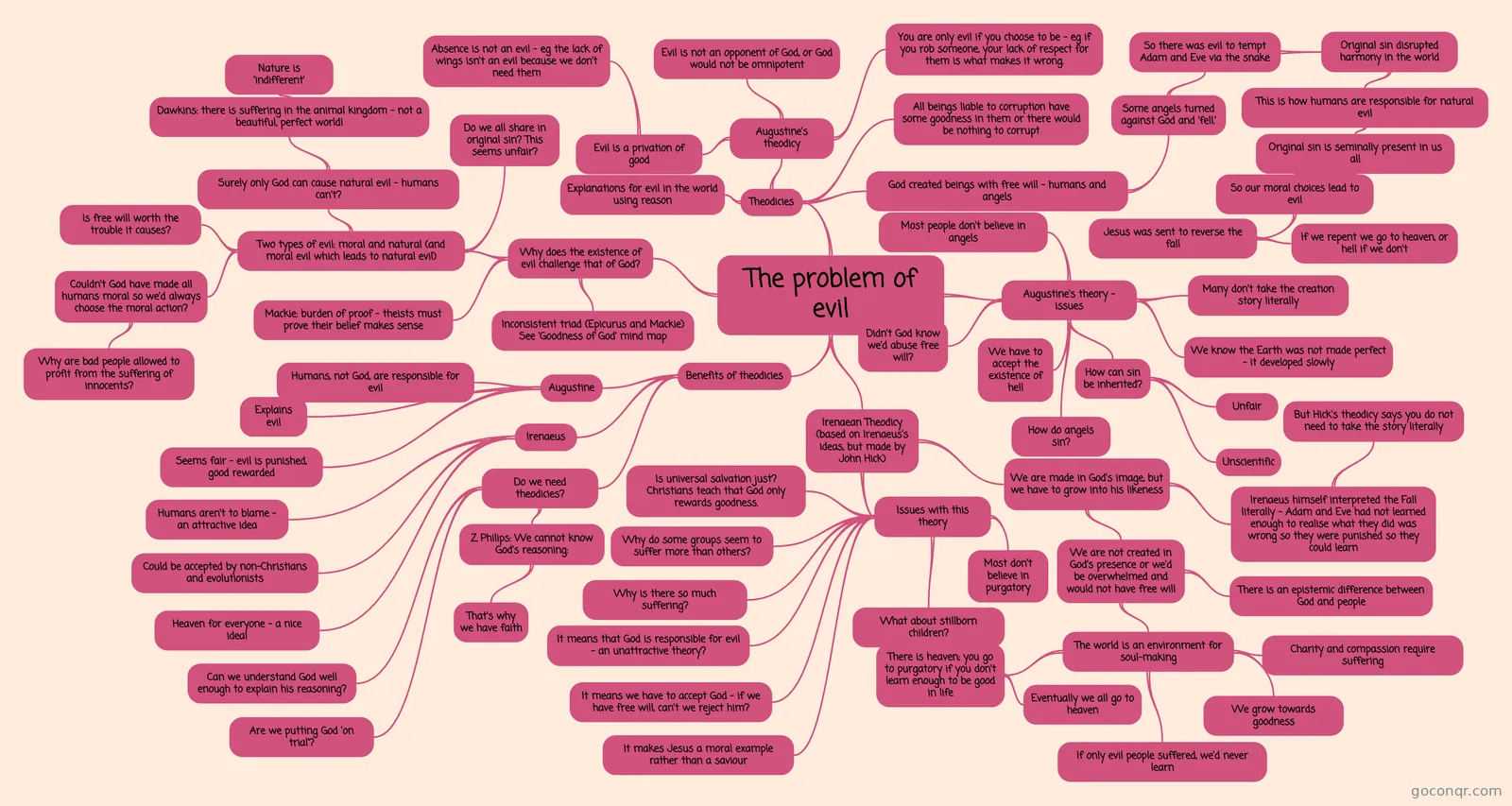
Mind map: the problem of evil
Conteúdo do mapa
The problem of evil
Why does the existence of evil challenge that of God?
- Inconsistent triad (Epicurus and Mackie) See 'Goodness of God' mind map
- Mackie: burden of proof - theists must prove their belief makes sense
- Two types of evil: moral and natural (and moral evil which leads to natural evil)
- Surely only God can cause natural evil - humans can't?
- Dawkins: there is suffering in the animal kingdom - not a beautiful, perfect world!
- Nature is 'indifferent'
- Dawkins: there is suffering in the animal kingdom - not a beautiful, perfect world!
- Is free will worth the trouble it causes?
- Couldn't God have made all humans moral so we'd always choose the moral action?
- Why are bad people allowed to profit from the suffering of innocents?
- Do we all share in original sin? This seems unfair?
- Surely only God can cause natural evil - humans can't?
Theodicies
- Explanations for evil in the world using reason
- Augustine's theodicy
- Evil is a privation of good
- Absence is not an evil - eg the lack of wings isn't an evil because we don't need them
- Evil is not an opponent of God, or God would not be omnipotent
- You are only evil if you choose to be - eg if you rob someone, your lack of respect for them is what makes it wrong.
- Evil is a privation of good
- All beings liable to corruption have some goodness in them or there would be nothing to corrupt
- God created beings with free will - humans and angels
- Some angels turned against God and 'fell.'
- So there was evil to tempt Adam and Eve via the snake
- Original sin disrupted harmony in the world
- This is how humans are responsible for natural evil
- Original sin is seminally present in us all
- So our moral choices lead to evil
- Jesus was sent to reverse the fall
- If we repent we go to heaven, or hell if we don't
- Jesus was sent to reverse the fall
- So our moral choices lead to evil
- Original sin is seminally present in us all
- This is how humans are responsible for natural evil
- Original sin disrupted harmony in the world
- So there was evil to tempt Adam and Eve via the snake
- Some angels turned against God and 'fell.'
Augustine's theory - issues
- Most people don't believe in angels
- Many don't take the creation story literally
- We know the Earth was not made perfect - it developed slowly
- How can sin be inherited?
- Unscientific
- Unfair
- How do angels sin?
- We have to accept the existence of hell
- Didn't God know we'd abuse free will?
Irenaean Theodicy (based on Irenaeus's ideas, but made by John Hick)
- We are made in God's image, but we have to grow into his likeness
- Irenaeus himself interpreted the Fall literally - Adam and Eve had not learned enough to realise what they did was wrong so they were punished so they could learn
- But Hick's theodicy says you do not need to take the story literally
- We are not created in God's presence or we'd be overwhelmed and would not have free will
- There is an epistemic difference between God and people
- The world is an environment for soul-making
- Charity and compassion require suffering
- We grow towards goodness
- If only evil people suffered, we'd never learn
- There is heaven; you go to purgatory if you don't learn enough to be good in life
- Eventually we all go to heaven
- Irenaeus himself interpreted the Fall literally - Adam and Eve had not learned enough to realise what they did was wrong so they were punished so they could learn
- Issues with this theory
- Most don't believe in purgatory
- Is universal salvation just? Christians teach that God only rewards goodness.
- What about stillborn children?
- Why do some groups seem to suffer more than others?
- Why is there so much suffering?
- It means that God is responsible for evil - an unattractive theory?
- It means we have to accept God - if we have free will, can't we reject him?
- It makes Jesus a moral example rather than a saviour
- We are made in God's image, but we have to grow into his likeness
Benefits of theodicies
- Augustine
- Explains evil
- Humans, not God, are responsible for evil
- Seems fair - evil is punished, good rewarded
- Irenaeus
- Humans aren't to blame - an attractive idea
- Could be accepted by non-Christians and evolutionists
- Heaven for everyone - a nice idea!
- Do we need theodicies?
- Can we understand God well enough to explain his reasoning?
- Are we putting God 'on trial'?
- Z Philips: We cannot know God's reasoning:
- That's why we have faith
- Augustine
Informações
- Descrição
- A-Level Philosophy Mapa Mental sobre The problem of evil, criado por Sumahlor em 04-05-2015.
- Criado por
- Sumahlor
- Visualizações
- 28
- Tags
- Avaliação