
Mapa mental
Chapter 1: Parenting and attachment
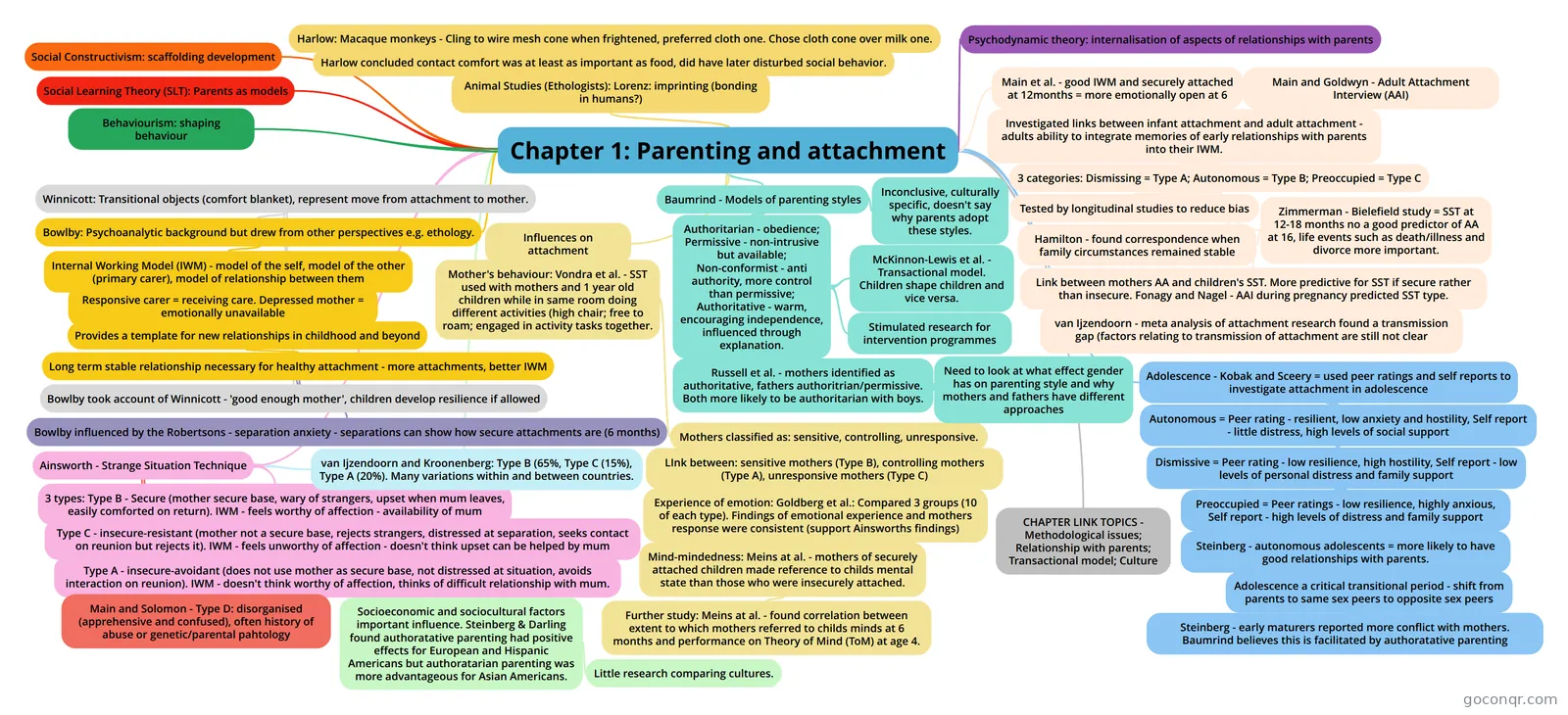
Mind map: Chapter 1: Parenting and attachment
Conteúdo do mapa
Chapter 1: Parenting and attachment
Behaviourism: shaping behaviour
Social Learning Theory (SLT): Parents as models
Social Constructivism: scaffolding development
Psychodynamic theory: internalisation of aspects of relationships with parents
Animal Studies (Ethologists): Lorenz: imprinting (bonding in humans?)
- Harlow: Macaque monkeys - Cling to wire mesh cone when frightened, preferred cloth one. Chose cloth cone over milk one.
- Harlow concluded contact comfort was at least as important as food, did have later disturbed social behavior.
- Harlow: Macaque monkeys - Cling to wire mesh cone when frightened, preferred cloth one. Chose cloth cone over milk one.
Bowlby: Psychoanalytic background but drew from other perspectives e.g. ethology.
- Internal Working Model (IWM) - model of the self, model of the other (primary carer), model of relationship between them
- Responsive carer = receiving care. Depressed mother = emotionally unavailable
- Provides a template for new relationships in childhood and beyond
- Long term stable relationship necessary for healthy attachment - more attachments, better IWM
- Bowlby influenced by the Robertsons - separation anxiety - separations can show how secure attachments are (6 months)
- Long term stable relationship necessary for healthy attachment - more attachments, better IWM
- Winnicott: Transitional objects (comfort blanket), represent move from attachment to mother.
- Bowlby took account of Winnicott - 'good enough mother', children develop resilience if allowed
- Internal Working Model (IWM) - model of the self, model of the other (primary carer), model of relationship between them
Ainsworth - Strange Situation Technique
- 3 types: Type B - Secure (mother secure base, wary of strangers, upset when mum leaves, easily comforted on return). IWM - feels worthy of affection - availability of mum
- Type C - insecure-resistant (mother not a secure base, rejects strangers, distressed at separation, seeks contact on reunion but rejects it). IWM - feels unworthy of affection - doesn't think upset can be helped by mum
- Type A - insecure-avoidant (does not use mother as secure base, not distressed at situation, avoids interaction on reunion). IWM - doesn't think worthy of affection, thinks of difficult relationship with mum.
- Type C - insecure-resistant (mother not a secure base, rejects strangers, distressed at separation, seeks contact on reunion but rejects it). IWM - feels unworthy of affection - doesn't think upset can be helped by mum
- Main and Solomon - Type D: disorganised (apprehensive and confused), often history of abuse or genetic/parental pahtology
- van Ijzendoorn and Kroonenberg: Type B (65%, Type C (15%), Type A (20%). Many variations within and between countries.
- 3 types: Type B - Secure (mother secure base, wary of strangers, upset when mum leaves, easily comforted on return). IWM - feels worthy of affection - availability of mum
Influences on attachment
- Mother's behaviour: Vondra et al. - SST used with mothers and 1 year old children while in same room doing different activities (high chair; free to roam; engaged in activity tasks together.
- Mothers classified as: sensitive, controlling, unresponsive.
- LInk between: sensitive mothers (Type B), controlling mothers (Type A), unresponsive mothers (Type C)
- Experience of emotion: Goldberg et al.: Compared 3 groups (10 of each type). Findings of emotional experience and mothers response were consistent (support Ainsworths findings)
- Mind-mindedness: Meins at al. - mothers of securely attached children made reference to childs mental state than those who were insecurely attached.
- Further study: Meins at al. - found correlation between extent to which mothers referred to childs minds at 6 months and performance on Theory of Mind (ToM) at age 4.
- Mind-mindedness: Meins at al. - mothers of securely attached children made reference to childs mental state than those who were insecurely attached.
- Experience of emotion: Goldberg et al.: Compared 3 groups (10 of each type). Findings of emotional experience and mothers response were consistent (support Ainsworths findings)
- LInk between: sensitive mothers (Type B), controlling mothers (Type A), unresponsive mothers (Type C)
- Mothers classified as: sensitive, controlling, unresponsive.
- Mother's behaviour: Vondra et al. - SST used with mothers and 1 year old children while in same room doing different activities (high chair; free to roam; engaged in activity tasks together.
Baumrind - Models of parenting styles
- Authoritarian - obedience; Permissive - non-intrusive but available; Non-conformist - anti authority, more control than permissive; Authoritative - warm, encouraging independence, influenced through explanation.
- Russell et al. - mothers identified as authoritative, fathers authoritrian/permissive. Both more likely to be authoritarian with boys.
- Need to look at what effect gender has on parenting style and why mothers and fathers have different approaches
- McKinnon-Lewis et al. - Transactional model. Children shape children and vice versa.
- Stimulated research for intervention programmes
- Russell et al. - mothers identified as authoritative, fathers authoritrian/permissive. Both more likely to be authoritarian with boys.
- Inconclusive, culturally specific, doesn't say why parents adopt these styles.
- Authoritarian - obedience; Permissive - non-intrusive but available; Non-conformist - anti authority, more control than permissive; Authoritative - warm, encouraging independence, influenced through explanation.
Main et al. - good IWM and securely attached at 12months = more emotionally open at 6
- Main and Goldwyn - Adult Attachment Interview (AAI)
- Investigated links between infant attachment and adult attachment - adults ability to integrate memories of early relationships with parents into their IWM.
- 3 categories: Dismissing = Type A; Autonomous = Type B; Preoccupied = Type C
- Tested by longitudinal studies to reduce bias
- Zimmerman - Bielefield study = SST at 12-18 months no a good predictor of AA at 16, life events such as death/illness and divorce more important.
- Hamilton - found correspondence when family circumstances remained stable
- Link between mothers AA and children's SST. More predictive for SST if secure rather than insecure. Fonagy and Nagel - AAI during pregnancy predicted SST type.
- van Ijzendoorn - meta analysis of attachment research found a transmission gap (factors relating to transmission of attachment are still not clear
- 3 categories: Dismissing = Type A; Autonomous = Type B; Preoccupied = Type C
- Investigated links between infant attachment and adult attachment - adults ability to integrate memories of early relationships with parents into their IWM.
- Main and Goldwyn - Adult Attachment Interview (AAI)
Adolescence - Kobak and Sceery = used peer ratings and self reports to investigate attachment in adolescence
- Autonomous = Peer rating - resilient, low anxiety and hostility, Self report - little distress, high levels of social support
- Dismissive = Peer rating - low resilience, high hostility, Self report - low levels of personal distress and family support
- Preoccupied = Peer ratings - low resilience, highly anxious, Self report - high levels of distress and family support
- Steinberg - autonomous adolescents = more likely to have good relationships with parents.
- Adolescence a critical transitional period - shift from parents to same sex peers to opposite sex peers
- Steinberg - early maturers reported more conflict with mothers. Baumrind believes this is facilitated by authoratative parenting
- Adolescence a critical transitional period - shift from parents to same sex peers to opposite sex peers
- Steinberg - autonomous adolescents = more likely to have good relationships with parents.
- Preoccupied = Peer ratings - low resilience, highly anxious, Self report - high levels of distress and family support
- Dismissive = Peer rating - low resilience, high hostility, Self report - low levels of personal distress and family support
- Autonomous = Peer rating - resilient, low anxiety and hostility, Self report - little distress, high levels of social support
Socioeconomic and sociocultural factors important influence. Steinberg & Darling found authoratative parenting had positive effects for European and Hispanic Americans but authoratarian parenting was more advantageous for Asian Americans.
- Little research comparing cultures.
CHAPTER LINK TOPICS - Methodological issues; Relationship with parents; Transactional model; Culture
Informações
- Descrição
- Mapa Mental sobre Chapter 1: Parenting and attachment, criado por Lottie Pogson em 25-05-2015.
- Criado por
- Lottie Pogson
- Visualizações
- 0
- Avaliação