
Mapa mental
Representation Learning
Conteúdo do mapa
Representation Learning
Representation Learning: A Review and New Perspectives (Yoshua)
- why representation learning?
- make learning algorithms less dependent on feature engineering
- what makes a representation good?
- data priors for representation learning in IA
- smootheness
- multiple explanatory factors
- hierarchical organization of explanatory factors
- semi-supervised learning
- shared factors across tasks
- manifolds
- natural clustering
- temporal and spatial coherence
- sparsity
- simplicity of factor dependencies
- deep architectures
- promote the reuse of features
- leed to progressively more abstract features
- how to build deep architectures?
- A Fast Learning Algorithm for Deep Belief Nets (Hinton)
- Greedy Layer-Wise Training of Deep Networks (Yoshua)
- Efficient Learning of Sparse Representations with an Energy-Based Model (LeCunn)
- Learning Deep Architectures for AI (Yoshua)
- learn a hierarchy of features one level at a time
- distange factors of variation
- data priors for representation learning in IA
- applications
- speech recognition and signal processing
- object recognition
- natural language processing
- multi-task and transfer learning
- image reconstruction/recovery?
- why representation learning?
generative models
- model for randomly generating observable-data values, typically given some hidden parameters
- probabilistic models
- directed graphical models
- p(x,h) = p(x|h)p(h) : parametrizes the likelihood and the prior separately
- Gaussian Mixture Models (GMM)
- Naive Bayes
- PCA (probabilistic interpretation)
- p(h) = N(h;0;\sigma^2 I )
- p(x|h) = N(x; Wh+\mu_x, \sigma^2 I )
- latent representation h
- linear mapping W to the data x
- Sparse Coding (probabilistic interpretation)
- latent representation h
- linear mapping W to the data x
- includes a penalty to ensure a sparse activation of h is used to encode x
- dictionary learning: find the most suited linear mapping W
- K-SVD: An Algorithm for Designing Overcomplete Dictionaries for Sparse Representation (Aharon)
- application on image reconstruction/recovery
- Spike-and-Slab Sparse Coding
- p(x,h) = p(x|h)p(h) : parametrizes the likelihood and the prior separately
- undirected graphical model
- Markov Random FIelds (MRFs) parametrize p(x,h) through a product of unnormalized non-negative clique potentials
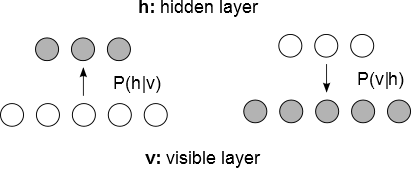
- Restricted Boltzman Machine (RBMs)
- p(x,h) defined with clique potentials constrained to be positive
- energy based models
- A Tutorial on Energy-Based Learning (LeCunn)
- energy based models
- positive phase computes p(h|x)
- negative pahse computes p(x|h)
- hiden layer and visible layer are binary
- may be stacked to compose a deep architecture
- generalization of the RBM to real-valued data are not ultimately solved yet
- Gaussian RBM (GRBM)
- mcRBM
- mPot
- ssRBM
- p(x,h) defined with clique potentials constrained to be positive
- directed graphical models
- models based on parametric map from input to representation
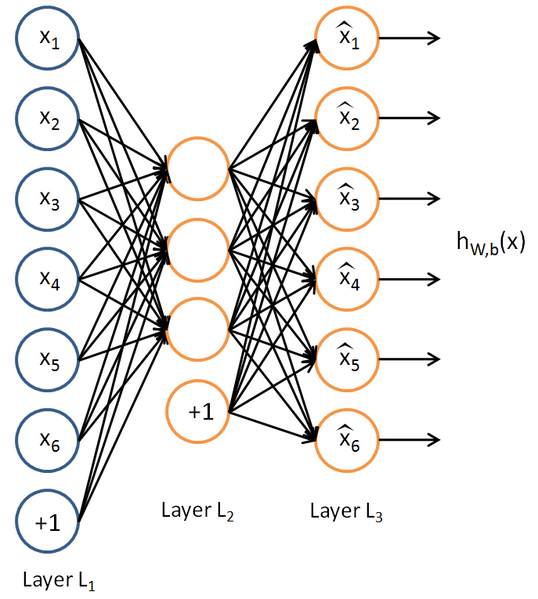
- Auto-Encoders
- defines an encoder function h = f(x)
- defines a decoder function x = g(h)
- g(h) está explicitamente associado à reconstrução do modelo (Yoshua)
- regularized Auto-Encoders
- prevents the auto-encoder to learn the identity function h = x
- Sparse Auto-Encoder (SAE)
- introduces sparsity regularization in the hidden unit
- Denoising Auto-Encoder (DAE)
- objective: recontruct the original data from a corrupted input
- learns more robust features than SAE
- DAE features perfoms similarly or better than RBM features (Yoshua)
- Contarctive Auto-Encoders
- relation with RBMs
- f(x) plays the role of P(h|x)
- g(h) plays the role of P(x|h)
- Auto-Encoders
Imagens e arquivos do mapa
Informações
- Descrição
- Mapa Mental sobre Representation Learning, criado por luisfilipeap1 em 29-05-2015.
- Criado por
- luisfilipeap1
- Visualizações
- 2
- Avaliação