
Mapa mental
LEXICAL RELATIONS
Conteúdo do mapa
LEXICAL RELATIONS
What is a word?
- A sequence of letters that we write consecutively, with no spaces
- Word Form
- the inflected form of a word represented by a stem and a list of inflections to be attached: fish, fishes, fished, fishing, etc.
- LEXEME
- Grouping of one or more word forms.
- LEXEME 1 fish, fishes, fished, fishing
- LEXEME 2 house, houses ;
- Grouping of one or more word forms.
- Possible restrictions:
- utility
- culture-dependency
Structural constaints on lexicalization
Lexical vs. grammatical meaning
- Elements carrying each kind of meaning:
- Closed-set items: grammatical meaning
- have to be general and flexible enough to be able to combine with a wide range of lexical roots.
- (Present-past-future go with almost the verbs, singular and plural with almost all the nouns, etc.)
- have to be general and flexible enough to be able to combine with a wide range of lexical roots.
- Open-set items: lexical meaning
- do not have any restriction on the richness of their meaning
- The former are normally added to the latter
- do not have any restriction on the richness of their meaning
- more on closet-set items:
- Articulate the grammatical structure of sentences
- -they change at a slow rate through time
- a single speaker is unlikely to see loss or gain of items
- more on open-set items:
- they belong to relatively large substitution sets
- there is a relatively rapid turnover in substitution classes
- a single speaker is likely to encounter many losses
- principal function is to carry the meaning of a sentence
- Closed-set items: grammatical meaning
- Major problems of lexical semantics
- Description of content
- Contextual variation
- Sense relations and structures in the lexicon
- Word meaning and syntactic properties
- Elements carrying each kind of meaning:
Sense relations – semantic relations between units of meaning
- Types of sense relations
- syntagmatic
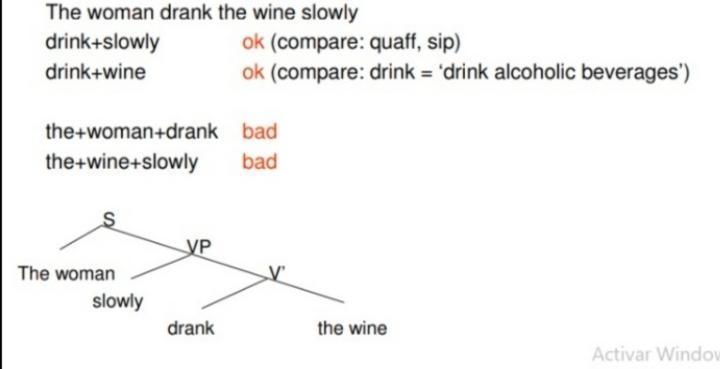
- Hold between items which occur in the same sentence. SYNTAX
- derivational
- word families (fish, fisher, fishy) MORPHOLOGY
- paradigmatic
- reflect the semantic choices available at a particular structure point in a sentence.
- syntagmatic
- Types of sense relations
Types of paradigmatic lexical relations in terms of set-theoretical relations
- I. Identity: class A and class B have the same members
- II. Inclusion: class B is wholly included in class A
- III. Disjunction: class A and class B have no members in common
- Incompatibility
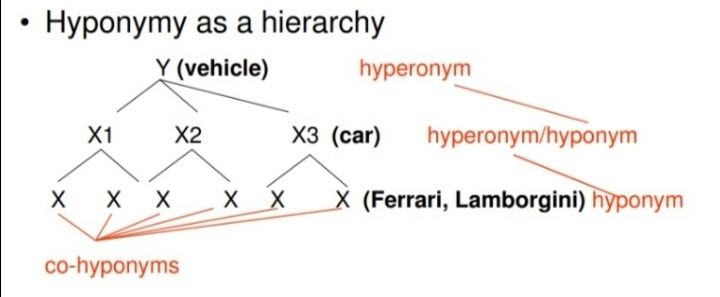
- co-hyponymy 1
- Nothing in the world can belong simultaneously to the class
- co-hyponymy 3
- co-hyponymy 1
- co-meronymy
- concepts are not clear-cut:
- Oppositeness
- Binarity
- Inherentness
- Patency
- Opposites 1: complementaries
- Is partitioned by the terms of the opposition into two mutually exclusive compartments
- Opposites 2: antonyms 1
- need to be interpreted comparatively in relation
- Opposites 2: antonyms 2
- The comparative forms of both terms are impartial
- Opposites 3: reversives
- Reversives are directional opposites which include -straightforward directions
- Incompatibility
- (hyperonymy) 1
- (hyperonymy) 2
- (hyperonymy) 3
- Is context independent
- (hyperonymy) 4
- hyponymy is a transitive relation
- (hyperonymy) 5
- require items related hyperonymously
- meronymy
- (holonymy) 1
- is the lexical reflex of the part-whole relation
- (holonymy) 2
- displays a prototypic character
- Necessity
- Integrality
- Discreteness
- (holonymy) 3
- Pieces are discrete once they have been formed
- displays a prototypic character
- (holonymy) 1
- III. Disjunction: class A and class B have no members in common
- Synonymy
- •Identity: synonymy sameness of meaning
- • Absolute synonymy: complete identity of meaning
- Propositional synonymy
- If two lexical items are propositional synonyms, they can be substituted in any expression
- Near-synonymy
- The language users do have intuitions as to which pairs of words are synonyms and which are not.
- II. Inclusion: class B is wholly included in class A
- I. Identity: class A and class B have the same members
Imagens e arquivos do mapa





Informações
- Descrição
- Mapa Mental sobre LEXICAL RELATIONS, criado por leydy leyva em 13-03-2021.
- Criado por
- leydy leyva · mar 2021
- Atualizado
- 14 mar 2021
- Visualizações
- 14
- Avaliação