
Mapa mental
Percept: intro & vision
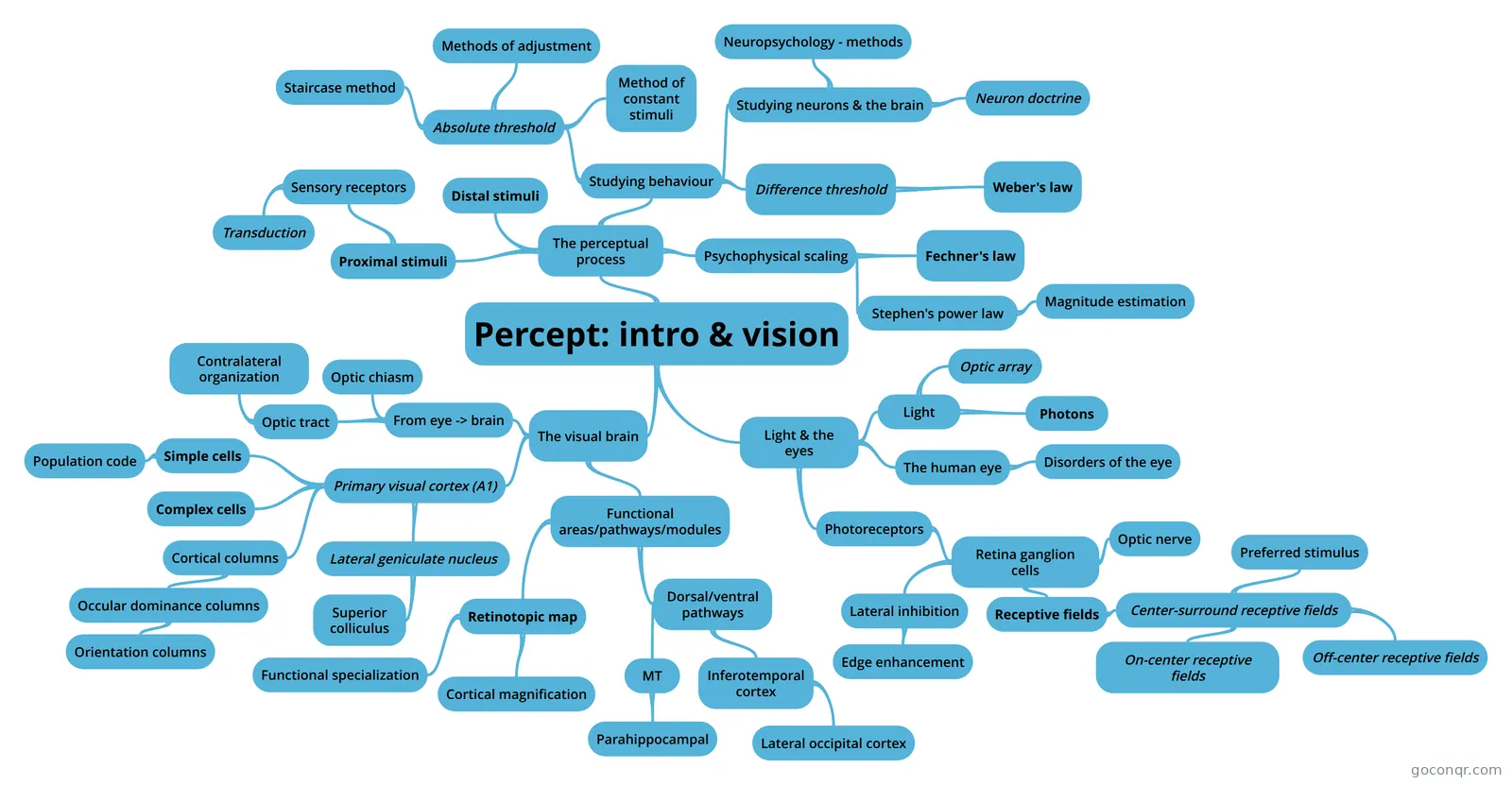
Mind map: Percept: intro & vision
Conteúdo do mapa
Percept: intro & vision
The perceptual process
- Distal stimuli
- a perceived object or event in the world
- Proximal stimuli
- a physical phenomenon evoked by a distal stimuli that impinges on the specialized cells of the sense
- Sensory receptors
- specialized neurons that convert proximal stimulus into neural signals
- = transduction
- Transduction
- Studying behaviour
- Absolute threshold
- the minimum intensity of a physical stimulus that can just be detected by an observer
- Methods of adjustment
- the participant observes stimulus & manipulates a control that adjusts the intensity
- Method of constant stimuli
- the participant is repeatedly presented with a fixed set of stimuli, in random order, cover range of intensities, indicate whether stimuli was detected
- Staircase method
- participant indicate whether detect stimuli, then next stimuli is either one step up/down in intensity
- Difference threshold
- minimum difference between stimulus that can be detected
- method of adjustment, constant stimuli can also be used here
- Weber's law
- the relationship between the intensity of a standard stimuli & the size of the just noticable difference
- the size of JND tends to increase as the intensity of the standard stimulus increases
- JND is more than the intensity of the light of one candle - in a room of 100
- Studying neurons & the brain
- Neuron doctrine
- the principle that perception depends on the combined activity of specialized neurons, each of which responds to specific aspects of a stimulus
- Neuropsychology - methods
- eeg, pet, fmri, dot
- Neuron doctrine
- Absolute threshold
- Psychophysical scaling
- the process of measuring how changes in stimulus intensity relate to changes in the perceived intensity
- Fechner's law
- how the perceived intensity of a stimulus changes as its physical intensity changes
- k same as webers law
- low intensity stimulus needs less JND to be perceived changed, higher needs more difference
- Stephen's power law
- the relationship between the perceived intensity & physical intensity
- line lenght & electrical schocks not low intensity needs less change
- relationship different for different perceptual dimensions, some fechners law some other
- Magnitude estimation
- standard stimulus is 100, then what is the next in comparisons
- Distal stimuli
Light & the eyes
- Light
- type of electromagnetic radiation - light is a wave & a stream of particles
- differences in wavelenght perceived as color
- number of particles/intensity perceived as brightness
- light can be transmitted, absorbed, reflected or refracted
- light that enters the eye forms a spatial pattern of brightness & color called the optic array
- Optic array
- the spatial pattern of light rays, varying in brightness & color- entering your eyes from different locations in a scen
- Photons
- particles of light - smallest possible quantity of electromagnetic radiation
- intensity - the amount of light (photons) reflected from a surface/emitted by a light source
- brightness - the perceived intensity of the light reflected by a surface/emitted by a light source
- The human eye
- the field of view is the portion of surrounding space you can see with your eyes in a fixed position
- acuity is greatest at the part your eyes are pointed - extraocular muscles enable you to point your eye
- roughly spherical & is encased in three membranes: the sclera, the chloroid, the retina - iris constricts/dilates the pupil, lens focuses an image on the retina
- retina contains rods & cones - photopigments in them translate light into neural signals that is sent to retinal ganglion
- axons of the ganglion cells form the optic nerve - which sends signals to the brain - the fovea
- Disorders of the eye
- strabismus, amblyopia
- disorders of accommodation: myopia, hyperopia, presbyopia, astigmatism
- cataracts - high intraocular pressure: glaucoma, floaters & phosphenes
- retinal disease: macular degeneration & retinitis pigmentosa
- Photoreceptors
- rods & cones - trasduction of light
- three types of cones (used to see in daylight) & one type of rod (used to see dimlight)
- density of cones declines rapidly with distance from the fovea - density of rods greatest in ring around fovea, declines gradually with distance
- photoreceptors change their sensitivity under different lighting conditions
- Retina ganglion cells
- circuits in the retina send information to the brain
- circuits receives neural signal from muliple photoreceptors show convergence
- convergent circuits more sensitive to dimlight than nonconvergent - nonconvergent support greater acuity
- most retinal ganglion cells have receptive fields with a center-surround structure: in or off center
- those with center-surround structure exhibit lateral inhibition which supports edge enhancement
- Optic nerve
- amacrine cells recieve signals from bipolar cells & other amacrine cells, send signals back to bipolar & other amacrine & send signals to RGCs
- retinal ganglion cells recieve signals from bipolar cells & amacrine cells & send action potentials to the brain via the optic nerve
- Receptive fields
- the region of a sensory surface that when stimulated causes a change in the firing rate of a neuron that monitor that region
- the receptive fields of an RGC is the region of the retina occupied by the photoreceptors from which the RGC recieve signals
- Center-surround receptive fields
- an RGC receptive fields in which the RGC responds differentlyto stimulationof the center of the receptive field than the surrounding portion
- On-center receptive fields
- receptive fields of the RGCs with the center-surround configuration in which the RGCs increase their firing rate when the amount of light striking the center increases relative to the light striking around
- off-center exist
- Preferred stimulus
- the type of stimulus that produces a neuron's maximum firing rate
- for on-center rgcs is the spot center of the field
- Off-center receptive fields
- the receptive fields of RGCs with center-surround configuration in which RGC increase their firing rate when the amount of light striking the center decrease relative to the amount striking the surround
- Lateral inhibition
- inhibitory neural signals transmitted by horizontal cells in retinal circuits
- Edge enhancement
- a process by which the visual system makes edges as visible as possible, facilitating perception of where one object/surface ends in the retinal image & another begins
- Light
The visual brain
- From eye -> brain
- the optic nerves meet at the optic chiasm & recombine into the optic tracts
- which convey signals from the retinas to the lateral geniculate nuclei in accord with the its representation of visual space
- it contains functionally specialized layers that relay information about different types of visual features of the brain
- some signals from the retina also flow to the superior colliculus which controls eye movements
- Optic chiasm
- the location where the optic nerves from the two eyes split in half, with half of the axons from each eye crossing over to the other hemisphere
- Optic tract
- the continuation of the optic nerve past the optic chiasm: the right optic tract consists of axons from the retinal ganglion cells in the right half of each retina vice versa
- Contralateral organization
- opposite side organisation - left visual field to right side of the retina & vice versa
- Primary visual cortex (A1)
- part of occipital lobe - signals flow from lateral geniculate nuclei - contains simple cells & complex cells
- simple are tuned to respond most strongly to stimuli with a particular orientation at the location of their receptive fields
- the visual system uses a population code - varying responses of simple cells - to determine orientation tuning
- complex cells respond to a wider range of stimuli at a wider range of locations - many V1 neurons are also tuned for visual feature other than orientation, motion color, edge lenght, binocular disparity
- A1 is organized into layers ´, cortial columns running vertically through the layers, neurons here receive signals from the same eye, similar tuning field
- Lateral geniculate nucleus
- part of the thalamus - on each side - receives signals from axons of the retinal ganglion cells
- magnocellular layers - layers of it containing neurons with large cell bodies
- parvocellular layers - containing neurons with small cell bodies
- koninocellular layers - containing neurons with very small cell bodies
- Superior colliculus
- a structure near the top of the brain stem - one each side - its principle function is to help control eye movement - concerned bout where
- LGN - 90% retina axons goes there, other to structures like this
- LGN - volume control
- SC multisensory integration - somatosensory auditory
- Simple cells
- a type of neuron in the v1 that responds best to a stimulus with a particular orientation in the location of its receptive fields
- Population code
- a consistent difference in the patterning of the relative responses of a population of differently tuned neurons
- used to compute perceptual features such as the orientation of a visual stimulus - population of thousands of cells produces a wide enough range of response patterns to code every location
- Complex cells
- neurons in v1 that reponds best to a stimulus with a particular orientation - differ from simple cells in the variety & location of stimuli that generate response
- Cortical columns
- a small volume of neural tissue running through the layers of the cortex perpendicular to its surface
- consists of neurons that respond to similar types of stimuli & that have highly overlapping receptive fields
- Occular dominance columns
- cortical columns consisting of neurons that recieve signals mainly from the left eye or mainly from the right eye
- Orientation columns
- cortical columns consisting of neurons with the same/similar orientation tuning
- Functional areas/pathways/modules
- begin in retina with parasol, midget, retinal ganglion cells - signals to magnocellular, parvocellular, koniocellular layers
- from lateral geniculate nucleus signals sent to V1/2/4 & MT - dorsal/ventral pathway
- v4 colors edge curvatures - lateral occipital cortex & inferotemporal cortex object recognition - fusiform face area face recognition MT motion perception - parahippocampal spatial large -
- Retinotopic map
- V1 organized into this based on polar coordinates, exhibits cortical magnification - more cortical territory representing from fovea
- an arrangement of neurons in the visual system whereby signals from the retinal ganglion cells with receptive fields that are next to each other on the retina travel to neurons that are next to each other in each visual area of brain
- Functional specialization
- the specialization of different neural pathways & different areas of the brain for representing different kinds of information
- Cortical magnification
- the nonuniform representation of visual space in the cortex, the amount of cortical territory devoted to the central part of the visual field is much greater than periphery
- Dorsal/ventral pathways
- where/what pathways
- Inferotemporal cortex
- in the bottom of temporal lobe, one of the object-selective regions
- Lateral occipital cortex
- an area of the occipital lobe, one of the object-selective regions
- V4 - responds to color of stimuli & curvature of edges
- MT
- an area in the middle temporal lobe, neurons that respond to direction/speed of stimuli
- Parahippocampal
- in inferotemporal cortex, responds selectively to large-scale spatial layouts such as landscapes
- From eye -> brain
Informações
- Descrição
- B Psykologi B Mapa Mental sobre Percept: intro & vision, criado por amelia juslin em 01-04-2021.
- Criado por
- amelia juslin
- Visualizações
- 1
- Avaliação