
Mapa mental
Percept: attention, action, auditory
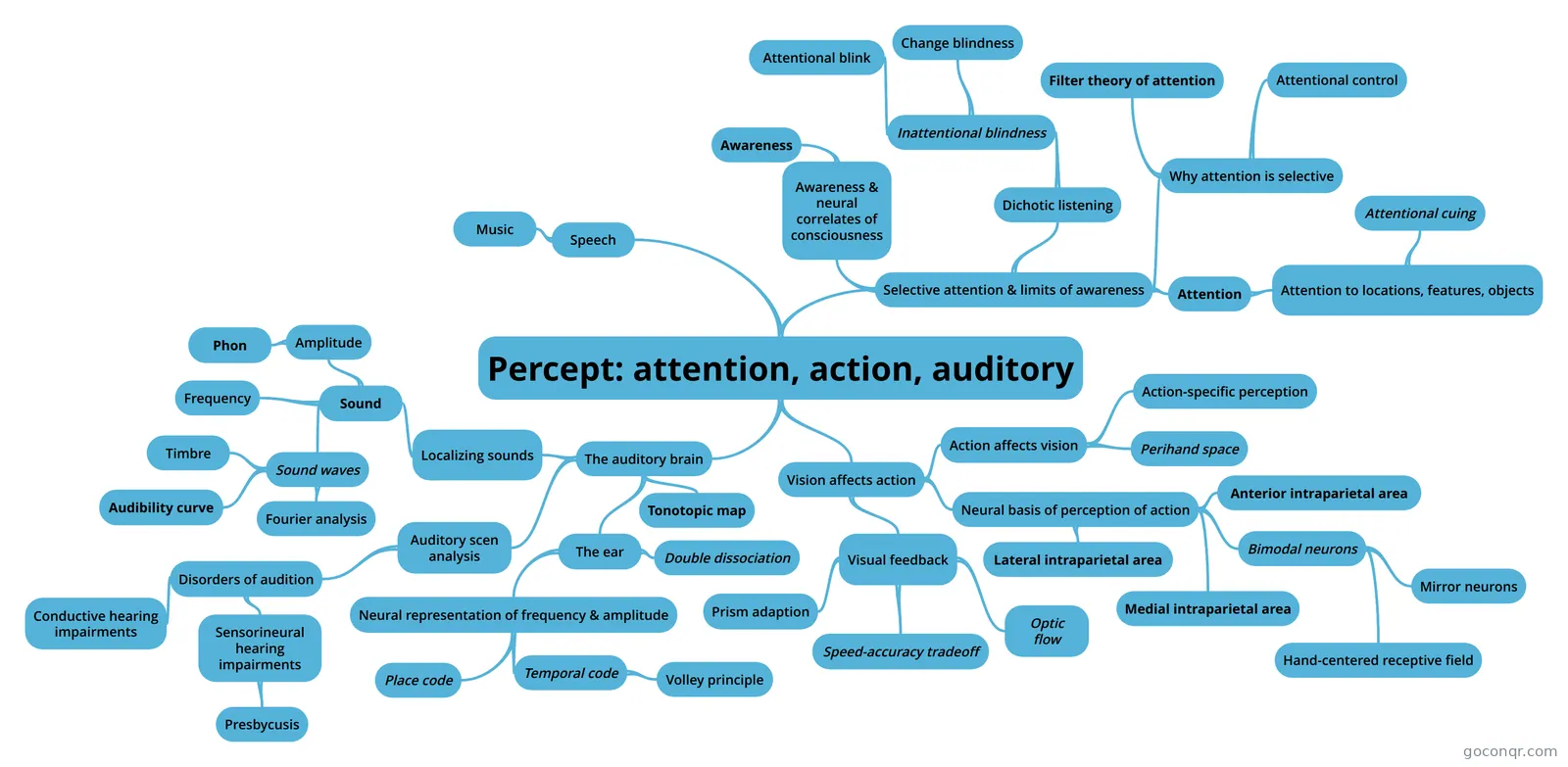
Mind map: Percept: attention, action, auditory
Conteúdo do mapa
Percept: attention, action, auditory
Selective attention & limits of awareness
- attention is selective - shown by the cocktail party problem & the dichotic listening experiments
- the filter theory of attenion proposes that only some sensory stimuli are selected by attention & processed for meaning
- dichotic listening experiments suggest that even ignored messages are sometimes processed for meaning to some extent - notice your name tho ignored message
- inattentional blindness, attentional blink, change blindness show the degree & inevitability of the selectivity of attention - we often fail
- Why attention is selective
- different features of object are represented in different parts of the brain (distributed representation) - the binding problem
- feature integration theory proposes that by selectively attending to one object while ignoring other
- the competition for neural representation - objects compete to have their features represented
- biased competition theory proposes that attention biases teh competion so that only the features of the attended object are represented - supported by single-neuron recording
- Attentional control
- top-down attentional control involves paying attention to achieve goals - bottom-down involves unvoluntary capture of attention by highly valued stimuli - bottom-down attentional control is more rapid
- bottom-down attentional control can be evoked by apparently nonsalient stimulus such as seeing a person looking in a particular direction - impaired in autistic individuals
- studies of unilateral visual neglect show that posterior parietal cortex is involved in attentional control - the frontal eye field is also important
- Filter theory of attention
- the theory that all sensory information is registered as physical signals but only some are interpreted for meaning
- Awareness & neural correlates of consciousness
- explaining how brain activity cause consciousness by searching for neural correlates
- experiments involving binocular rivalry & perceptual bistability have shown at least some activity in the fusiform face area & parahippocampal place area - also some activity in earlier visual areas
- patients with damaged area v1 have no conscious awareness of visual stimuli - yet them can discriminate objects visually at a level above chance - suggesting v1 necessary for awareness of visual objects
- Awareness
- active thinking about or concentration on some source of stimulation
- Attention
- the selection of some source of sensory stimulation for increased cognitive processing
- overt, selectively attending by moving eyes - covert, selectively attending without moving eye
- Attention to locations, features, objects
- attentional cuing experiments show that we can direct our attention to a spatial location to enhance our perception of a stimulus there
- neurophysiological recordings have shown that attention modulates the activities of single neurons that have RF in that location
- human neuroimaging has shown a similar change in the brain activity during shifts of spatial attention - can also attend to nonspatial features of objects
- binding together features require attention to their spatial location - compraing feature search & conjunction search - attention can spread from part to whole of object
- Attentional cuing
- providing a cue (arrow or tone) about the location & timing of an upcoming stimulus
- examine how the spatial location of a persons attention affects the speed with which the person can become aware/respond
- Dichotic listening
- low-level sensory changes in the ignored ear are noticed, but not words of meaning
- Inattentional blindness
- failure to perceive a fully visible but unattended visual object
- Attentional blink
- unawareness of stimuli in an attended location if the stimuli occur when we're processing something else
- Change blindness
- inability to quickly detect changes in complex scens
Vision affects action
- the speed-accuracy tradeoff means that more speed less accurate - increased speed doesn't allow time to use visual feedback to guide movement
- people adapt quickly to disorted visual information, like that experienced when looking through a wedge prism - adaption when motion slightly inaccurate
- perception of optic flow helps determine heading & maintain upright body orientation - can also cause illusory perception of self-motion
- Action affects vision
- planning to grasp an object enhances processing of body orientation - useful for grasp
- preparing small pinch increases sensitivity to small objects - large squeeze increases sensitivity to changes in large objects
- perception of objects in perihand space benefits from special processing - hold hand near display enhances processing of low-spatial frequency information
- the theory of action-specific perception maintains that perception depends on the perceivers action capabilities -object looks further away to someone wearing a big backpack (?)
- Perihand space
- the space near the hands, visual processing of objects there is special
- processing visual information about near by objects is different when hands are near them - potential relevant information when near
- Action-specific perception
- the theory that our perceptions are shaped by our ability to perform actions
- further away with heavy backpack - evolutionary good to overestimate/underestimate depending on context/resources
- Neural basis of perception of action
- posterior parietal lobe crucial role in coordinating perception & action - lateral intraparietal eye motion, medial intraparietal plan reach objects, anterior intraparietal grasping
- some bimodal neurons in premotor cortex have hand-centered visual RF - the field of such neurons might expand to include space around handheld tool
- mirror neurons involved in both action & perception of others actions - are they involved in understanding meaning of others actions?
- Lateral intraparietal area
- a region of the posterior parietal lobe in monkeys that is involved in the control of eye-movements - included
- neurons respond to both spatially specific visual input & spatially specific planned eye movements
- Medial intraparietal area
- a region of the posterior parietal lobe involved in planning reach movements
- these neurons tuned to for the production of reahing movements in specific directions
- Anterior intraparietal area
- a region of the posterior parietal lobe thought to be involved in grasping objects
- neurons control differences in hand configuration
- Bimodal neurons
- neurons that respond to two modalities of stimulation - in premotor cortex tactle stimulation of hand & to visual stimuli near the hand
- Hand-centered receptive field
- visual receptive field that responds to visual stimuli near the hand, relative to it - not on retinal location stimulated
- Mirror neurons
- neurons that fire when an action is produced & when the same action is observed being produced by others
- Visual feedback
- visual information used to control an ongoing movement
- Speed-accuracy tradeoff
- processing takes time - perception of the relative positions of the limb & the target of movement - adjustment of the muscle commands to the hand
- Optic flow
- objects & surfaces move outward from where you're heading - called focus of expansion
- provides crucial information to guide actions like navigation, include heading as well as balance & body orientation
- Prism adaption
- adaption to the inaccurate visual feedback obtained when looking through a wedge prism - reveals a mechanism that helps us compensate for inaccurate movements
- involves a change in visually perceived directions & a change in the felt position of the arm
- shows that we can compensate for changes in the correspondence between the apparent visual location of an object & what must be done with the arm/limbs
- goes into operation anytime we make a slightly inaccurate hand movement
The auditory brain
- auditory information travels via pathways at the inner hair cells in cochlea, sends signals to the ipsilateral & contralateral superior olivary complex - to inferior colliculus in the midbrain then the medial geniculate body in thalamus - then auditory cortex
- beginning with the superior olivary complex, all the brain structures on the ascending auditory pathways receive signals from both - signals seem to play a role in attention & fine discrimination of frequencies
- the auditory cortex contains the auditory core region (consists of area a1), the rostral core, rostrotemporal core - the belt & parabelt are wrapped around the auditory core region & recieve signals from it
- neurons in area A1, rostral core & rostrotemporal core are arranged into tonotopic maps - frequency tuned neurons in these areas can have narrow or broad tuning widhts - what & where systems - large areas along both pathways are multimodal
- sound discrimination & recognition = belt & parabelt like areas beyond v1 visual
- Localizing sounds
- based on comparing aspects - ILD good for high frequencies ITD good for low frequencies - head motion is used to determine whether a sound comes from one direction or another
- the spectral shape cue - an effect of pinna shape - used to determine elevation - for familiar sounds loudness determine distance - Doppler effect cues for distance moving source
- echolocating bats track & capture pray by emitting sounds & processing the echoes - also blind can use - the precedence effect means that a sound is perceived as coming from the direction from which it first arrives
- when audition & vision in conflict - vision always wins - ventriloquism effect - in humans neurons in the superior olive are thought to function as coincidence detectors, neural basis
- medial superior olive & ITD - fire only when signals from two cochlear nuclei arrive at the same time - neurons tuned for different itds, each receives signals from both fire strongly both
- Sound
- sound is wave of pressure changes in a medium such as air - propagating outward from source like vibrating tuning fork
- the related physical/perceptual dimensions of sound are frequency & pitch, amplitude & loudness, waveform & timbre
- an audibilitycurve shows the audibility threshold of any given frequency - each loudness contours show the amplitude that sounds of different frequencies must have to be perceived as having same loudness
- a periodic sound with a complex waveform can be decomposed by Fourier analysis into a Fourir spectrum - the combination of pure tones of different frequencies, amplitude making up a sound - timbre depend on harmonics relative amplitude
- Sound waves
- waves of pressure changes in air caused by the vibrations of a source
- pure tone - sound wave in which air pressure changes over time according to mathematical formula called a sine wave
- periodic sound waves - waves in which the cycles of compression & rarefaction repeat in a regular, or periodic, fashion
- Audibility curve
- the absolute threshold for hearing - a curve showing the minimum amplitude at which sounds can be detected at each frequency
- the auditory sensitivity is maximal in the middle range of frequencies
- equal loudness contour - a curve showing the amplitude of tones at different frequencies that sound about equally loud
- Fourier analysis
- a mathematical procedure for decomposing a complex waveform into a collection of sine waves with various frequencies/amplitudes
- fourier spectrum - a depiction of the amplitudes at all frequencies that make up a complex waveform
- Timbre
- the difference in sound quality between two sounds with the same pitch/loudness
- for complex periodic sounds timbre is mainly due to differences in relative amplitudes of the sounds overtones
- the perceptual dimension of a sound that is related to the physical dimension of waveform
- Frequency
- the physical dimension of sound that is related to the perceptual dimension of pitch
- fundamental frequency - the frequency of the lowest-frequency component of a complex waveform - determines the perceived pitch
- harmonic - a component frequency of a complex waveform that is an integer multipe of the fundamental fequency - first harmonic is fundamental f
- Amplitude
- the difference between the maximum & minimum sound pressure in a sound wave - physical dimension related to loudness
- dB
- Phon
- a unit of loudness - the loudness of a tone in phons is numerically equal to the amplitude of a 1000Hz tone that sounds equally loud
- Auditory scen analysis
- involves perceptual organization of the auditory scen into distinct auditory streams - as in vision the principles of perceptual organization best guesses & reflect physical regularities we have evolved to detect
- principles of simulataneous grouping grouping includes grouping of harmonic coherence, grouping of synchrony/asynchrony
- princples of sequential grouping include grouping of frequency similarity & grouping by temporal proximity
- in many situations, listeners perceptually complete occluded sounds - they tend to perceive sounds that are masked by other sounds or to perceive sounds behind a masking sound even when those sounds aren't actually present
- Disorders of audition
- hearing tests audiometer presents pure tones to determine auditory sensitivity to frequencies - the results depicted by audiogram which shows degree of loss in each frequency
- conductive hearing impairments arise bc of problems in outer/middle ear, loss of sound conduction to cochlea
- sensorineural hearing impairments arise through damage to the cochlea, the auditory nerve or auditory areas/pathways in brain - often age related
- exposure to loud noise can damage the cochlea mechanically & by causing death of hair cells - tinnitus is severe & can disrupt daily life, various causes/treatments found
- Conductive hearing impairments
- hearing impairments charasterized by a loss of sound conduction to the cochlea - as a result of problems in the outer or middle ear
- Sensorineural hearing impairments
- hearing impairments caused by damage to cochlea, the auditory nerve or the auditory areas/pathways in brain
- more common, due to aging, effects of exposure to loud noise
- Presbycusis
- age-related condition - lifelong exposure to sounds, smoking, industrual chemicals, alcohole abuse, diabetes, genes
- The ear
- the ear gathers sound energy & transduces it into neural signals - the pinna funnels sound into the auditory canal & onto the tympanic membrane
- the vibration of tympanic membrane transfers the sound energy to the occicles, which then transmit onto oval window - sends energy to cochlea
- the Eustachian tube can be opened to maintain normal air pressure in the middle ear - the cochlea is partitioned into three chambers, vestibular canal, cochlear duct tympanic canal
- basilar membrane separate the cochlear duct & the tympanic canal - is thicker narrower stiffer at the base than at apex - pressure wave displace basilar - the organ of corti contains structures involved in auditory transduction
- Neural representation of frequency & amplitude
- frequency is represented in both a place code & a temporal code - place code based on displacement of basilar resulting in action potential by Type 1 auditory nerve fibers connected to inner ear hair cells at those locations frequency depend
- the temporal code is based on a match between frequencies in the incoming sound wave & spike timing in auditory nerve fibers
- place coding provides good representations of frequencies above 5000hz - temporal coding best for lower frequencies
- amplitude is based on the fact that as the amplitude increases, the firing rate of auditory nerve fibers & number of nerve fibers also increases
- Place code
- frequency representation based on the displacement of the basilar membrane at different locations
- how the stiffness of the basilar membrane at each location determines its response to different sound frequencies
- measured through physiological frequency tuning curves - psychophysical frequency tuning curves
- Temporal code
- frequency representation based on a match between the frequencies in incoming sound waves & the firing rates of auditory nerve fibers
- Volley principle
- the idea that each nerve fiber in a population of auditory nerve fibers produce action potentials in phase with the peaks in the incoming sound wave even if not at every peak
- explains how temporal code could represent frequencies much higher than the maximum firing rate of any individual fiber
- Double dissociation
- pattern of impaired performance - damaged patients could recognize but not localize vs could localize but not recognize - dorsal ventral
- Tonotopic map
- an arrangement of neurons within auditory brain regions such that the characteristic frequencies of the neurons gradually shift from lower at one end to higher at the other
- cone of confusion = a hypothetical coneshaped surface, when two equally distant sounds are located there they're confused bc same itd ild
Speech
- phonemes are the basic sounds of speech, produced by the vocal apparatus - vowels & consonants - different vowels through modifying the shape of oral cavity which changes the peaks in vowels harmonic spectrum
- sound spectrograms show how the frequency spectra of vowels vary over time - consonants defined by place of articulation, manner of articulation, voicing - coarticulation ariculation of phonemes affects the acoustic properties of surrounding phonemes
- phoneme perception is categorical - The McGurk effect (audition compromise vision when conflict) - phoneme transition probability - phonemic restoration (perceive phonemes masked)
- speech processing left hemisphere ventral speech comprehension dorsal speech production
- Music
- primary dimensions of music is pitch, loudness, timing & timbre - most fundamental pitch - notes used can be organized into octaves - notes separated by an octave perceived similar sound qualities
- rhythm & dynamics - variations in tempo used to express mood - listeners tend to recognize melodies on basis of the sequence of relative pitches - a scale particular subset of notes in octave
- music perception is also based on expectations & knowledge
Informações
- Descrição
- B Psykologi B Mapa Mental sobre Percept: attention, action, auditory, criado por amelia juslin em 15-04-2021.
- Criado por
- amelia juslin
- Visualizações
- 0
- Avaliação