
Mapa mental
Antimicrobial Agents
Conteúdo do mapa
Antimicrobial Agents
Microbes as Infectious Agents
- Microbes as infectious agents fit into one of the following groups: *Viruses *Bacteria *Fungi
- Viruses
- Classed as infectious agents, these all need to grow in human cells, which are their hosts. There are many different viral pathogens, but since they have small genomes and small number of proteins, this restricts the range of antiviral therapy available. For example, influenza ssRNA virus' genome codes for only 11 proteins!
- Certain viruses: *cause common complaints e.g. cold/rhinoviruses *cause more clinical concern, e.g influenza/herpes viruses *are particularly dangerous pathogens that are rare in human populations e.g. ebola virus
- Concerns about viruses are: *Their potential for rapid spread => e.g. the rapid spread of influenza virus in Mexico 2009 *Their potential for fatality and lack of treatment options => e.g. Nipah virus, which causes inflammation of the brain and respiratory disease with high fatality rate currently has no vaccines for prevention or drugs fro treatment!
- If these traits were to combine, it would be a huge cause for concern and note that virus strains change so we are dealing with changing problems
- Fungi and other eukaryotic pathogens (parasites)
- Eukaryotes have membrane bound organelles and a distinct, membrane bound nucleus thus their cell machinery is similar to human cells. This can make it difficult to treat with antimicrobial agents, and harder still to eliminate resting stages/spores
- Fungi: *grow either as single cells called yeasts or as long branches called hyphae *certain fungi are dimorphic, meaning they can switch between the yeast forms and hyphae forms *Most clinical concerns focuses on *Candida albicans* (thrush, yeast infections)and *Aspergillus fumigates* (aspergillosis), particularly in invasive infections, which are increasing in the UK
- Other non-fungal eukaryotes are primarily parasites: *Again, these can be difficult to treat with antimicrobial agents since they are eukaryotic and have similar cell machinery to us *Not many clinical problems in the UK but primarily outside the UK *e.g. *Plasmodium falciparum* which can cause fatal malaria. These disease patterns are likely to change, i.e. malaria could come to UK (e.g. global warming)
- Bacteria
- These form the biggest clinical concern out of the three categories *These are prokaryotic, along with archaea, don't have membrane bound organelles or membrane bound nucleus *Bacteria grow as individual cells outside of the human body *Many bacterial species exist with around 35,000 species. Hundreds of these can be pathogenic *Species are divided into Gram-positive or Gram-negative, depending on wall type *Of all these species, certain ones are of particular clinical concern because they can lead to mortality within days (e.g. *Staphylococcus aureus* in pneumonia)
- However, resistance to antimicrobial agents means certain species are particularly difficult to treat: *MRSA (methicllin-resistant *Staphylococcus aureus*) * *Pseudomonas aeruginosa * *Mycobacterium tuburculosis* *Gram-negative cells that acquire Extended Spectrum Beta Lactamase (ESBL) resistance mechanisms
- Also, some bacteria have the ability to make spores which makes their treatment with antimicrobial agents difficult. Spores are resting stages for bacterial cells. When environmental conditions allow, these spores then grow into individual cells. Spores can remain dormant for months or even years. Of spore-forming bacteria, arguably most clinical concern over *Clostridium difficile*
- Abundance of Microbes
- *High number of microbes in the environment *High number of microbes in the human body, mostly upper respiratory tract, skin, GIT
- Reasons for high abundance of microbes: *microbes can grow rapidly as cell division can be as rapid as every 20 minutes *Microbes can disperse rapidly, since they are so small *Microbes have very diverse physiologies and thus can exploit many different habitats (-5-120`C, pH 1-11, oxygen levels from aerobic to non-aerobic). These diverse physiologies are supported by diverse functions coded by microbial genomes
Developing antimicrobial agents - strategies!
- 1. Pharmaceutical preparations need to be microbe free, i.e. STERILE. This is to prevent infections or anaphylactic shock, and also prevent drug/excipient spoilage 2. Microbe management in care facilities/pharmacies/hospitals to manage microbes within defined limits, using either disinfectants or antiseptics 3.Infections in or on the body,which are pathogenic, need to be treated using antibiotics Going from 1-3, the strategy tends to become more challening
- Sterilisation
- 'The complete removal of microbes or damaging them such that they are killed' ... sterilisation is carried out without the use of antimicrobial agents and is of critical industrial importance
- Variety of ways to do this: *heat: dry or wet *ionising radiation *filter sterilisation These strategies indiscriminantly damage microbes meaning they cannot be used in humans, thus are not in themselves 'antimicrobial agents'
- Normal bacterial growth in the library
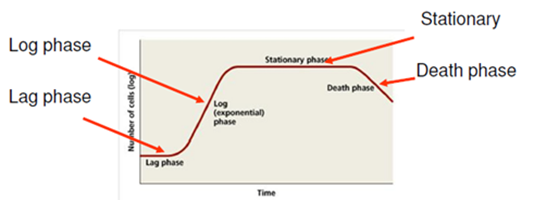
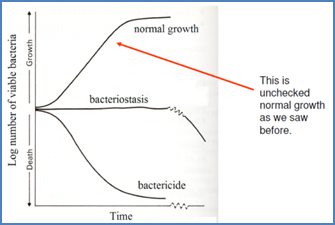
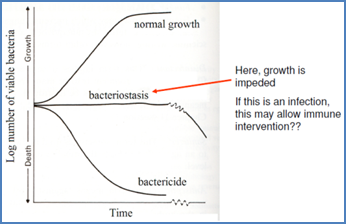
- Innoculate sterile growth medium with a few cells. Over time,the bacteria grow and the growth medium will grow cloudy/turbid. High cell numbers 10 to the 10/mL This normal graph (above) emerges as four distinct phases => this is typical for all bacterial species
- Agents that stop bacterial or fungal growth are called bacteriostatic or fungostatic Agents that kill bacteria, fungi or viruses are called bactericidal, fungicidal or virucidal
- Disinfection
- 'The reduction in the number of viable microorganisms in or on a product to a level specified previously as appropriate' This typically means reducing the number of potential pathogens until they no longer represent a hazard Typically these compounds are used on inanimate objects as they are still too toxic or corrosive for use on humans. However, antiseptics could be considered for use on humans, i.e. antiseptic wipes
- Antisepsis
- 'The destruction or inhibition of microbes in or on living tissue' For practical purposes, antiseptics can routinely be thought of as topical agents
- Preservatives
- 'The prevention of multiplication of microbes in products' Here, the reality is we have accepted the presence of microbes but want to limit their growth as much as possible. These preservatives are used in pharmaceuticals, foods, and cosmetics
- Practicalities
- Little money to be had in this and therefore little inclination to find new disinfectants
- As a consequence, comparatively little is known about their mechanism of action => they simply work for some of the microbes we encounter
- The modes of action of disinfectants/antiseptics are often so fundamental to the microbe that this is a difficult topic to study anyway
- Disinfectant and Antiseptic Classes
- Why are there so many different antiseptic/disinfectant classes? The answer is that there is an extremely different and wide range of scenarios to deal with
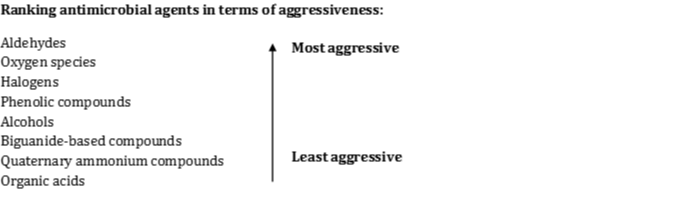
- Ranking antimicrobial agents in terms of Aggressiveness
- This ranking can change with certain variables, i.e. concentration
- Aldehydes
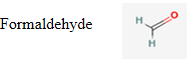
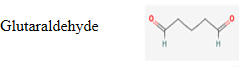
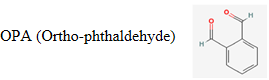
- The three aldehydes most commonly used as antiseptics/disinfectants are: *Formaldehyde *Glutaraldehyde *OPA (ortho-phthaldehyde)
- Glutaraldehyde and OPA are similar in use
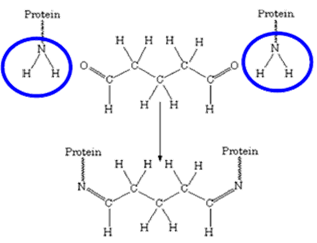
- These are liquid disinfectants mainly used for treating surfaces and medical equipment which is temperature sensitive. The main mode of action is through cross-linking proteins and thus preventing synthesis of microbial macromolecules
- Advantages
- Glutaraldehyde and OPA show broad spectrum of efficacy => rapidly bactericidal, fungicidal and virucidal
- Glutaraldehyde also has sporocidal activity (at conc used, usually minutes for normal cells, but hours for spores)
- Both effective at low temperatures
- Both are not corrosive
- Glutaraldehyde is so effective, it is used as chemosterilant (sterilises devices)
- e.g for glutaraldehyde
- Disadvantages
- Skin irritation Wider toxicity
- Formaldehyde
- This is even more active than OPA/Glutaraldehyde, and is thought to work in a similar way to other aldehydes. In addition, it complexes with nucleic acids and as such stops many microbial actions quickly. Formaldehyde is also bactericidal, fungicidal and virucidal
- Advantages
- Cost effective and cheap Causes little environmental damage due to breakdown into carbon dioxide and water, thus can be managed easily
- Disadvantages
- Safe use is a concern => differing concentrations have been considered either irritant or carcinogenic/mutagenic. It certainly is toxic!
- Others: Biguanide-based compounds
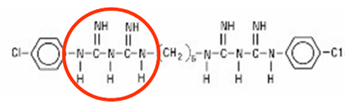
- An example of these compounds is chlorhexidine, which is the most widely used biguanide based compound. The circled portion (see diagram) is the guanide chemical 'signature'
- Chlorhexidine has a wide range of uses as an antiseptic in dentistry (mouthwashes) and medicine (wound treatment). *It is rapidly absorbed through bacterial or yeast cells *Acts primarily on cell membranes and causes cytoplasm leakage *As such, this causes loss of cell structure and function *Chlorhexidine may also precipitate microbial proteins and nucleic acids at high concentrations
- Chlorhexidine has broad spectrum antibacterial activity. Compare the following advantages and disadvantages with that of formaldehyde/other aldehydes
- Advantages
- Relatively little irritation of skin/mucous membranes
- Effective against spread of pathogens in hospitals
- Broad spectrum antibacterial activity
- Disadvantages
- Less effective against fungi
- Limited effectiveness against certain viruses
- Can cause eye problems and damage to inner ear
- Some bacterial species are showing increased tolerance against biguanides
- In very rare cases, can cause anaphylactic shock
- Organic Acids
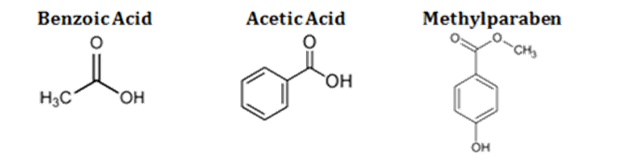
- Acids are defined as substances that dissolve in water to release protons H+. Strong acids, like HCl, are good antimicrobials but are limited by their safety issues and damage to materials being treated. As such, much milder organic acids are discussed here, used mostly in food and cosmetics
- Mode of action is not clear but they may disrupt the uptake/transport of nutrients by microbes. Methylparaben like other parabens is fungistatic and bacteriostatic for Gram-positive cells (though less effective for Gram-negative cells) Other acids vary very widely in their efficacy with a tendency to be microbistatic. Compare this with biguanides
- Advantages
- *Readily broken down in vivo and in the environment *Application specific efficacy
- Disadvantages
- At the concentrations used, not typically toxic to microbes (they are microbistatic), thus used as preservatives
Selective toxicity
- Paul Ehrlich found that certain dyes would bind to certain cell types but not others (so perhaps target parasite cells vs host cells). Using these stains as magic bullets to target microbes to kill them, he also took this idea forward, to think about their potential for selective toxicity => where the compound is selectively toxic to microbial cell than host human cell. However, this is harder for eukaryotic cells possessing similar cell machinery to us, i.e. fungi/parasites
- As we have seen: *disinfectants are too toxic for human use *antiseptics can only be used topically *therefore OTHER STRATEGIES are needed to tackle internal infections
Antibiosis
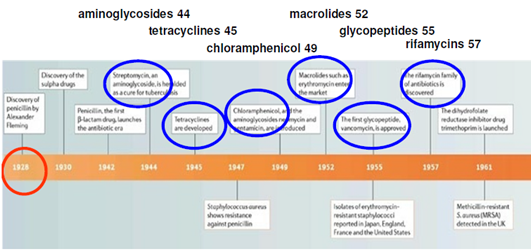
- 'The association of two organisms in which at least one kills or harms the other' The first antibiotic that was found, was discovered by accident: *1928 => Alexander Fleming had been studying colour variants of *Staphylococcus aureus* *After a holiday, he saw a fungal contaminant (*Penicillium spp.*) and understood the significance of extensive lysis of bacterial colonies adjacent to the fungal contaminant and that the colonies further away were unaffected *A lot of work was needed to change this observation into a product *The first humans were treated systemically with penicillin in 1941 *There was immediate interest in developing new antibiotics and more than 20 new antibiotic classes were discovered between 1940 and 1962
- Where were these antibiotics coming from?
- Natural sources
- Secondary metabolites (produced in stationary phase, after phase of active growth) by other microbes, especially: *Streptomyces sp*, *Penicillium sp*, *Bacillus sp*, *Cephalosporin sp*. The term antibiotic in 1940s was defined as a substance produced by another microbe, which in low concentrations, inhibits the growth of other microorganisms. However, with this definition, only substances from natural sources could be classed as antibiotics
- Semisynthetic Sources
- Once an antibiotic has been discovered, its chemical structure can be determined and from this new variations can be made by changing different parts of the antibiotic molecule, leading to hybrid molecules
- Synthetic Sources
- As we have seen, working with microbial cultures means having to extract the compound from a complex mix of other substances and worse, many of these are bioactive. As such, if possible, it is easier to synthesize atnibiotics completely synthetically
- Natural sources
Some Important Pathogenic Species
- When a sample is received in a diagnostic lab, the sample type dictates which growth medium and conditions should be used that are likely to culture one or more pathogens in the sample
- After growth, pure colonies are isolated whose phenotypic characteristics on an individual medium suggests a species identity
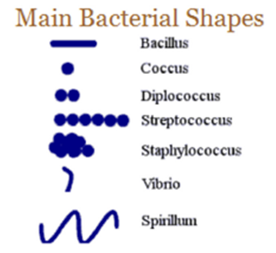
- Microscopy at different stages can help identify or rule out which pathogen it could or could not be, based on cell shape and Gram-staining properties
- A lot of skill is needed as individual pathogens are often present as a mix of species on the growth medium
- Cocci
- Gram Positive
- Staphylococcus aureus Staphylococcus epidermis Streptococci pneumoniae Streptococci pyogenes Viridans streptococci Enterococci faecalis Enterococci faecium
- Gram-negative
- Neisseria meningitis Neisseria gonorrhoea
- Gram Positive
- Rods
- Gram-positive
- Clostridium difficile Listeria monocytogenes Clostridium tetani/perfringens/botulinum Bacillus spp.
- Gram-negative
- Escherichia coli Klebsiella pneumoniae Serretia spp Proteus spp Acinetobacter baumani Salmonella spp Shigella spp Helicobacter pylori Campylobacter jejuni Legionella pneumoniae
- Gram-positive
Commonly Used Antibiotics
- Plus some relatively new ones: Ertapenem Ceftobiprole Tigecycline Daptomycin Linezolid
- This may be obvious, but not all bacterial species are susceptible to every antibiotic, hence this list is so long!
- Penicillins
- Benzylpenicillin Phenoxymethylpenicillin Flucloxacillin Amoxicillin Coamoxiclav Piperacillin/Tazobactam (combination antibiotic)
- Cephalosporins
- Cefalexin Cefotaxime/Ceftriaxome Ceftaxidime Cefuroxime
- Carbapenems
- Meropenem
- Tetracyclines
- Doxycycline
- Aminoglycosides
- Gentamicin
- Macrolides
- Erythromycin, Clarithromycin
- Clindamycin
- Teicoplanin, Vancomycin
- Co-trimoxazole, Trimethoprim
- Metronidazole
- Quinolones
- Ciprofloxacin Levofloxacin/Moxifloxacin
- Anti-TB drugs
- Rifampicin Isoniazid Ethambutol Pyrazinamid
Antibiotics - some terminology
- Antibiotic resistance
Imagens e arquivos do mapa

Informações
- Descrição
- University Infections and Microbiology Mapa Mental sobre Antimicrobial Agents, criado por katpotter71 em 28-07-2015.
- Criado por
- katpotter71
- Visualizações
- 12
- Avaliação