
Mapa mental
Fundamental Data Structures
Conteúdo do mapa
Fundamental Data Structures
Data Types
- Type is a collection of values, such as booleans and integers.
- A record (like a bank account) is an example of an composite type.
- A Data Item is a member (or a part) of a type
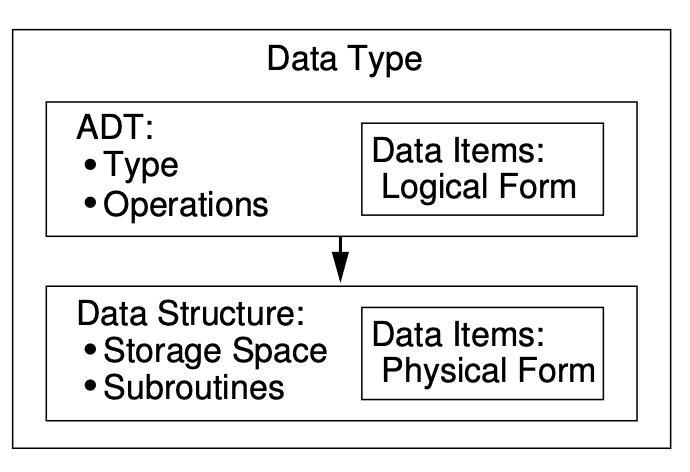
- A data type is a type together with a collection of operations to manipulate the type.
- An abstract data type (ADT) is the realization of a data type as a software component
- A given ADT might be supported by more than one implementation
- Data types have both a logical and a physical form, and the definition of the data type in terms of an ADT is its logical form.
- An abstract data type (ADT) is the realization of a data type as a software component
- Type is a collection of values, such as booleans and integers.
Data Structures
- A data structure is the implementation for an ADT.
- In a object-oriented language as C++, and ADT and its implementation (data structure) together make up a class.
- The term "data structure"often refers to data stored in a computer's main memory
- A data structure is the implementation for an ADT.
Lists
- We define a list to be a finite, ordered sequence of data items known as elements
- Every element has a position in the list and a data type
- sorted lists have their elements positioned in ascending order of value, while unsorted lists have no particular relationship between element values and positions
- Given that we wish to support the concept of a sequence, with access to any position in the list, we need many of the member functions such as insert and moveToPos.
- It is also important to support the concept of a current position, for example with the method moveToStart
- The current position is where any action such as insertion or deletion will take place.
- It is also important to support the concept of a current position, for example with the method moveToStart
- We increase the flexibility of the list ADT by writing it as a C++ template.
- The declaration for abstract class List also makes private the class copy constructor and an overloading for the assignment operator. This protects the class from accidentally being copied
- We define a list to be a finite, ordered sequence of data items known as elements
Array-Based List Implementation
- Advantages and disadvantages
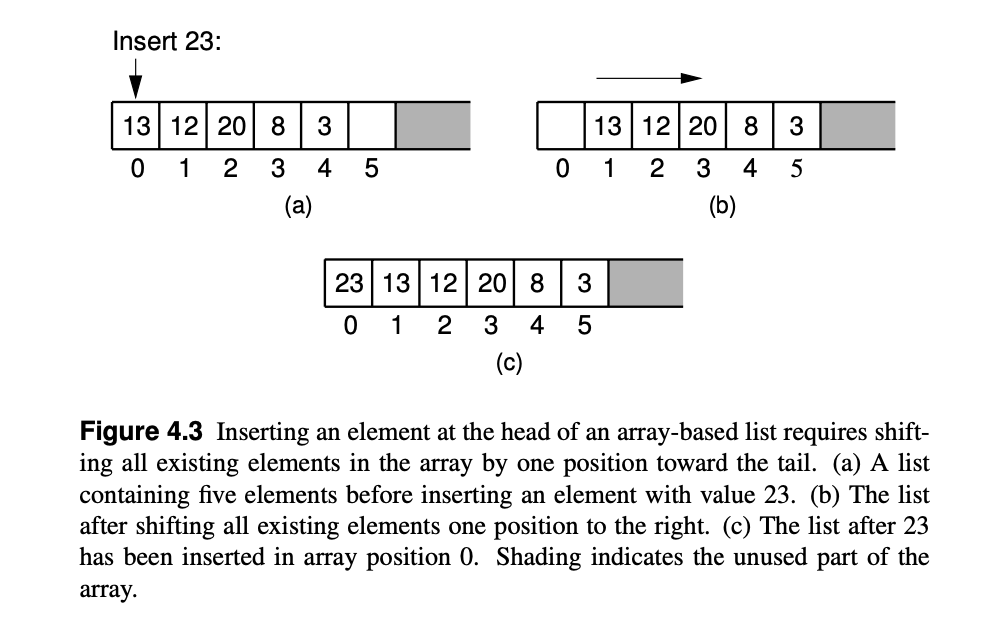
- Array-based lists have the advantage that there is no wasted space for an in- dividual element
- Array-based lists have the disadvantage that their size must be predetermined before the array can be allocated.
- Because listArray must be allocated at some fixed size, the size of the array must be known when the list object is created
- Because each list can have a differently sized array, each list must remember its maximum permitted size. Data member maxSize serves this purpose.
- The array-based list implementation is defined to store list elements in contiguous cells of the array, so the insert, append, and remove methods must maintain this property
- Because each list can have a differently sized array, each list must remember its maximum permitted size. Data member maxSize serves this purpose.
- Advantages and disadvantages
Linked Lists
- The linked list uses dynamic memory allocation, that is, it allocates memory for new list elements as needed.
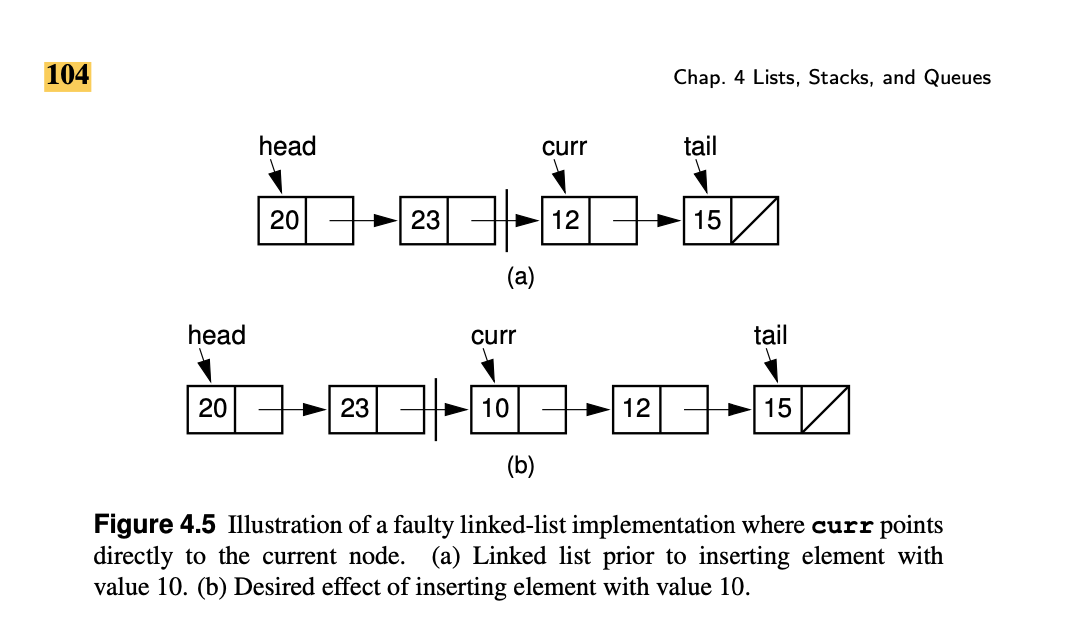
- A linked list is made up of a series of objects, called the nodes of the list and it is a good practice to make a separate list node class
- The list built from such nodes is called a singly linked list, or a one-way list, because each list node has a single pointer to the next node on the list.
- Objects in the Link class contain an element field to store the element value, and a next field to store a pointer to the next node on the list
- A linked list is made up of a series of objects, called the nodes of the list and it is a good practice to make a separate list node class
- Advantages and disadvantages
- Linked lists require that an extra pointer be added to every list node. If the element size is small, then the overhead for links can be a significant fraction of the total storage.
- Linked lists have the advantage that they only need space for the objects actually on the list.
- The linked list uses dynamic memory allocation, that is, it allocates memory for new list elements as needed.
Freelists
- Instead of making repeated calls to new and delete, the Link class can handle its own freelist
- A freelist holds those list nodes that are not currently being used.
- When a node is deleted from a linked list, it is placed at the head of the freelist. When a new element is to be added to a linked list, the freelist is checked to see if a list node is available. If so, the node is taken from the freelist. If the freelist is empty, the standard new operator must then be called.
- A freelist holds those list nodes that are not currently being used.
- The C++ free-store management operators new and delete are expensive to use, so Freelists are particularly useful for linked lists that periodically grow and then shrink.
- The freelist variable declaration uses the keyword static. This creates a single variable shared among all instances of the Link nodes
- Instead of making repeated calls to new and delete, the Link class can handle its own freelist
Doubly Linked Lists
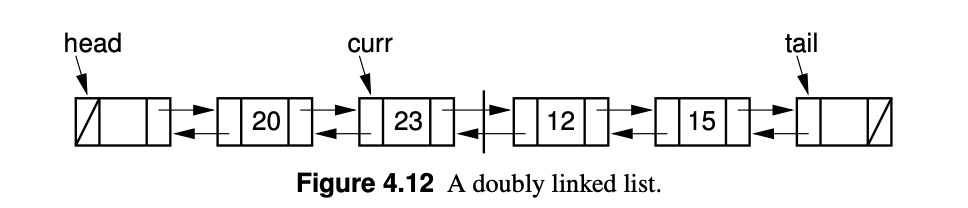
- Allows convenient access from a list node to the next node and also to the preceding node on the list
- It works by storing two pointers: one to the node following it (as in the singly linked list), and a second pointer to the node preceding it
- It is easier to implement than a singly linked list
- While the code for the doubly linked implementation is a little longer than for the singly linked version, it tends to be a bit more “obvious” in its intention, and so easier to implement and debug
- Allows convenient access from a list node to the next node and also to the preceding node on the list
Imagens e arquivos do mapa
Informações
- Descrição
- Mapa Mental sobre Fundamental Data Structures, criado por Sara Nicoly Ferreira Lins em 02-06-2021.
- Criado por
- Sara Nicoly Ferreira Lins
- Visualizações
- 0
- Avaliação