
Mapa mental
MACROEVO & FOSSIL RECORD
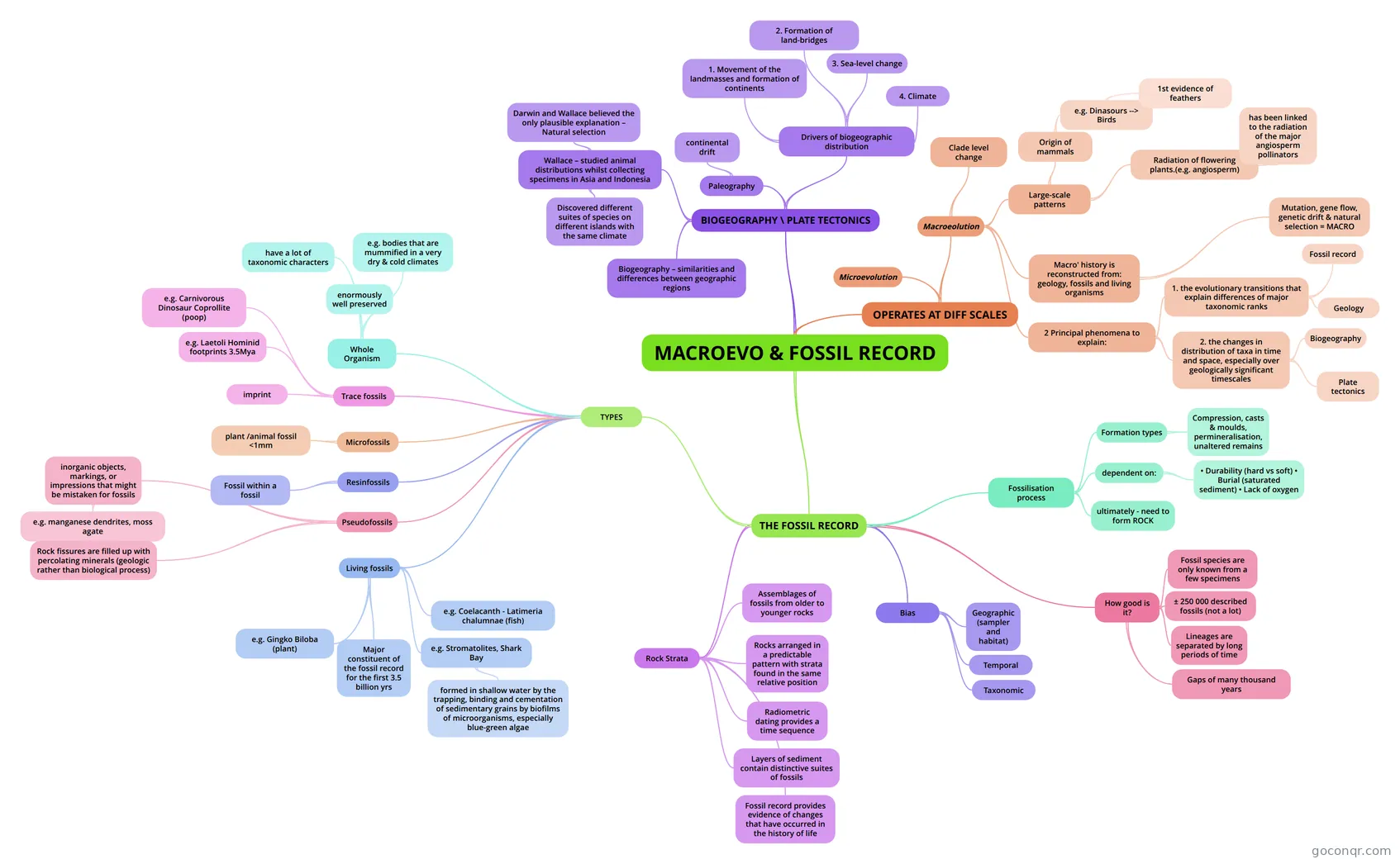
Mind map: Macroevo and Fossil Record
Conteúdo do mapa
MACROEVO & FOSSIL RECORD
OPERATES AT DIFF SCALES
- Microevolution
- changes in gene freq & traits that occur within populations and species = the study of Population genetics
- Macroeolution
- evolution of large differences – above species level, warranting placement in a new genera or higher taxonomic group = the study of phylogenetics
- Clade level change
- Large‐scale patterns
- Origin of mammals
- e.g. Dinasours --> Birds
- Discovered in the 1970’s that Archeopteryx (originally found in 1860) was a transitional form between the Birds and Reptiles
- 1st evidence of feathers
- e.g. Dinasours --> Birds
- Radiation of flowering plants.(e.g. angiosperm)
- has been linked to the radiation of the major angiosperm pollinators
- radiation of angiosperm- also see radiation among other pollinator groups
- has been linked to the radiation of the major angiosperm pollinators
- Origin of mammals
- Macro' history is reconstructed from: geology, fossils and living organisms
- Mutation, gene flow, genetic drift & natural selection = MACRO
- 2 Principal phenomena to explain:
- 1. the evolutionary transitions that explain differences of major taxonomic ranks
- Fossil record
- Geology
- 2. the changes in distribution of taxa in time and space, especially over geologically significant timescales
- Biogeography
- Plate tectonics
- 1. the evolutionary transitions that explain differences of major taxonomic ranks
- Microevolution
THE FOSSIL RECORD
- • Preserves traces of past life • Arbitrarily older than 10,000 yrs
- TYPES
- Whole Organism
- e.g. bodies that are mummified in a very dry & cold climates
- enormously well preserved
- have a lot of taxonomic characters
- Trace fossils
- e.g. Carnivorous Dinosaur Coprollite (poop)
- e.g. Laetoli Hominid footprints 3.5Mya
- imprint
- Microfossils
- plant /animal fossil <1mm
- Resinfossils
- Fossil within a fossil
- Pseudofossils
- inorganic objects, markings, or impressions that might be mistaken for fossils
- e.g. manganese dendrites, moss agate
- Rock fissures are filled up with percolating minerals (geologic rather than biological process)
- inorganic objects, markings, or impressions that might be mistaken for fossils
- Living fossils
- Major constituent of the fossil record for the first 3.5 billion yrs
- e.g. Stromatolites, Shark Bay
- formed in shallow water by the trapping, binding and cementation of sedimentary grains by biofilms of microorganisms, especially blue‐green algae
- e.g. Coelacanth - Latimeria chalumnae (fish)
- Originally thought to have been extinct since the end of the cretaceous (65 Mya)
- e.g. Gingko Biloba (plant)
- Dates back in the fossil record to 270 Mya 5‐2 Mya disappeared from the fossil record everywhere except small area in central China
- Whole Organism
- Fossilisation process
- Organism must be buried before complete decay, erosion or consump-on by a scavenger
- Formation types
- Compression, casts & moulds, permineralisation, unaltered remains
- dependent on:
- • Durability (hard vs soft) • Burial (saturated sediment) • Lack of oxygen
- ultimately - need to form ROCK
- How good is it?
- ± 250 000 described fossils (not a lot)
- Lineages are separated by long periods of time
- Gaps of many thousand years
- Fossil species are only known from a few specimens
- Bias
- Geographic (sampler and habitat)
- Any sort of preservation dependent on location relative to lowland and marine habitat. The animal/plant has to have the opportunity to be covered by sediment
- Taxonomic
- - Marine organisms dominate the fossil record BUT make up only 10% of extant species - 2/3rds of all animal phyla underrepresented as do not have mineralised hard parts - Soft reproductive structures of plants (flowers) not generally preserved
- Temporal
- - The Earth’s crust is being constantly recycled - Both tectonic activity and erosion of rock surfaces has/will lead to the loss of fossils
- Geographic (sampler and habitat)
- Rock Strata
- Rocks arranged in a predictable pattern with strata found in the same relative position
- Assemblages of fossils from older to younger rocks
- Layers of sediment contain distinctive suites of fossils
- Radiometric dating provides a time sequence
- Fossil record provides evidence of changes that have occurred in the history of life
BIOGEOGRAPHY \ PLATE TECTONICS
- Paleography
- continental drift
- Wallace – studied animal distributions whilst collecting specimens in Asia and Indonesia
- Discovered different suites of species on different islands with the same climate
- Darwin and Wallace believed the only plausible explanation – Natural selection
- Biogeography – similarities and differences between geographic regions
- Drivers of biogeographic distribution
- All drive macroevolutionary patterns of species distribution
- 1. Movement of the landmasses and formation of continents
- 2. Formation of land-bridges
- 3. Sea‐level change
- 4. Climate
- Paleography
Informações
- Descrição
- undergraduate degree genetics and evolution Mapa Mental sobre MACROEVO & FOSSIL RECORD, criado por chaz_id89 em 03-11-2013.
- Criado por
- chaz_id89
- Visualizações
- 42
- Tags
- Avaliação