
Mapa mental
Python : Built-in Functions

Conteúdo do mapa
Python : Built-in Functions
abs() Function
- Get the absolute value of a number
all() Function
- Return "True" if all the items in a iterable object ar true
- using all() Function on an empty list,tuple,set or dictionary, it returns 'True'
- Return "True" if all the items in a iterable object ar true
any() Function
- Return "True" when any item of an itarable object is true
- Using all() Function on an empty list,tuple,set,or dictionary,it returns'False'
- Return "True" when any item of an itarable object is true
ascii() Function
- Get the unicode value of a symbol that is not avialable in the keyboard
bin() Function
- Return the binary number of a given number
callable() Function
- Return "True" if function is callable and return "False" if not
compile(),eval(),exec() Functions
- Execute a code that in the string format,compile has 3 arguments at less: compile(Source,Filename="random Filname",mode="Eval or Exec")
- Look at this Explaining Example
- Eval mode
- Exec mode
- Eval mode
- Look at this Explaining Example
- Execute a code that in the string format,compile has 3 arguments at less: compile(Source,Filename="random Filname",mode="Eval or Exec")
delattr() Function
- delete an attribut. delattr() function has 2 arguments are: object,and "the attribut"
dir() Function
- the function allows us to access to all the elements in a specific Module, it has one argument taht is te Module's name
enumerate() Function
- Give the items of a sequence with its index number, and we can specify the start index
- How does it work ?
- How does it work ?
- Give the items of a sequence with its index number, and we can specify the start index
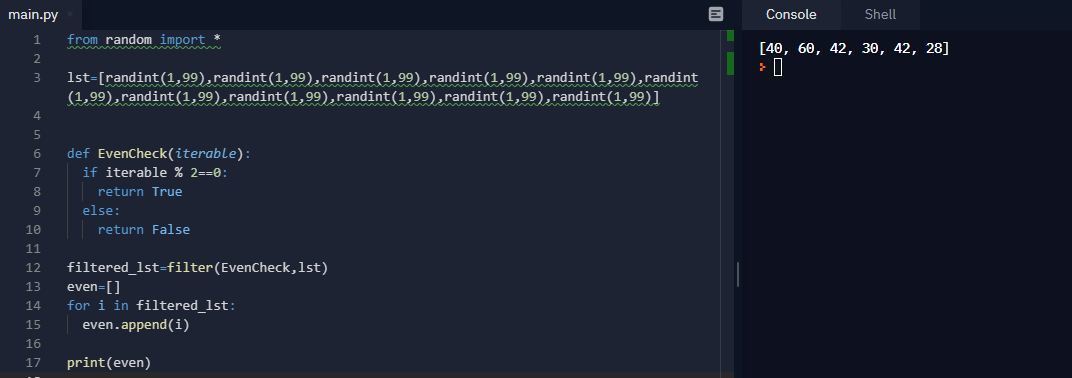
filter() Function
- this function allows us to filter some elements in a list, it takes 2 arguments: function's name and the object
- How does it work ?
- How does it work ?
- this function allows us to filter some elements in a list, it takes 2 arguments: function's name and the object
format() Function
- as its name indicate,this function lets us to format any DataType . It takes as arguments : the DataType and the format specification
getattr() Function
- This function allows us to get the value of a specified attribute,it takes as arguments: The object and 'the attribute's name'
globals() Function
- The globals() function return the global symbol table as a dictionary
- The globale Symbol Table contains all the informations about the current program
- The globals() function return the global symbol table as a dictionary
hasattr() Function
- Return "True" if a specified attribut exists in a class and return "False" if it isn't in this class
hash() Function
- Return the hash value of an object. Hash values are just integers that are used to compare dictionary keys during a dictionary look quickly.
help() Function
- Execute the built-in help system
- This function is take one argumen
- Execute the built-in help system
hex() Function
- return the hexadecimal value of a number
- If the number is a float. w should store it in a variable and use the hex() Function as attribute
- return the hexadecimal value of a number
id() Function
- It is used to return the id value of an object or DataType, because anything in Python has a unique id value
isinstance() Function
- it returns "True" if an object is an instance of a specified object.Otherwise "False".this function takes as arguments: the object,the class
issubclass() Function
- it returns "True" if an object is a sub-class of a specified object.Otherwise "False"
iter(),next() Functions
- iter() create a iterator object, and next(iterator_obj)return the next item in an iterable
locals() Function
- Return all the local values in a function
map() Function
- allows us to apply a function on each item of an iterable object,it takes 2 arguments:function's name and the iterable
- How does it work?
- How does it work?
- allows us to apply a function on each item of an iterable object,it takes 2 arguments:function's name and the iterable
oct() Function
- Return the octal value of an integer
- this function takes only 1 argument and it should be an integer
- Return the octal value of an integer
open() Function
- this function is very usefull for the file handling it allows us to open files and return them as object.it takes 2 arguments at less:"file's name" and 'the mode'
print() Function
- Allows us to print some values in the terminal or the consol
- it takes 4 arguments:the value, sep='the value that the elements printed should be separeted with',end='the value that the elements printed should be ended with',file="where we want to print the value"
- Allows us to print some values in the terminal or the consol
range() Function
- specify a range between 2 numbers and define the steps
reversed() Function
- Reverse the items of an iterable object
setattr() Function
- change the value of an attribute or create a new one if the specified doesn't exist
vars() Function
- return all the variables and its values in dictionary format
zip() Function
- join the items of two iterables objects and pair them together
repr() Function
- returns a printable representation of the given object.
Imagens e arquivos do mapa



Informações
- Descrição
- Mapa Mental sobre Python : Built-in Functions, criado por Briache Issam em 22-08-2021.
- Criado por
- Briache Issam
- Visualizações
- 2
- Avaliação