
Mapa mental
Modals verbs
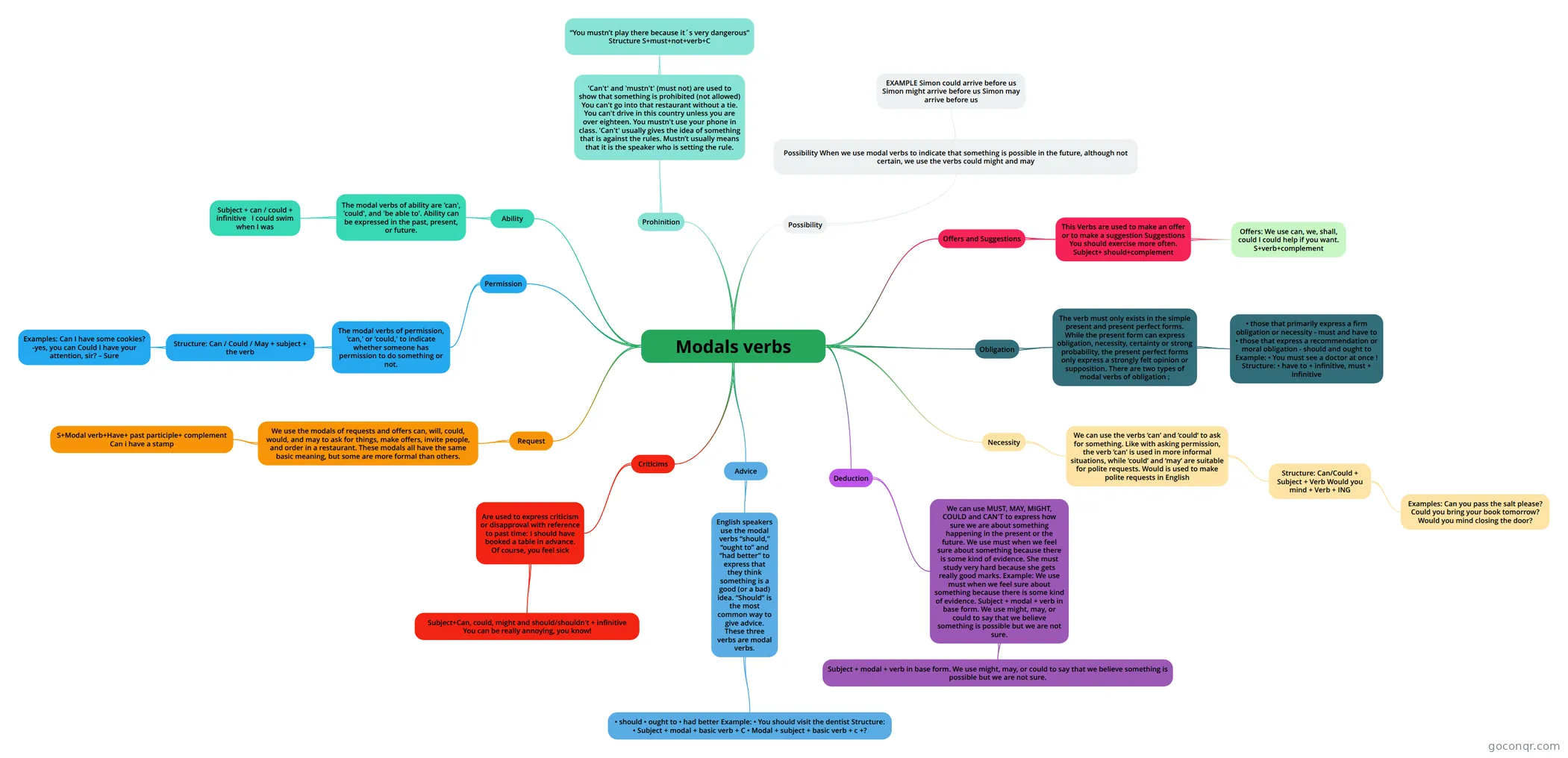
Mind map: Modal verbs
Conteúdo do mapa
Modals verbs
Ability
- The modal verbs of ability are 'can', 'could', and 'be able to'. Ability can be expressed in the past, present, or future.
- Subject + can / could + infinitive I could swim when I was
- The modal verbs of ability are 'can', 'could', and 'be able to'. Ability can be expressed in the past, present, or future.
Permission
- The modal verbs of permission, 'can,' or 'could,' to indicate whether someone has permission to do something or not.
- Structure: Can / Could / May + subject + the verb
- Examples: Can I have some cookies? -yes, you can Could I have your attention, sir? – Sure
- Structure: Can / Could / May + subject + the verb
- The modal verbs of permission, 'can,' or 'could,' to indicate whether someone has permission to do something or not.
Request
- We use the modals of requests and offers can, will, could, would, and may to ask for things, make offers, invite people, and order in a restaurant. These modals all have the same basic meaning, but some are more formal than others.
- S+Modal verb+Have+ past participle+ complement Can i have a stamp
- We use the modals of requests and offers can, will, could, would, and may to ask for things, make offers, invite people, and order in a restaurant. These modals all have the same basic meaning, but some are more formal than others.
Obligation
- The verb must only exists in the simple present and present perfect forms. While the present form can express obligation, necessity, certainty or strong probability, the present perfect forms only express a strongly felt opinion or supposition. There are two types of modal verbs of obligation ;
- • those that primarily express a firm obligation or necessity - must and have to • those that express a recommendation or moral obligation - should and ought to Example: • You must see a doctor at once ! Structure: • have to + infinitive, must + infinitive
- The verb must only exists in the simple present and present perfect forms. While the present form can express obligation, necessity, certainty or strong probability, the present perfect forms only express a strongly felt opinion or supposition. There are two types of modal verbs of obligation ;
Offers and Suggestions
- This Verbs are used to make an offer or to make a suggestion Suggestions You should exercise more often. Subject+ should+complement
- Offers: We use can, we, shall, could I could help if you want. S+verb+complement
- This Verbs are used to make an offer or to make a suggestion Suggestions You should exercise more often. Subject+ should+complement
Necessity
- We can use the verbs ‘can‘ and ‘could‘ to ask for something. Like with asking permission, the verb ‘can‘ is used in more informal situations, while ‘could‘ and ‘may‘ are suitable for polite requests. Would is used to make polite requests in English
- Structure: Can/Could + Subject + Verb Would you mind + Verb + ING
- Examples: Can you pass the salt please? Could you bring your book tomorrow? Would you mind closing the door?
- Structure: Can/Could + Subject + Verb Would you mind + Verb + ING
- We can use the verbs ‘can‘ and ‘could‘ to ask for something. Like with asking permission, the verb ‘can‘ is used in more informal situations, while ‘could‘ and ‘may‘ are suitable for polite requests. Would is used to make polite requests in English
Prohinition
- 'Can't' and 'mustn't' (must not) are used to show that something is prohibited (not allowed) You can't go into that restaurant without a tie. You can't drive in this country unless you are over eighteen. You mustn't use your phone in class. 'Can't' usually gives the idea of something that is against the rules. Mustn’t usually means that it is the speaker who is setting the rule.
- “You mustn’t play there because it´s very dangerous” Structure S+must+not+verb+C
- 'Can't' and 'mustn't' (must not) are used to show that something is prohibited (not allowed) You can't go into that restaurant without a tie. You can't drive in this country unless you are over eighteen. You mustn't use your phone in class. 'Can't' usually gives the idea of something that is against the rules. Mustn’t usually means that it is the speaker who is setting the rule.
Possibility
- Possibility When we use modal verbs to indicate that something is possible in the future, although not certain, we use the verbs could might and may
- EXAMPLE Simon could arrive before us Simon might arrive before us Simon may arrive before us
- Possibility When we use modal verbs to indicate that something is possible in the future, although not certain, we use the verbs could might and may
Criticims
- Are used to express criticism or disapproval with reference to past time: I should have booked a table in advance. Of course, you feel sick
- Subject+Can, could, might and should/shouldn't + infinitive You can be really annoying, you know!
- Are used to express criticism or disapproval with reference to past time: I should have booked a table in advance. Of course, you feel sick
Advice
- English speakers use the modal verbs “should,” “ought to” and “had better” to express that they think something is a good (or a bad) idea. “Should” is the most common way to give advice. These three verbs are modal verbs.
- • should • ought to • had better Example: • You should visit the dentist Structure: • Subject + modal + basic verb + C • Modal + subject + basic verb + c +?
- English speakers use the modal verbs “should,” “ought to” and “had better” to express that they think something is a good (or a bad) idea. “Should” is the most common way to give advice. These three verbs are modal verbs.
Deduction
- We can use MUST, MAY, MIGHT, COULD and CAN'T to express how sure we are about something happening in the present or the future. We use must when we feel sure about something because there is some kind of evidence. She must study very hard because she gets really good marks. Example: We use must when we feel sure about something because there is some kind of evidence. Subject + modal + verb in base form. We use might, may, or could to say that we believe something is possible but we are not sure.
- Subject + modal + verb in base form. We use might, may, or could to say that we believe something is possible but we are not sure.
- We can use MUST, MAY, MIGHT, COULD and CAN'T to express how sure we are about something happening in the present or the future. We use must when we feel sure about something because there is some kind of evidence. She must study very hard because she gets really good marks. Example: We use must when we feel sure about something because there is some kind of evidence. Subject + modal + verb in base form. We use might, may, or could to say that we believe something is possible but we are not sure.
Informações
- Descrição
- Mapa Mental sobre Modals verbs, criado por Gonzalo Vaca em 08-09-2021.
- Criado por
- Gonzalo Vaca
- Visualizações
- 2
- Avaliação