Mapa mental
Quadratics
Conteúdo do mapa
Quadratics
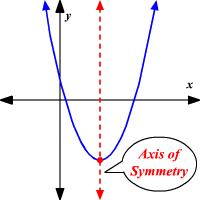
Axis of Symmetry
- A line through a shape so that each side is a mirror image. When the shape is folded in half along the axis of symmetry, then the two halves match up.
- "Axis of Symmetry." Mathisfun. N.p., n.d. Web. 13 Sept. 2015.
- "Axis of Symmetry of a Parabola." Axis of Symmetry of a Parabola. N.p., n.d. Web. 13 Sept. 2015.
- A line through a shape so that each side is a mirror image. When the shape is folded in half along the axis of symmetry, then the two halves match up.
Vertex
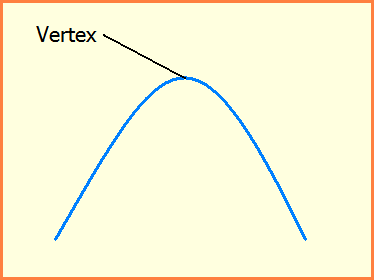
- The vertex is the minimum or the maximum of the quadratic equation.
- Equation=(x)=a(x-h)^2+k
- "The Math Blog." : Vertex of a Parabola. N.p., n.d. Web. 13 Sept. 2015.
Parabola
- a plane curve formed by the intersection of a right circular cone with a plane parallel to a generator of the cone
- "Parabola." Dictionary.com. Dictionary.com, n.d. Web. 13 Sept. 2015.
- "Pauls Online Notes : Algebra - Parabolas." Pauls Online Notes : Algebra - Parabolas. N.p., n.d. Web. 13 Sept. 2015.
- a plane curve formed by the intersection of a right circular cone with a plane parallel to a generator of the cone
Minimum
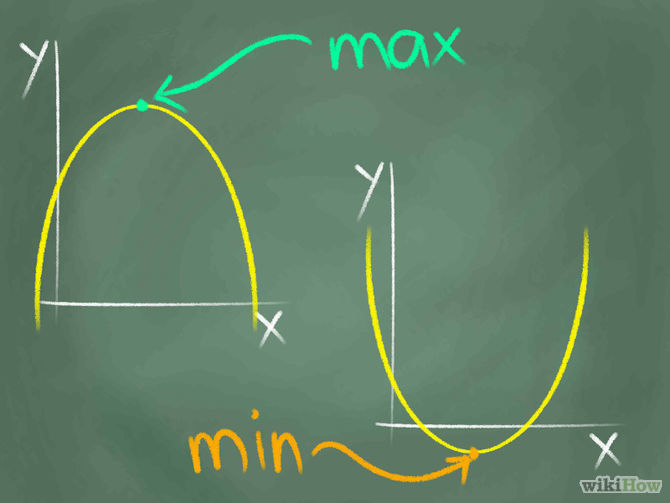
- The minimum is the vertex when the parabola opens up and the vertex is the lowest point.
- It can be found with 2 of the quadratic equations: ax^2+bx+c, a(x-h)^2+K, or by graphing the parabola
- "How to Find the Maximum or Minimum Value of a Quadratic Function Easily." WikiHow. N.p., n.d. Web. 13 Sept. 2015.
- It can be found with 2 of the quadratic equations: ax^2+bx+c, a(x-h)^2+K, or by graphing the parabola
- The minimum is the vertex when the parabola opens up and the vertex is the lowest point.
Maximum
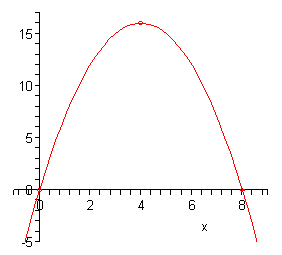
- The maximum is the vertex when the parabola opens down and the vertex is the highest point
- It can be found with 2 of the quadratic equations: ax^2+bx+c, a(x-h)^2+K, or by graphing the parabola
- The maximum is the vertex when the parabola opens down and the vertex is the highest point
X-intercepts
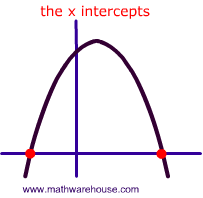
- The x-intercepts, roots, or zeroes, are the points in which the quadratic crosses the x-axis
- The easiest way to find the x-intercepts is to graph the parabola, but using the factored form equation (x-+h)(x-+k), h and k would be the x-intercepts, but with opposite signs
- "Parabola Intercepts." . How to Find the X Intercept and Y Intercept. N.p., n.d. Web. 13 Sept. 2015.
Y-intercept
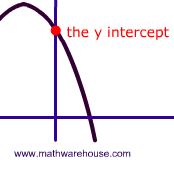
- The y-intercept is the point at which the quadratic crosses the y-axis
- Equation to find the y-intercept=ax^2+bx+c, c=y-intercept
Zeros of the Function
- The zero of a function is the x-value that makes the function equal to 0
- "What's the Zero of a Function?" What's the Zero of a Function? N.p., n.d. Web. 13 Sept. 2015.
- The easiest way to do this is to put your equation into standard form, (x)=ax^2+bx+c. Then you write in 0 where (x) is, then solve for x. That gives you the zero of the function
- The zero of a function is the x-value that makes the function equal to 0
Roots of the Equation
- The roots of the equation are the x-values of the equation
- The easiest way to find the x-intercepts is to graph the parabola, but using the factored form equation (x-+h)(x-+k), h and k would be the x-intercepts, but with opposite signs
End Behavior
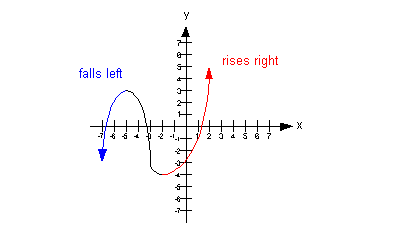
- The appearance of a graph as it is followed farther and farther in either direction. For polynomials, the end behavior is indicated by drawing the positions of the arms of the graph, which may be pointed up or down. Other graphs may also have end behavior indicated in terms of the arms, or in terms of asymptotes or limits.
- "Mathwords: End Behavior." Mathwords: End Behavior. N.p., n.d. Web. 13 Sept. 2015.
- "College Algebra." Virtual Math Lab. N.p., n.d. Web. 13 Sept. 2015.
- The appearance of a graph as it is followed farther and farther in either direction. For polynomials, the end behavior is indicated by drawing the positions of the arms of the graph, which may be pointed up or down. Other graphs may also have end behavior indicated in terms of the arms, or in terms of asymptotes or limits.
Discriminant
- The Discriminant of an equation gives an idea of the number of roots and the nature of roots of the equation.
- D = b2 - 4ac.
- "Discriminant." Definition and Examples Discriminant. N.p., n.d. Web. 13 Sept. 2015.
- The Discriminant of an equation gives an idea of the number of roots and the nature of roots of the equation.
Difference of Squares
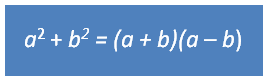
- The difference of two squares is the product of sum of two numbers and their difference.
- "Difference of Two Squares." - Definition, Formula & Examples. N.p., n.d. Web. 13 Sept. 2015.
- "Math Conjugates: Definition & Explanation | Study.com." Study.com. N.p., n.d. Web. 13 Sept. 2015.
- The difference of two squares is the product of sum of two numbers and their difference.
Perfect Square Trinomial
- A Perfect Square Trinomial is the expansion of a Binomial Squared.
- "How Do I Know If My Trinomial Is a Perfect Square Trinomial?" (n.d.): n. pag. Web.Cerritos. Web. 13 Sept. 2015.
- a^2+2ab+b^2=(a+b)^2 or a^2-2ab+b^2=(a-b)^2
- A Perfect Square Trinomial is the expansion of a Binomial Squared.
Factors of a Quadratic
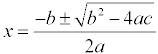
- Factoring quadratics finds the roots or x-intercepts of a quadratic equation. Factoring quadratic equations in standard form, , can often be accomplished by finding two numbers that add to give b, and multiply to give ac.
- "Chegg.com." Definition of Factoring Quadratics. N.p., n.d. Web. 13 Sept. 2015.
- Factoring quadratics finds the roots or x-intercepts of a quadratic equation. Factoring quadratic equations in standard form, , can often be accomplished by finding two numbers that add to give b, and multiply to give ac.