
Mapa mental
The periodic table and its development
Conteúdo do mapa
The periodic table and its development
The early periodic table
- Newlands' law of octaves
- Spotted a pattern when arranging elements in order of atomic mass
- Noticed properties of elements repeat every eighth element
- 'Law of Octaves'
- Inconsistencies in his method meant his ideas weren't accepted at the time
- Mendeleev's achievement
- Same idea as Newland but noticed undiscovered elements which he left gaps shown by * in the table
- Allowed him to organise table in a repeating pattern
- Elements with similar properties occur in groups at regular intervals - periods
- Same idea as Newland but noticed undiscovered elements which he left gaps shown by * in the table
- Changing the order
- Following the discovery of protons, neutrons and electrons, it became clear that elements should be placed in order of atomic number not mass
- Mendeleev thought the atomic masses of some elements had been measured inaccurately but he'd placed the elements in order of atomic number without realising
- Mendeleev's table was accepted because of his remarkable predictions turning out to be correct
- Newlands' law of octaves
The modern periodic table
- Structure
- Elements are arranged by proton number
- Making elements naturally fall into groups with similar properties
- Elements are arranged by proton number
- Electronic Structure and the periodic table
- Atomic number describes the number of protons in the atom
- Therefore also the number of electrons and their arrangement around the nucleus
- Pattern is directly linked to the way in which electrons are arranged around the atoms of each element
- Period number tells you how many energy levels containing electrons the element has
- Group number tells you how many electrons an element has in its outer energy level
- Periodic table predicts the chemical properties of elements
- Atomic number describes the number of protons in the atom
- Metals
- Found in the middle and on the left of the periodic table
- Groups 1 and 2 contain very reactive but quote soft metals with low melting points
- The transition metals block contains 'everyday' metals such as iron and copper
- Not as reactive as group 1 and 2 but are harder, stronger and have higher melting points
- Non-metals
- Found to the right of the table
- Groups 6 and 7 contain reactive non-metals
- Gases at the top but solids further down
- Group 0 contains the Noble gases, highly un-reactive metals
- Groups 3,4 and 5
- Elements at the top are non-metals
- More metallic as you move down
- Boundary between non-metals and metals zig-zags down the right
- Elements on the boundary show intermediate properties between non-metals and metals
- semi-conductors e.g. silicon
- Elements at the top are non-metals
- Structure
Group 1 - the alkali metals
- Physical properties
- All soft and conduct heat and electricity
- Freshly cut is shiny but soon tarnishes in the air
- etals have low density and relatively low melting and boiling points
- Typical chemical reactions
- React with water and oxygen in the air (which is why they tarnish)
- Put in oil to stop this from happening
- All have one outer electron
- When they react, they lose this electron and form 1+ions
- When they react with non-metals, they form ionic compounds
- These compounds are white and dissolve in water to form colourless solutions
- When reacted with water, they form a metal hydroxide and hydrogen
- The metal hydroxides dissolve in water, making an alkaline solution.
- React with water and oxygen in the air (which is why they tarnish)
- Trends in chemical properties
- Reactions get more vigorous as you go down
- Because alkali metals react by losing their lone outer electron
- Atoms get bigger as you go down the group as more energy levels are added
- Means lone outer electron is further away from positive nucleus increasingly screened by the inner electron shells
- Reduces attraction from the nucleus to the outer electron and makes the electron easier to lose
- The bigger the atom, the more reactive the metal
- Means lone outer electron is further away from positive nucleus increasingly screened by the inner electron shells
- Reactions get more vigorous as you go down
- Physical properties
Transition metals
- 'Everyday' metals
- Include most of the metals used for Construction, Machinery, Vehicles, Wiring etc.
- Conduct heat and electricity
- Compared with group 1 metals, the transition metals:
- Higher melting points
- Higher densities
- Stronger and harder
- Much less reactive
- Special properties
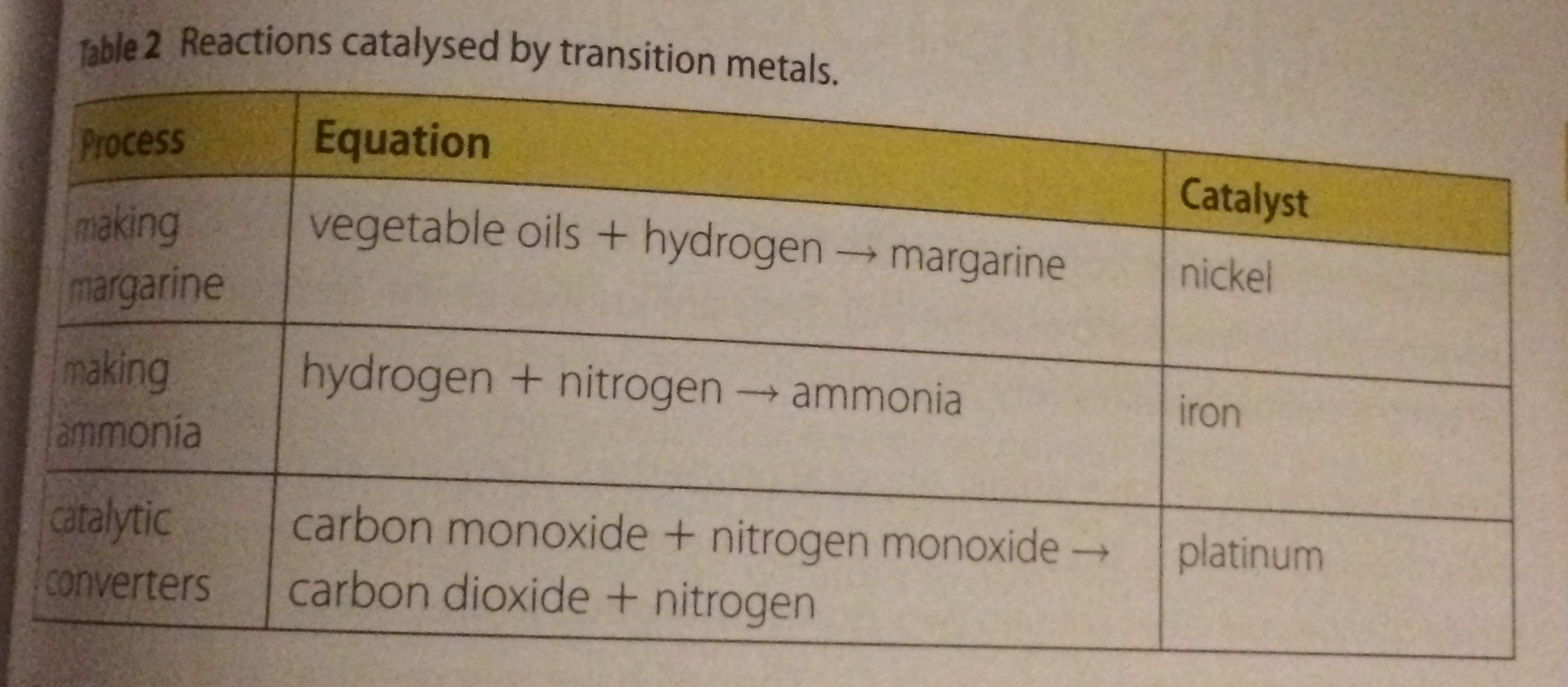
- Catlysts
- Compounds containing transition metals are usually coloured
- Some statues and roofs are made of copper
- Many gemstones are coloured by transition metal compounds
- Used in some paint pigments and ceramic glazes
- 'Everyday' metals
Group 7 - Halogens
- Coloured non-metals
- Non-metals with coloured vapours
- All made of molecules
- They don't conduct heat or electricity
- Low melting and boiling points
- Forces between molecules are weak
- Chemical Properties
- All react with metals to form ionic compounds containing halide ions
- Electrons are transferred from the metal atoms to the halogen atoms, forming halide ions with a 1- electric charge
- Halogens react with non-metals to form molecular compounds containing covalent bonds
- Electrons are shared between atoms
- Reactivity
- ess reactive as you go down the gorup
- When reacted the atoms gain an electron
- Atoms get bigger down the gorup
- Electron gained is further from the nucleus
- Attraction of the nucleus for the electron being gained is weaker and so the electron is harder to gain
- Electron gained is further from the nucleus
- Atoms get bigger down the gorup
- A more reactive halogen will displace a less reactive halogen from a compound in a displacement reaction
- Coloured non-metals
Imagens e arquivos do mapa
Informações
- Descrição
- Chemistry (Further) Mapa Mental sobre The periodic table and its development, criado por ryangriscti em 11-11-2013.
- Criado por
- ryangriscti
- Visualizações
- 80
- Tags
- Avaliação