
Mapa mental
Polynomials
Conteúdo do mapa
Polynomials
Definition.
- Polynomial is an algebraic expression consisting of one or more terms where the power of the variable is a whole no.
Types of Polynomials
- On basis of Terms
- Monomial :- A polynomial having only one term is called a monomial. Eg: 2x, 5x^4, etc.
- Binomial :- A polynomial having two terms is called a binomial. Eg: 2x + 1, 5x^4 - 3, etc.
- Trinomial :- A polynomial having three terms is called a trinomial. Eg: 2x^3 + 3x - 2, 5x^4 - 3x^2 - 7, etc.
- On basis of Degrees
- Linear Polynomial :- A polynomial having it's highest degree as 1 is called a linear polynomial. Eg: 3x - 2, 3 - u, etc.
- Quadratic Polynomial :- A polynomial having it's highest degree as 2 is called a quadratic polynomial. Eg: 3x^2 - 2, 7x^2, etc.
- Cubic Polynomial :- A polynomial having it's highest degree as 3 is called a cubic polynomial. Eg: 3x^3 + 2y^2 - 2, etc.
- Bi-quadratic Polynomial :- A polynomial having it's highest degree as 4 is called a bi-quadratic polynomial. Eg: 3x^3 + 2y^2 - 2, etc.
- Constant Polynomial.
- This polynomial contains only one constant term and the degree of the variable here is 0 Eg: 2x^0 = 2a^0 = 2, is a constant polynomial having only one constant term and the variable's degree is always 0.
- Zero Polynomial
- It's a constant polynomial having the only constant term 0 and it's degree is undefined.
- On basis of Terms
Algebraic Identities.
- (x+y)^2 = x^2 + 2xy + y^2
- x^2 - y^2 = (x+y)(x-y)
- (x+a)(x+b) = x^2 + (a+b)x + ab
- (x-y)^2 = x^2 - 2xy + y^2
- (x+y+z)^2 = x^2 + y^2 + z^2 + 2xy + 2yz + 2zx
- (x+y)^3 = x^3 + 3x^2y + 3xy^2 + y^3
- (x-y)^3 = x^3 - 3x^2y + 3xy^2 - y^3
- x^3 + y^3 + z^3 - 3xyz = (x+y+z)(x^2 + y^2 + z^2 - xy - zy - zx)
- If x + y + z = 0 then, x^3 + y^3 + z^3 = 3xyz
Zero of a Polynomial
- We say that the zero of the polynomial p(x) is a number 'c' such that p(c) = 0
Basic terms used
- Constants
- A term in the polynomial where the value is fixed and is known as constant. Eg: In 9x + 5, 5 is the constant in the polynomial as it has a fixed value.
- Variables
- A symbol or letter used in the polynomial standing as an unknown value and is known as variable. Eg: In 9x + 5, x is the variable of the polynomial as it has no fixed value.
- Algebraic Expression
- An expression obtained by a finite number of the fundamental operations of algebra upon symbols representing numbers are called algebraic expression. Eg: x + y, x^5 + y^2 - 6, etc. are algebraic expressions.
- Terms
- In a polynomial the values on which the mathematical operations of "+" and "-" take place is known as terms. It can be a constant and a variable. Eg: In x^2 + 2x, both x^2 and 2x are the terms in the polynomial.
- Co-efficients
- A number that is being multiplied by a variable is known as co-efficients. Eg: In 4x, 4 is the co-efficient of x.
- Degree
- The highest power of the variable in a polynomial is known as the degree of the polynomial. Eg: In x^5 + y^2 - 6, the highest power of the polynomial is 5, so it is the degree of this polynomial.
- Constants
Theorems
- Factor Theorem
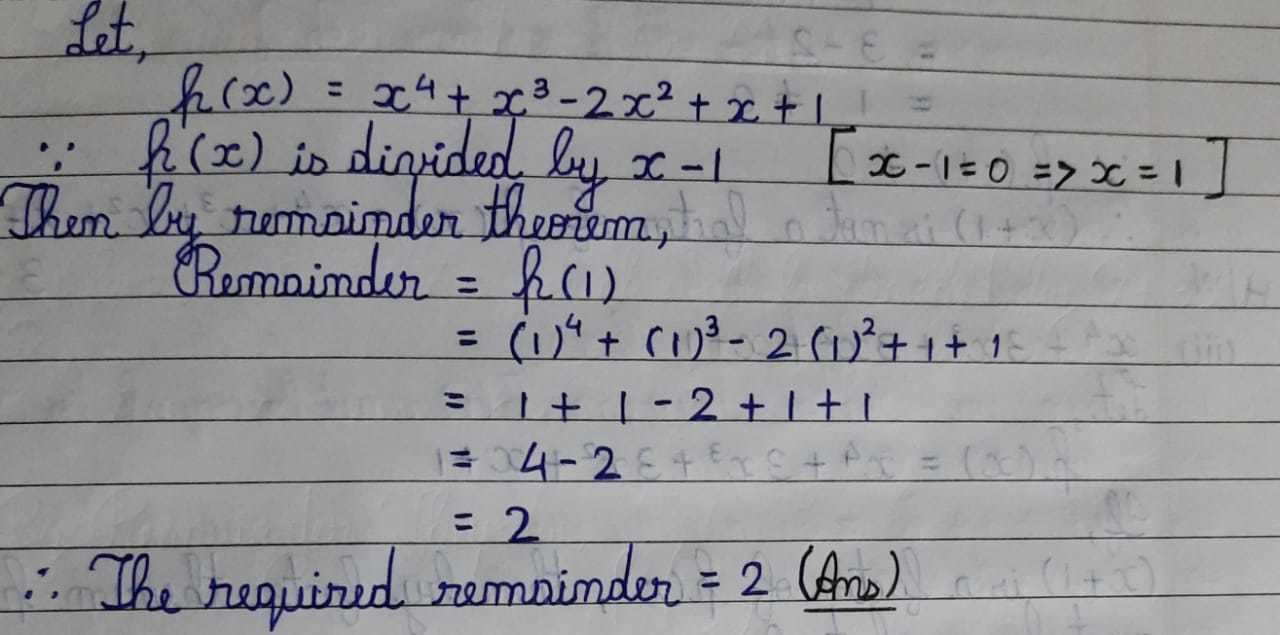
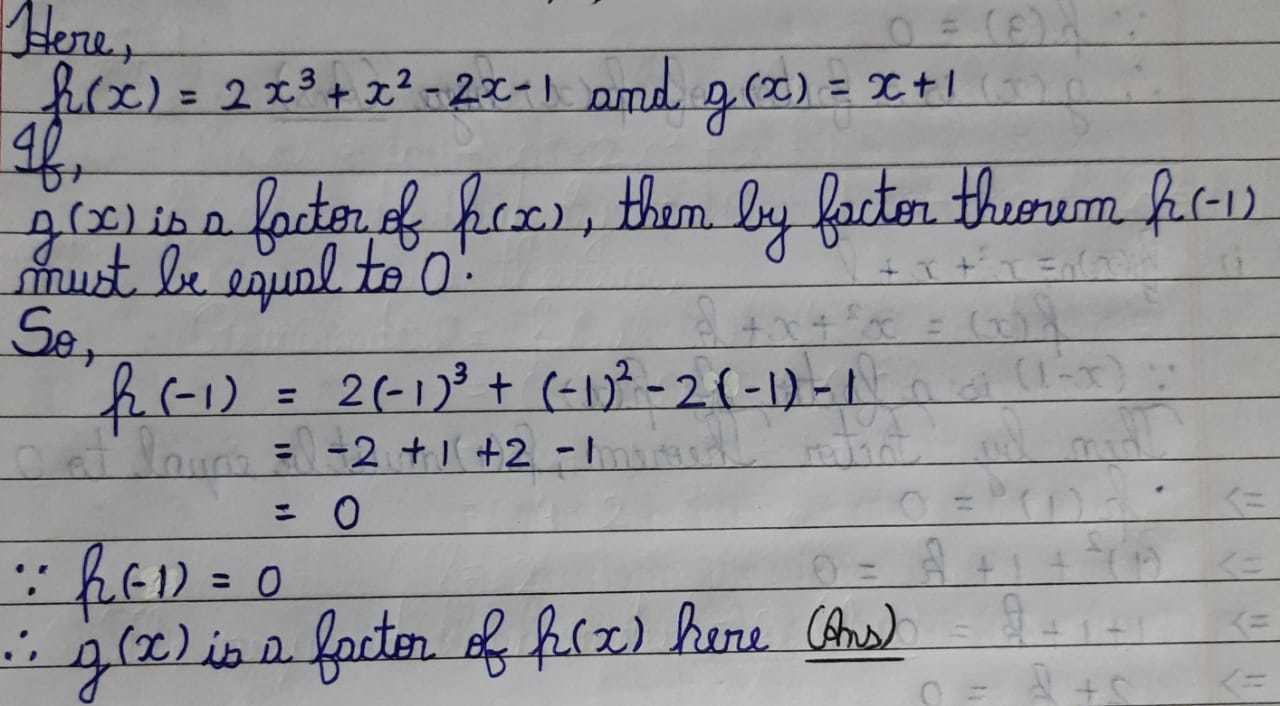
- If p(x) is a polynomial of degree greater than or equal to one and 'a' is any real no., then (x-a) is a factor of p(x), if p(a) = 0, also p(a) = 0, if (x-a) is a factor of p(x).
- If p(x) is a polynomial of degree greater than or equal to one and 'a' is any real no., then (x-a) is a factor of p(x), if p(a) = 0, also p(a) = 0, if (x-a) is a factor of p(x).
- Remainder Theorem
- If p(x) is divided by a linear polynomial (x-a), then the remainder is p(a). Here, p(x) is any polynomial of degree greater than or equal to one and 'a' is any real number.
- If p(x) is divided by a linear polynomial (x-a), then the remainder is p(a). Here, p(x) is any polynomial of degree greater than or equal to one and 'a' is any real number.
- Factor Theorem
Factorisation of Polynomials
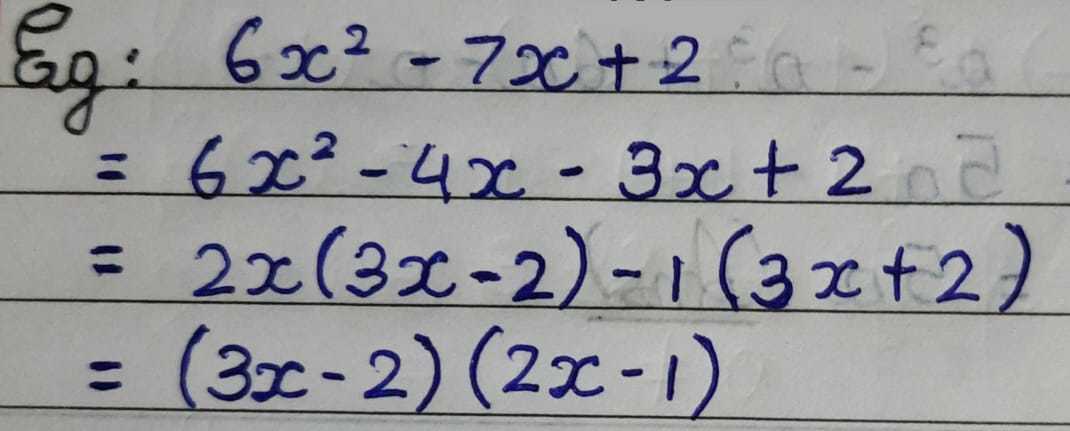
- Splitting Middle Term
- Here, we have to rewrite the middle term of the quadratic expression as the sum or difference of the two terms. We have to split the middle term into two parts in terms of sum or difference of the terms.
- Here, we have to rewrite the middle term of the quadratic expression as the sum or difference of the two terms. We have to split the middle term into two parts in terms of sum or difference of the terms.
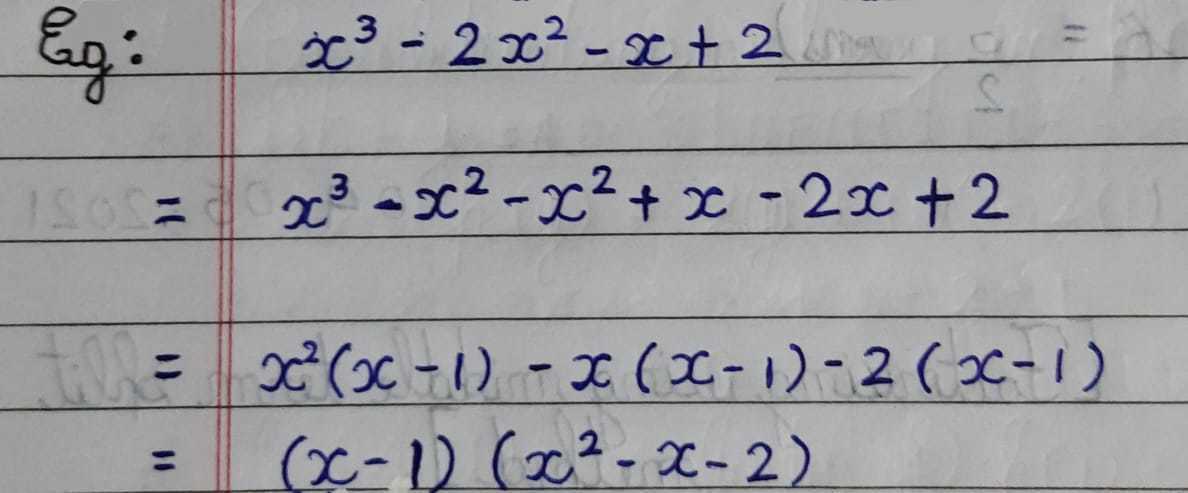
- Vanishing Method
- Here, we're going to substitute and such value of x by trial and error for which the polynomial will vanish.
- Here, we're going to substitute and such value of x by trial and error for which the polynomial will vanish.
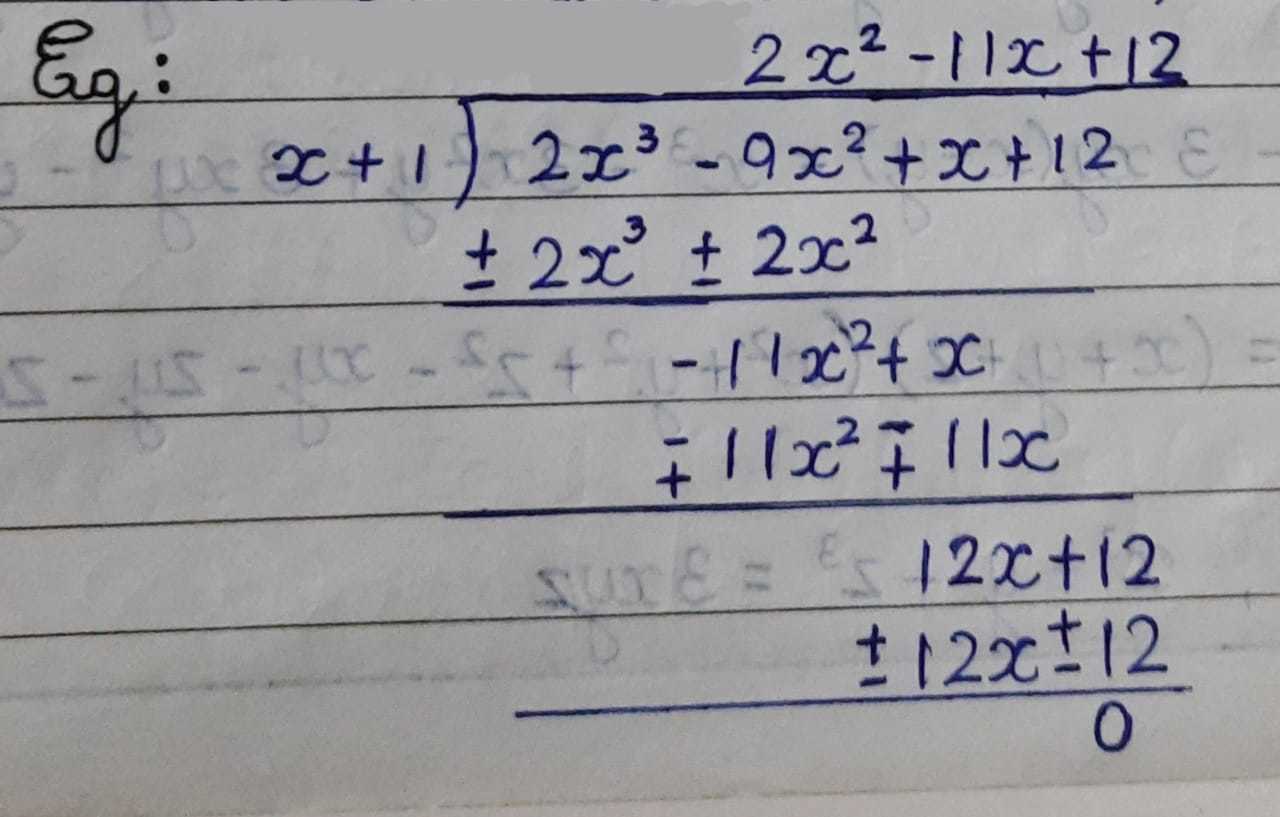
- Long Division Method
- This, is an algorithm for dividing a polynomial by another polynomial of the same or lower degree, a generalized version of the familiar arithmetic technique called long division.
- This, is an algorithm for dividing a polynomial by another polynomial of the same or lower degree, a generalized version of the familiar arithmetic technique called long division.
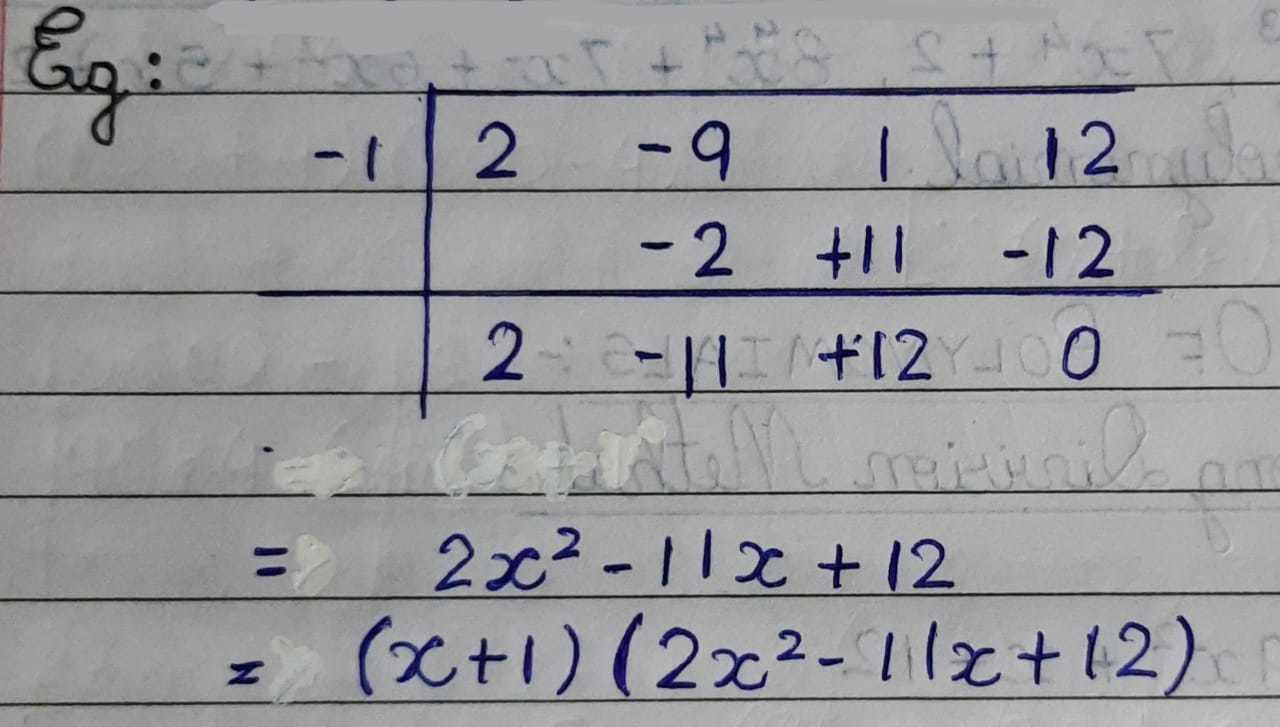
- Synthetic Division Method
- This, is a simplified method for dividing a polynomial by another polynomial of the first degree by writing down only the coefficients of the several powers of the variable and changing the sign of the constant term in the divisor so as to replace the usual subtractions by additions.
- This, is a simplified method for dividing a polynomial by another polynomial of the first degree by writing down only the coefficients of the several powers of the variable and changing the sign of the constant term in the divisor so as to replace the usual subtractions by additions.
- Splitting Middle Term
Imagens e arquivos do mapa
Informações
- Descrição
- Made by Tanmaya Kumar Pradhan of class 9A in 2021-22, of DAV Public School, Haldia.
- Criado por
- Tanmaya Kumar Pradhan
- Visualizações
- 8
- Avaliação