
Mapa mental
READING SKILLS
Conteúdo do mapa
READING SKILLS
Reading involves making sense of written text
- To do this we need to understand the language of the text at word level, sentence level or whole-text level.
THE STRUCTURE OF THE ENGLISH ALPHABET CODE
- What we call ‘‘spelling’’ (encoding) is the fundamental or basic operation, the process of turning sounds into symbols.
- What we call ‘‘reading’’ involves decoding those symbols back into sounds to recover the words.
- Maria Montessori strongly advised teachers to teach children to write (spell) first, and then allow them to discover that they can read what they have written.
- The Prototype
- Teach phonemes only—no other sound units.
- Begin with basic code
- Link writing (spelling) and reading to ensure children learn that the alphabet is a code and that codes are reversible
- Lessons should move on to include the advanced spelling code.
- What we call ‘‘spelling’’ (encoding) is the fundamental or basic operation, the process of turning sounds into symbols.
SUCCESS IN ENGLISH TEACHING
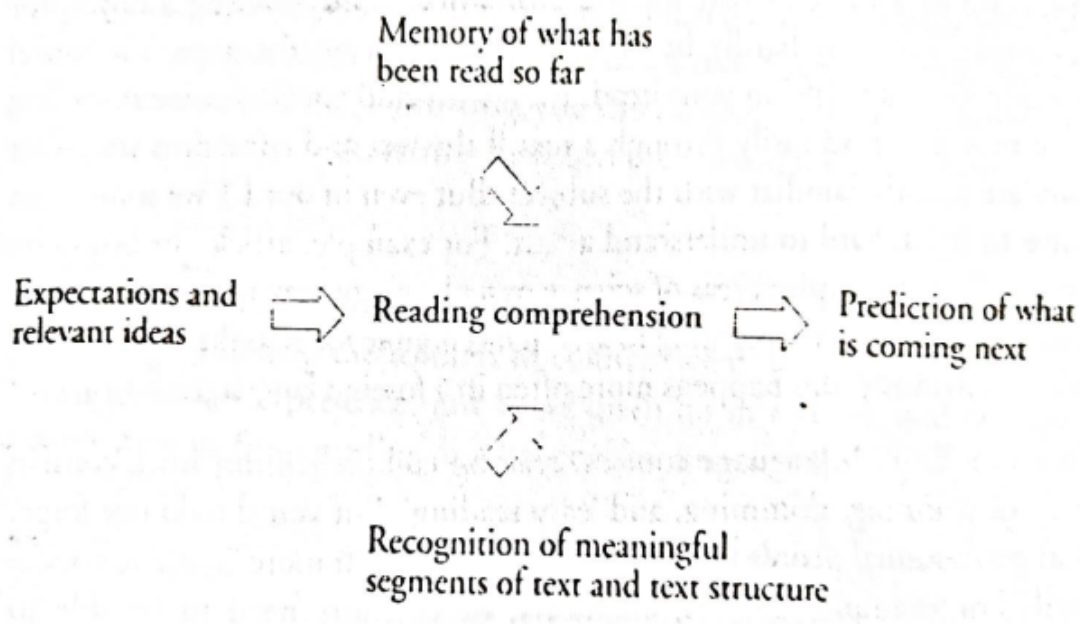
- Reading comprehension
- As we read, we try to confirm or identify the precise topic, and each change of topic.
- This activates the ideas we have stored in our mind, related to that topic.
- Model of reading comprehension
- the text in reading is usually clearly, completely, and permanently on the page in front of us
- Reading texts has positive and negative sides, especially for non-native readers.
- On the positive side, people can read at their own pace, and reread things they do not understand immediately.
- On the negative side, some people read very slowly, word by word, even in their L1.
- Reading texts has positive and negative sides, especially for non-native readers.
- Reading comprehension in a foreign language is not translation
- As we read, we try to confirm or identify the precise topic, and each change of topic.
- Reading activities
- three stages are generally recommended to make reading more realistic and interesting
- Pre-reading
- This stage is to prepare the learners for what they are going to read, just as we are usually prepared in real life.
- Guess the topic of the text from the headings, illustrations, etc.
- Predict what the text will say.
- While-reading
- This stage is to help the learners understand the text. They may first do an easy scanning or skimming task, and then a task requiring more thorough comprehension.
- Scan for two to four items of information. Skim for the general idea.
- Post-reading
- This stage is to help the learners to connect what they have read with their own idea and experience.
- Discuss what was interesting or new in the text. Discuss or debate the topic of the text if it is controversial.
- Pre-reading
- three stages are generally recommended to make reading more realistic and interesting
- Reading outside the classroom
- Reading is something that they can do at home, and you should encourage this as much as possible.
- Extensive reading is an excellent way to extend vocabulary and consolidate grammar, as well as to develop a general communicative command of the language.
- Ways of reading
- Two types, scanning and skimming
- When scanning a text, you look quickly through it to find some specific information
- When skimming, you look quickly through a text just to get a general idea of what it is about, in other words, the gist.
- In many English language courses, reading comprehension work consists only of scanning skimming, and ‘easy reading’.
- Two types, scanning and skimming
- Reading comprehension
Imagens e arquivos do mapa
Informações
- Descrição
- Mapa Mental sobre READING SKILLS, criado por ESTEFANY GUADALUPE PEREZ FLORES em 12-03-2022.
- Criado por
- ESTEFANY GUADALUPE PEREZ FLORES
- Visualizações
- 1
- Avaliação