
Mapa mental
James Joyce
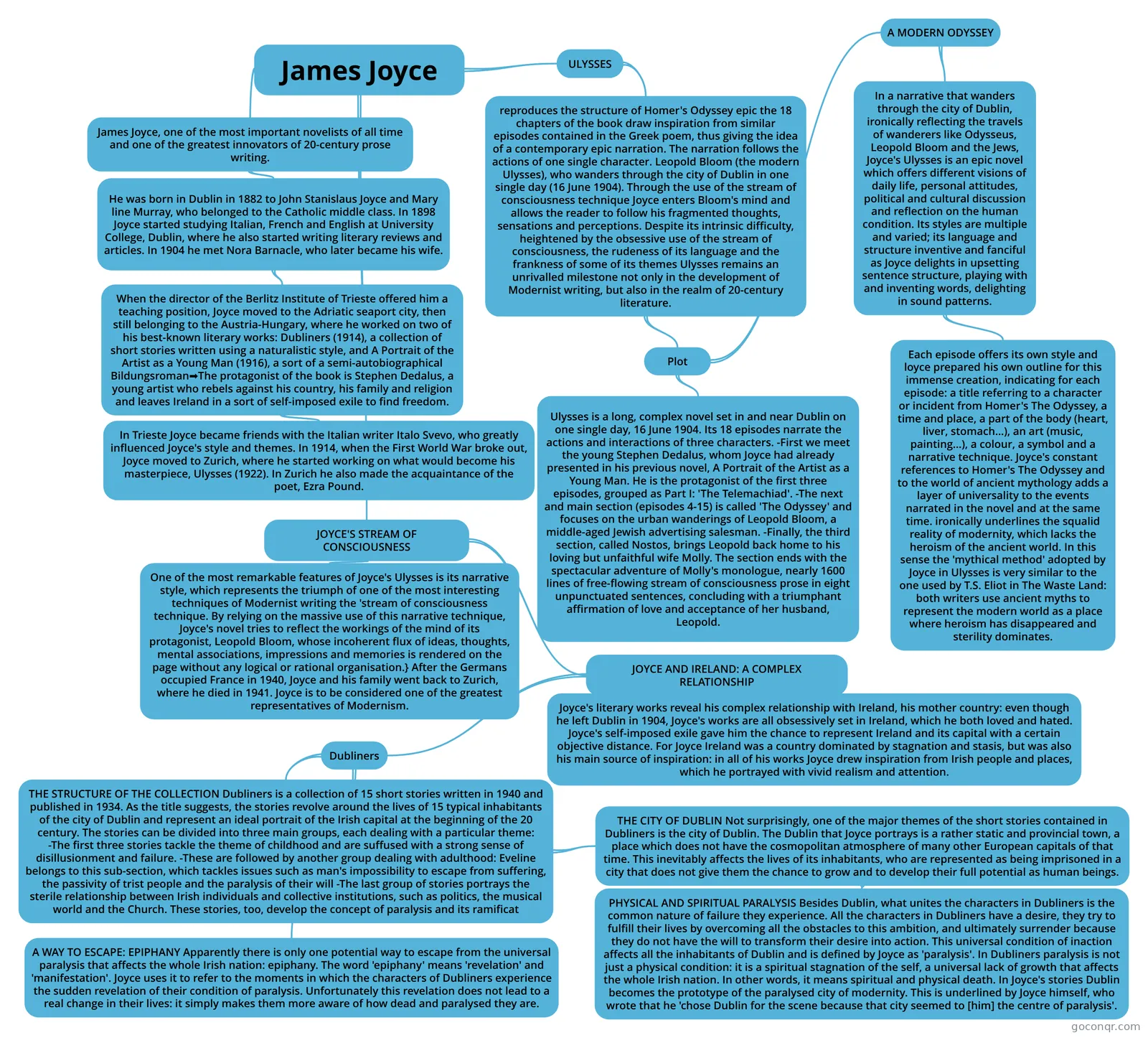
Mind map: James Joyce
Conteúdo do mapa
James Joyce
James Joyce, one of the most important novelists of all time and one of the greatest innovators of 20-century prose writing.
- He was born in Dublin in 1882 to John Stanislaus Joyce and Mary line Murray, who belonged to the Catholic middle class. In 1898 Joyce started studying Italian, French and English at University College, Dublin, where he also started writing literary reviews and articles. In 1904 he met Nora Barnacle, who later became his wife.
- When the director of the Berlitz Institute of Trieste offered him a teaching position, Joyce moved to the Adriatic seaport city, then still belonging to the Austria-Hungary, where he worked on two of his best-known literary works: Dubliners (1914), a collection of short stories written using a naturalistic style, and A Portrait of the Artist as a Young Man (1916), a sort of a semi-autobiographical Bildungsroman➡The protagonist of the book is Stephen Dedalus, a young artist who rebels against his country, his family and religion and leaves Ireland in a sort of self-imposed exile to find freedom.
- In Trieste Joyce became friends with the Italian writer Italo Svevo, who greatly influenced Joyce's style and themes. In 1914, when the First World War broke out, Joyce moved to Zurich, where he started working on what would become his masterpiece, Ulysses (1922). In Zurich he also made the acquaintance of the poet, Ezra Pound.
- When the director of the Berlitz Institute of Trieste offered him a teaching position, Joyce moved to the Adriatic seaport city, then still belonging to the Austria-Hungary, where he worked on two of his best-known literary works: Dubliners (1914), a collection of short stories written using a naturalistic style, and A Portrait of the Artist as a Young Man (1916), a sort of a semi-autobiographical Bildungsroman➡The protagonist of the book is Stephen Dedalus, a young artist who rebels against his country, his family and religion and leaves Ireland in a sort of self-imposed exile to find freedom.
- He was born in Dublin in 1882 to John Stanislaus Joyce and Mary line Murray, who belonged to the Catholic middle class. In 1898 Joyce started studying Italian, French and English at University College, Dublin, where he also started writing literary reviews and articles. In 1904 he met Nora Barnacle, who later became his wife.
ULYSSES
- reproduces the structure of Homer's Odyssey epic the 18 chapters of the book draw inspiration from similar episodes contained in the Greek poem, thus giving the idea of a contemporary epic narration. The narration follows the actions of one single character. Leopold Bloom (the modern Ulysses), who wanders through the city of Dublin in one single day (16 June 1904). Through the use of the stream of consciousness technique Joyce enters Bloom's mind and allows the reader to follow his fragmented thoughts, sensations and perceptions. Despite its intrinsic difficulty, heightened by the obsessive use of the stream of consciousness, the rudeness of its language and the frankness of some of its themes Ulysses remains an unrivalled milestone not only in the development of Modernist writing, but also in the realm of 20-century literature.
- Plot
- Ulysses is a long, complex novel set in and near Dublin on one single day, 16 June 1904. Its 18 episodes narrate the actions and interactions of three characters. -First we meet the young Stephen Dedalus, whom Joyce had already presented in his previous novel, A Portrait of the Artist as a Young Man. He is the protagonist of the first three episodes, grouped as Part I: 'The Telemachiad'. -The next and main section (episodes 4-15) is called 'The Odyssey' and focuses on the urban wanderings of Leopold Bloom, a middle-aged Jewish advertising salesman. -Finally, the third section, called Nostos, brings Leopold back home to his loving but unfaithful wife Molly. The section ends with the spectacular adventure of Molly's monologue, nearly 1600 lines of free-flowing stream of consciousness prose in eight unpunctuated sentences, concluding with a triumphant affirmation of love and acceptance of her husband, Leopold.
- A MODERN ODYSSEY
- In a narrative that wanders through the city of Dublin, ironically reflecting the travels of wanderers like Odysseus, Leopold Bloom and the Jews, Joyce's Ulysses is an epic novel which offers different visions of daily life, personal attitudes, political and cultural discussion and reflection on the human condition. Its styles are multiple and varied; its language and structure inventive and fanciful as Joyce delights in upsetting sentence structure, playing with and inventing words, delighting in sound patterns.
- Each episode offers its own style and loyce prepared his own outline for this immense creation, indicating for each episode: a title referring to a character or incident from Homer's The Odyssey, a time and place, a part of the body (heart, liver, stomach...), an art (music, painting...), a colour, a symbol and a narrative technique. Joyce's constant references to Homer's The Odyssey and to the world of ancient mythology adds a layer of universality to the events narrated in the novel and at the same time. ironically underlines the squalid reality of modernity, which lacks the heroism of the ancient world. In this sense the 'mythical method' adopted by Joyce in Ulysses is very similar to the one used by T.S. Eliot in The Waste Land: both writers use ancient myths to represent the modern world as a place where heroism has disappeared and sterility dominates.
- In a narrative that wanders through the city of Dublin, ironically reflecting the travels of wanderers like Odysseus, Leopold Bloom and the Jews, Joyce's Ulysses is an epic novel which offers different visions of daily life, personal attitudes, political and cultural discussion and reflection on the human condition. Its styles are multiple and varied; its language and structure inventive and fanciful as Joyce delights in upsetting sentence structure, playing with and inventing words, delighting in sound patterns.
- Plot
- reproduces the structure of Homer's Odyssey epic the 18 chapters of the book draw inspiration from similar episodes contained in the Greek poem, thus giving the idea of a contemporary epic narration. The narration follows the actions of one single character. Leopold Bloom (the modern Ulysses), who wanders through the city of Dublin in one single day (16 June 1904). Through the use of the stream of consciousness technique Joyce enters Bloom's mind and allows the reader to follow his fragmented thoughts, sensations and perceptions. Despite its intrinsic difficulty, heightened by the obsessive use of the stream of consciousness, the rudeness of its language and the frankness of some of its themes Ulysses remains an unrivalled milestone not only in the development of Modernist writing, but also in the realm of 20-century literature.
JOYCE'S STREAM OF CONSCIOUSNESS
- One of the most remarkable features of Joyce's Ulysses is its narrative style, which represents the triumph of one of the most interesting techniques of Modernist writing the 'stream of consciousness technique. By relying on the massive use of this narrative technique, Joyce's novel tries to reflect the workings of the mind of its protagonist, Leopold Bloom, whose incoherent flux of ideas, thoughts, mental associations, impressions and memories is rendered on the page without any logical or rational organisation.} After the Germans occupied France in 1940, Joyce and his family went back to Zurich, where he died in 1941. Joyce is to be considered one of the greatest representatives of Modernism.
- JOYCE AND IRELAND: A COMPLEX RELATIONSHIP
- Joyce's literary works reveal his complex relationship with Ireland, his mother country: even though he left Dublin in 1904, Joyce's works are all obsessively set in Ireland, which he both loved and hated. Joyce's self-imposed exile gave him the chance to represent Ireland and its capital with a certain objective distance. For Joyce Ireland was a country dominated by stagnation and stasis, but was also his main source of inspiration: in all of his works Joyce drew inspiration from Irish people and places, which he portrayed with vivid realism and attention.
- Dubliners
- THE STRUCTURE OF THE COLLECTION Dubliners is a collection of 15 short stories written in 1940 and published in 1934. As the title suggests, the stories revolve around the lives of 15 typical inhabitants of the city of Dublin and represent an ideal portrait of the Irish capital at the beginning of the 20 century. The stories can be divided into three main groups, each dealing with a particular theme: -The first three stories tackle the theme of childhood and are suffused with a strong sense of disillusionment and failure. -These are followed by another group dealing with adulthood: Eveline belongs to this sub-section, which tackles issues such as man's impossibility to escape from suffering, the passivity of trist people and the paralysis of their will -The last group of stories portrays the sterile relationship between Irish individuals and collective institutions, such as politics, the musical world and the Church. These stories, too, develop the concept of paralysis and its ramificat
- THE CITY OF DUBLIN Not surprisingly, one of the major themes of the short stories contained in Dubliners is the city of Dublin. The Dublin that Joyce portrays is a rather static and provincial town, a place which does not have the cosmopolitan atmosphere of many other European capitals of that time. This inevitably affects the lives of its inhabitants, who are represented as being imprisoned in a city that does not give them the chance to grow and to develop their full potential as human beings.
- PHYSICAL AND SPIRITUAL PARALYSIS Besides Dublin, what unites the characters in Dubliners is the common nature of failure they experience. All the characters in Dubliners have a desire, they try to fulfill their lives by overcoming all the obstacles to this ambition, and ultimately surrender because they do not have the will to transform their desire into action. This universal condition of inaction affects all the inhabitants of Dublin and is defined by Joyce as 'paralysis'. In Dubliners paralysis is not just a physical condition: it is a spiritual stagnation of the self, a universal lack of growth that affects the whole Irish nation. In other words, it means spiritual and physical death. In Joyce's stories Dublin becomes the prototype of the paralysed city of modernity. This is underlined by Joyce himself, who wrote that he 'chose Dublin for the scene because that city seemed to [him] the centre of paralysis'.
- THE CITY OF DUBLIN Not surprisingly, one of the major themes of the short stories contained in Dubliners is the city of Dublin. The Dublin that Joyce portrays is a rather static and provincial town, a place which does not have the cosmopolitan atmosphere of many other European capitals of that time. This inevitably affects the lives of its inhabitants, who are represented as being imprisoned in a city that does not give them the chance to grow and to develop their full potential as human beings.
- A WAY TO ESCAPE: EPIPHANY Apparently there is only one potential way to escape from the universal paralysis that affects the whole Irish nation: epiphany. The word 'epiphany' means 'revelation' and 'manifestation'. Joyce uses it to refer to the moments in which the characters of Dubliners experience the sudden revelation of their condition of paralysis. Unfortunately this revelation does not lead to a real change in their lives: it simply makes them more aware of how dead and paralysed they are.
- THE STRUCTURE OF THE COLLECTION Dubliners is a collection of 15 short stories written in 1940 and published in 1934. As the title suggests, the stories revolve around the lives of 15 typical inhabitants of the city of Dublin and represent an ideal portrait of the Irish capital at the beginning of the 20 century. The stories can be divided into three main groups, each dealing with a particular theme: -The first three stories tackle the theme of childhood and are suffused with a strong sense of disillusionment and failure. -These are followed by another group dealing with adulthood: Eveline belongs to this sub-section, which tackles issues such as man's impossibility to escape from suffering, the passivity of trist people and the paralysis of their will -The last group of stories portrays the sterile relationship between Irish individuals and collective institutions, such as politics, the musical world and the Church. These stories, too, develop the concept of paralysis and its ramificat
Informações
- Descrição
- Mapa Mental sobre James Joyce, criado por Giulia Luccioli em 20-05-2022.
- Criado por
- Giulia Luccioli
- Visualizações
- 18
- Avaliação
Mais sobre James Joyce: Life and Works