
Mapa mental
Phonetics and Phonology
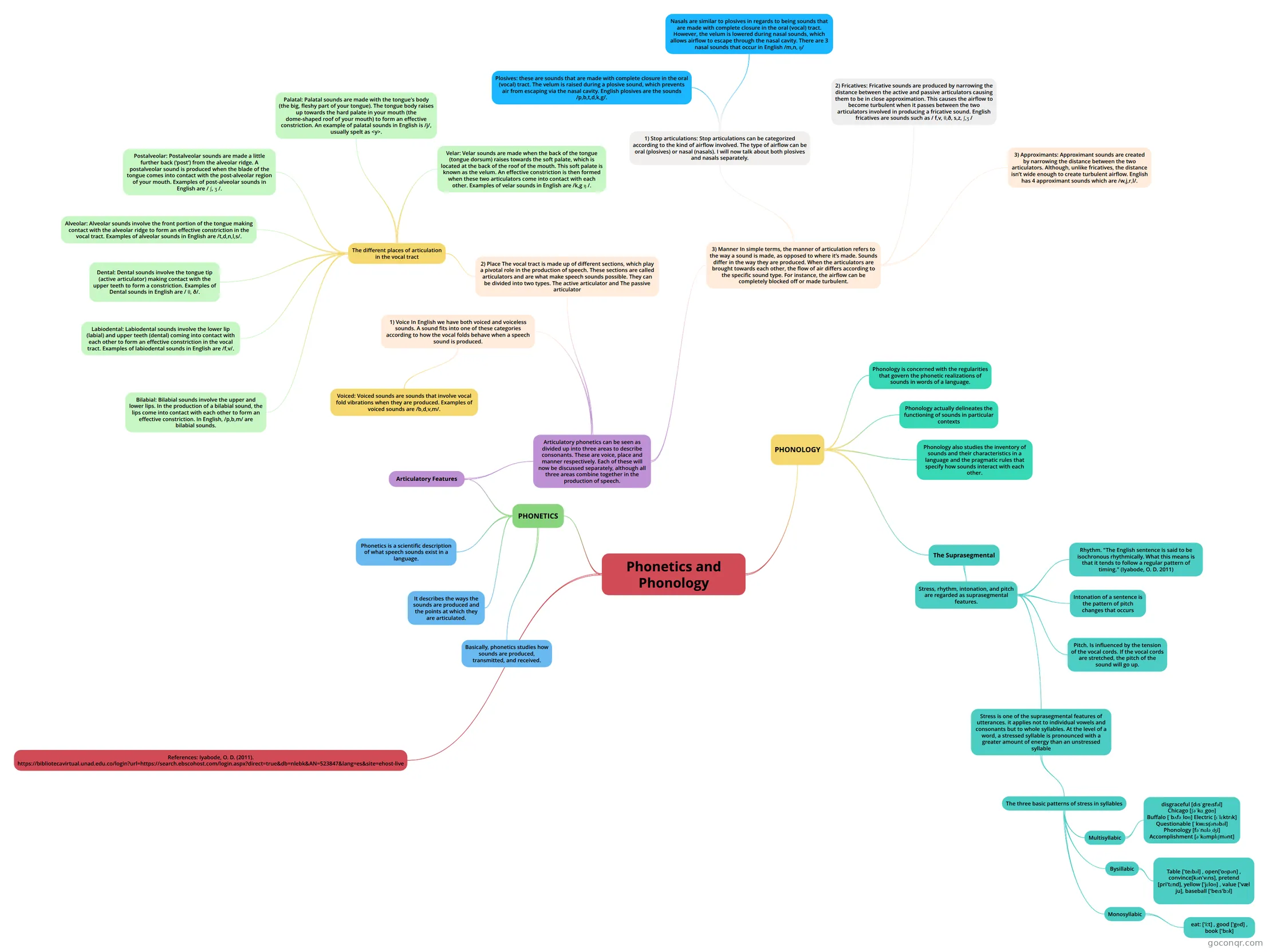
Mind map: Phonetics and phonology
Conteúdo do mapa
Phonetics and Phonology
PHONETICS
- Phonetics is a scientific description of what speech sounds exist in a language.
- It describes the ways the sounds are produced and the points at which they are articulated.
- Basically, phonetics studies how sounds are produced, transmitted, and received.
- Articulatory Features
- The production of speech involves 3 processes: Initiation: Setting air in motion through the vocal tract. Phonation: The modification of airflow as it passes through the larynx (related to voicing). Articulation: The shaping of airflow to generate particular sound types (related to manner)
- Articulatory phonetics can be seen as divided up into three areas to describe consonants. These are voice, place and manner respectively. Each of these will now be discussed separately, although all three areas combine together in the production of speech.
- 1) Voice In English we have both voiced and voiceless sounds. A sound fits into one of these categories according to how the vocal folds behave when a speech sound is produced.
- Voiced: Voiced sounds are sounds that involve vocal fold vibrations when they are produced. Examples of voiced sounds are /b,d,v,m/.
- 2) Place The vocal tract is made up of different sections, which play a pivotal role in the production of speech. These sections are called articulators and are what make speech sounds possible. They can be divided into two types. The active articulator and The passive articulator
- The different places of articulation in the vocal tract
- Bilabial: Bilabial sounds involve the upper and lower lips. In the production of a bilabial sound, the lips come into contact with each other to form an effective constriction. In English, /p,b,m/ are bilabial sounds.
- Labiodental: Labiodental sounds involve the lower lip (labial) and upper teeth (dental) coming into contact with each other to form an effective constriction in the vocal tract. Examples of labiodental sounds in English are /f,v/.
- Dental: Dental sounds involve the tongue tip (active articulator) making contact with the upper teeth to form a constriction. Examples of Dental sounds in English are / θ, ð/.
- Alveolar: Alveolar sounds involve the front portion of the tongue making contact with the alveolar ridge to form an effective constriction in the vocal tract. Examples of alveolar sounds in English are /t,d,n,l,s/.
- Postalveolar: Postalveolar sounds are made a little further back (‘post’) from the alveolar ridge. A postalveolar sound is produced when the blade of the tongue comes into contact with the post-alveolar region of your mouth. Examples of post-alveolar sounds in English are / ʃ, ʒ /.
- Palatal: Palatal sounds are made with the tongue's body (the big, fleshy part of your tongue). The tongue body raises up towards the hard palate in your mouth (the dome-shaped roof of your mouth) to form an effective constriction. An example of palatal sounds in English is /j/, usually spelt as <y>.
- Velar: Velar sounds are made when the back of the tongue (tongue dorsum) raises towards the soft palate, which is located at the back of the roof of the mouth. This soft palate is known as the velum. An effective constriction is then formed when these two articulators come into contact with each other. Examples of velar sounds in English are /k,g ŋ /.
- The different places of articulation in the vocal tract
- 3) Manner In simple terms, the manner of articulation refers to the way a sound is made, as opposed to where it’s made. Sounds differ in the way they are produced. When the articulators are brought towards each other, the flow of air differs according to the specific sound type. For instance, the airflow can be completely blocked off or made turbulent.
- 1) Stop articulations: Stop articulations can be categorized according to the kind of airflow involved. The type of airflow can be oral (plosives) or nasal (nasals). I will now talk about both plosives and nasals separately.
- Plosives: these are sounds that are made with complete closure in the oral (vocal) tract. The velum is raised during a plosive sound, which prevents air from escaping via the nasal cavity. English plosives are the sounds /p,b,t,d,k,g/.
- Nasals are similar to plosives in regards to being sounds that are made with complete closure in the oral (vocal) tract. However, the velum is lowered during nasal sounds, which allows airflow to escape through the nasal cavity. There are 3 nasal sounds that occur in English /m,n, ŋ/
- 2) Fricatives: Fricative sounds are produced by narrowing the distance between the active and passive articulators causing them to be in close approximation. This causes the airflow to become turbulent when it passes between the two articulators involved in producing a fricative sound. English fricatives are sounds such as / f,v, θ,ð, s,z, ʃ,ʒ /
- 3) Approximants: Approximant sounds are created by narrowing the distance between the two articulators. Although, unlike fricatives, the distance isn’t wide enough to create turbulent airflow. English has 4 approximant sounds which are /w,j,r,l/.
- 1) Stop articulations: Stop articulations can be categorized according to the kind of airflow involved. The type of airflow can be oral (plosives) or nasal (nasals). I will now talk about both plosives and nasals separately.
- 1) Voice In English we have both voiced and voiceless sounds. A sound fits into one of these categories according to how the vocal folds behave when a speech sound is produced.
PHONOLOGY
- Phonology is concerned with the regularities that govern the phonetic realizations of sounds in words of a language.
- Phonology actually delineates the functioning of sounds in particular contexts
- Phonology also studies the inventory of sounds and their characteristics in a language and the pragmatic rules that specify how sounds interact with each other.
- The Suprasegmental
- Stress, rhythm, intonation, and pitch are regarded as suprasegmental features.
- Stress is one of the suprasegmental features of utterances. it applies not to individual vowels and consonants but to whole syllables. At the level of a word, a stressed syllable is pronounced with a greater amount of energy than an unstressed syllable
- The three basic patterns of stress in syllables
- Monosyllabic
- eat: ['i:t] , good ['gʊd] , book ['bʊk]
- Bysillabic
- Table ['teɪbəl] , open['oʊpən] , convince[kən'vɪns], pretend [pri'tɛnd], yellow ['jɛloʊ] , value ['væl ju], baseball ['beɪs'bɔl]
- Multisyllabic
- disgraceful [dɪsˈgreɪsfəl] Chicago [ʃəˈkɑˌgoʊ] Buffalo [ˈbʌfəˌloʊ] Electric [ɪˈlɛktrɪk] Questionable [ˈkwɛsʧənəbəl] Phonology [fəˈnɑləˌʤi] Accomplishment [əˈkɑmplɪʃmənt]
- Monosyllabic
- The three basic patterns of stress in syllables
- Pitch. Is influenced by the tension of the vocal cords. If the vocal cords are stretched, the pitch of the sound will go up.
- Intonation of a sentence is the pattern of pitch changes that occurs
- Rhythm. "The English sentence is said to be isochronous rhythmically. What this means is that it tends to follow a regular pattern of timing." (Iyabode, O. D. 2011)
- Stress is one of the suprasegmental features of utterances. it applies not to individual vowels and consonants but to whole syllables. At the level of a word, a stressed syllable is pronounced with a greater amount of energy than an unstressed syllable
- Stress, rhythm, intonation, and pitch are regarded as suprasegmental features.
References: Iyabode, O. D. (2011). https://bibliotecavirtual.unad.edu.co/login?url=https://search.ebscohost.com/login.aspx?direct=true&db=nlebk&AN=523847&lang=es&site=ehost-live
Informações
- Descrição
- Mapa Mental sobre Phonetics and Phonology, criado por María Camela Baldovino Nuñez em 04-09-2022.
- Criado por
- María Camela Baldovino Nuñez
- Visualizações
- 0
- Histórico
-
- Criado por Laura Diaz · 30 ago 2022
- Copiado por María Camela Baldovino Nuñez · 4 set 2022
- Avaliação