
Mapa mental
comp sci mindmap
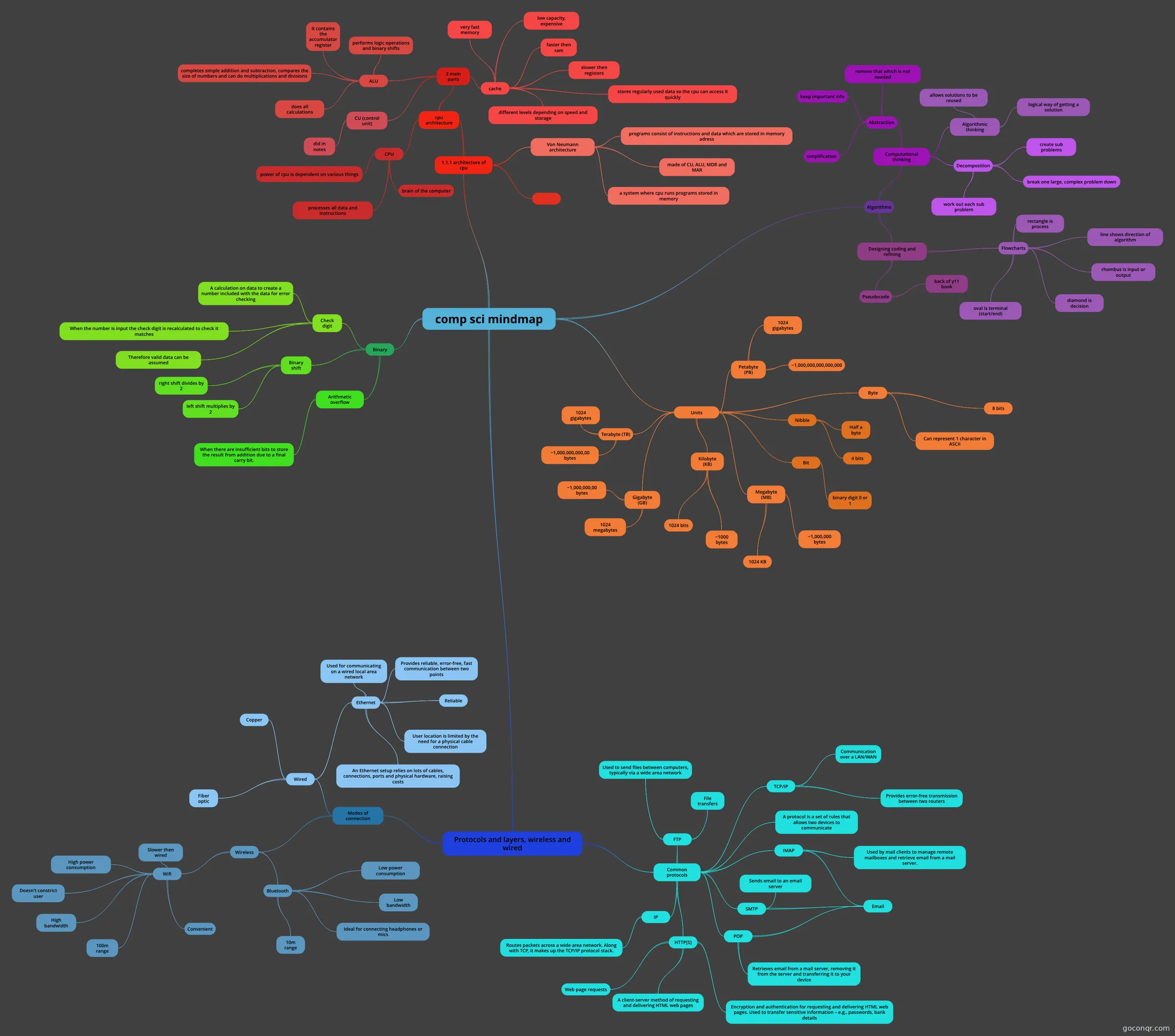
Mind map: computer science mind map
Conteúdo do mapa
comp sci mindmap
Binary
- Arithmetic overflow
- When there are insufficient bits to store the result from addition due to a final carry bit.
- Binary shift
- left shift multiplies by 2
- right shift divides by 2
- Check digit
- A calculation on data to create a number included with the data for error checking
- When the number is input the check digit is recalculated to check it matches
- Therefore valid data can be assumed
- Arithmetic overflow
Units
- Bit
- binary digit 0 or 1
- Nibble
- 4 bits
- Half a byte
- Byte
- Can represent 1 character in ASCII
- 8 bits
- Kilobyte (KB)
- 1024 bits
- ~1000 bytes
- Megabyte (MB)
- 1024 KB
- ~1,000,000 bytes
- Gigabyte (GB)
- 1024 megabytes
- ~1,000,000,00 bytes
- Terabyte (TB)
- 1024 gigabytes
- ~1,000,000,000,00 bytes
- Petabyte (PB)
- 1024 gigabytes
- ~1,000,000,000,000,000
- Bit
1.1.1 architecture of cpu
- Von Neumann architecture
- a system where cpu runs programs stored in memory
- programs consist of instructions and data which are stored in memory adress
- made of CU, ALU, MDR and MAR
- cpu architecture
- CPU
- brain of the computer
- processes all data and instructions
- power of cpu is dependent on various things
- 3 main parts
- CU (control unit)
- Controls the cpu Main job is to manage the fetching, decoding and execution of program instructions by following the fetch-execute cycle controls the flow of data inside the cpu (to alu, registers, cache) and outside the cpu (to main memory and input/output devices)
- did in notes
- ALU
- does all calculations
- completes simple addition and subtraction, compares the size of numbers and can do multiplications and divisions
- performs logic operations and binary shifts
- it contains the accumulator register
- cache
- very fast memory
- slower then registers
- faster then ram
- low capacity, expensive
- stores regularly used data so the cpu can access it quickly
- different levels depending on speed and storage
- CU (control unit)
- CPU
- Von Neumann architecture
Protocols and layers, wireless and wired
- Common protocols
- A protocol is a set of rules that allows two devices to communicate
- TCP/IP
- Communication over a LAN/WAN
- Provides error-free transmission between two routers
- HTTP[S]
- Web page requests
- A client-server method of requesting and delivering HTML web pages
- Encryption and authentication for requesting and delivering HTML web pages. Used to transfer sensitive information – e.g., passwords, bank details
- FTP
- File transfers
- Used to send files between computers, typically via a wide area network
- POP
- Retrieves email from a mail server, removing it from the server and transferring it to your device
- IMAP
- Used by mail clients to manage remote mailboxes and retrieve email from a mail server.
- SMTP
- Sends email to an email server
- IP
- Routes packets across a wide area network. Along with TCP, it makes up the TCP/IP protocol stack.
- Modes of connection
- Wireless
- Wifi
- 100m range
- High bandwidth
- High power consumption
- Convenient
- Slower then wired
- Doesn't constrict user
- Bluetooth
- 10m range
- Low bandwidth
- Low power consumption
- Ideal for connecting headphones or mics
- Wifi
- Wired
- Fiber optic
- Ethernet
- Used for communicating on a wired local area network
- Provides reliable, error-free, fast communication between two points
- User location is limited by the need for a physical cable connection
- An Ethernet setup relies on lots of cables, connections, ports and physical hardware, raising costs
- Reliable
- Copper
- Wireless
- Common protocols
Algorithms
- Computational thinking
- Decomposition
- break one large, complex problem down
- create sub problems
- work out each sub problem
- Algorithmic thinking
- logical way of getting a solution
- allows solutions to be reused
- Abstraction
- keep important info
- remove that which is not needed
- simplification
- Decomposition
- Designing coding and refining
- Flowcharts
- line shows direction of algorithm
- rhombus is input or output
- rectangle is process
- diamond is decision
- oval is terminal (start/end)
- Pseudocode
- back of y11 book
- Flowcharts
- Computational thinking
Informações
- Descrição
- this exists read if you want i guess
- Criado por
- George is is a dumb name
- Visualizações
- 9
- Tags
- Avaliação